Martyr
Eudald
A saint of Catalan tradition, remembered in Western calendars; few details survive.
- Era
- 5th century
- Order
- Martyrs
Life
Eudald, also called Thou or Hou, is a Catalan martyr saint whose historicity raises serious doubts. He is venerated as a saint in the Catholic Church and is patron of the town of Ripoll. His feast is 11 May, the anniversary of his martyrdom.
Tradition, hardly reliable, says he was born in Lombardy in the fifth century. Converted to Christianity, he was a monk and then a priest at Port-Vendres, a disciple of the hermit Pancras of Port-Vendres. From there he went into exile at Tavèrnoles in Urgell, and was killed at Ax in Ariège in the time of Attila. Other traditions place him in the eighth century, killed by Muslims. The tradition of Ripoll makes him a native of Toulouse, killed by the Vandals.
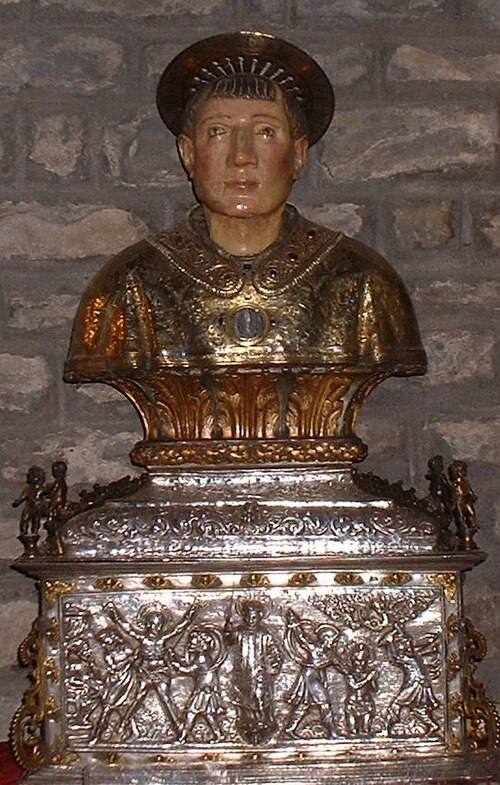
In the year 1004 he was proclaimed patron of Ripoll, after rains that came when his relics were carried out in procession ended a serious drought. According to the legend, the relics had been brought there in 978, stolen from Ax, and placed in a chapel on the site of today's Plaça Sant Eudald. From then on devotion to the saint spread through the Pyrenees. In 1054 a church was built in place of the chapel, rebuilt in 1622 and 1822, and demolished in 1936. After the war the seventeenth-century silver urn holding the relics passed to the monastery of Santa Maria at Ripoll, where it is venerated at the altar of Saint Joachim. The translation of the relics is kept on 6 November. At Ripoll, after the feast-day service, the faithful can receive the "cotton of Saint Eudald", blessed cotton fibres believed to heal.
Excavations in the 1970s at the church of Santa Maria de Sorba, in the municipality of Montmajor, uncovered a round, domed building of the sixth century, which could be a martyrium raised over the grave of a saint. An inscription, "Here are the relics of Eubaldis, martyr of Christ. Amen", may refer to Eudald. It is not certain, however, either that the building was a martyrium or that the attribution is right, since no earlier tradition mentions this burial.