Confessor
Gheorghe Calciu-Dumitreasa
Priest confessor
A priest imprisoned by the communist regime, who reposed in Washington in 2006; venerated by the faithful, not formally canonized.
- Feast
- November 21old style December 4
- Reposed
- 200621st century
- Place
- Washington D.C.; buried at Petru-Vodă Monastery
- Order
- Confessors
Life
Gheorghe Calciu-Dumitreasa, born on 23 November 1925 at Mahmudia, in Tulcea, was an Orthodox priest, former political prisoner and anti-communist dissident, known for the Seven Words to Youth of 1978. He died on 21 November 2006 in Washington. He is venerated by the faithful, without synodal canonization; the fact that in youth he was a legionary and took part in the Pitești re-education makes his veneration a discussed subject.
He was sentenced under the communist regime for belonging to the Legionary Movement and was in prison between 1948 and 1964. At Pitești, between 1949 and 1951, he gave way under the pressure of re-education and took part, with Eugen Țurcanu, in the torture of other prisoners; later he publicly repented of this. At the re-education trial he rejected the guilt of the prisoners, pointing to the leadership of the Securitate. In July 1958, at Jilava, in the Casimca cell, he shared with Constantin Oprișan, Marcel Petrișor and Iosif V. Iosif and cared for Oprișan, ill with tuberculosis. He was released in the amnesty of 1964 and sent to forced residence in the Bărăgan.
He studied Philology and Theology, was ordained priest and taught at the Theological Seminary in Bucharest. At the earthquake of 4 March 1977, when a wing of the boarding house collapsed, he came at night and worked with bare hands, with a few pupils, to get the seminarians out from under the rubble. In Great Lent of 1978 he gave seven sermons to young people, known as the Seven Words, in which he urged courage and confession. He protested publicly against the demolition of the Enei Church in Bucharest. He was arrested in 1979 and sentenced to more than ten years; he was held at Jilava and Aiud, much of the time in isolation. International pressure, from political leaders and Pope John Paul II, led to his release on 20 August 1984. In 1985 he was forced to leave the country.
He settled in the United States, worked in construction and served the Holy Cross parish in Alexandria, Virginia. He was received by Presidents Reagan and George W. Bush, started Romfest and travelled to Romania. In late interviews he spoke favourably of legionarism and Corneliu Zelea Codreanu and denied the Holocaust, which remains controversial. He died of pancreatic cancer on 21 November 2006. He was given a funeral service at Radu Vodă by Patriarch Teoctist and buried at Petru Vodă Monastery, as he wished. The Church has not canonized him; many believers venerate him as a confessor.
Commemorated the same day November 21
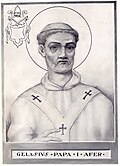 Gelasius ISaint · Bishop of RomeNov 21
 Maurus of PorečSaint · Bishop of PorečNov 21
- Aedhan of Cluain EidhneachSaintNov 21
- Amelberga of SusterenVenerable · Abbess of SusterenNov 21
- Auxilius of AntiochSaintNov 21
- Celsus and ClementHoly MartyrsNov 21
- CommanSaintNov 21
- Demetrius and HonoriusHoly MartyrsNov 21
- DigainRight-BelievingNov 21
- DiuchollSaintNov 21
- GarbhanSaintNov 21
- Hilary of San VincenzoVenerableNov 21