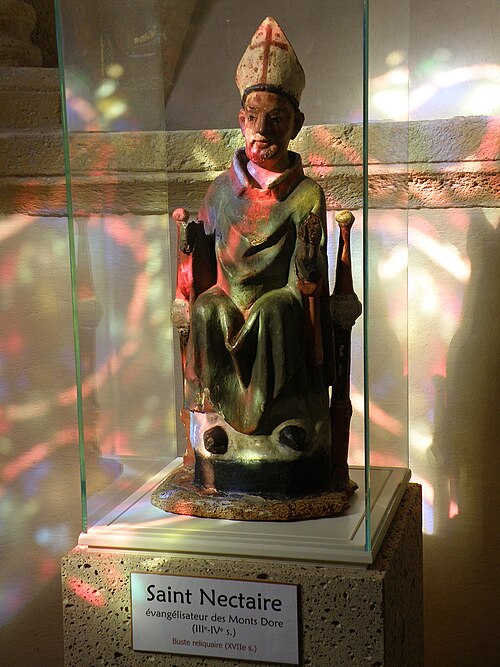
Martyr
Nectarius of Auvergne
Missionary in Auvergne
Christian missionary and martyr of Auvergne in the 4th century.
- Feast
- December 9old style December 22
- Reposed
- 3204th century
- Order
- Martyrs
Life
Saint Nectarius of Auvergne (also called Nectarius of Saint-Nectaire, of Limagne or of Senneterre) is venerated as a martyr and Christian missionary of the fourth century. Our sources show him venerated in the West, in France, with evidence of veneration from the tenth century, and show no Orthodox glorification. The record gives 9 December as the day of commemoration, but the sources do not give a day.
According to the legend, after the death of his wealthy parents Nectarius was accused of taking part in a conspiracy and fled to Rome, where he met Christians, was looked after and then baptized by Saint Peter. Peter then sent him with his brothers to evangelize Gaul. The story does not fit the fourth century that the sources give. According to Gregory of Tours, Nectarius was one of the seven missionaries sent by Pope Fabian from Rome to Gaul to spread Christianity there; the other six were Gatianus of Tours, Trophimus of Arles, Paul of Narbonne, Martial of Limoges, Denis of Paris and Saturninus of Toulouse. Nectarius was accompanied by the priests Baudimius (Baudime) and Auditor (Auditeur), and by tradition they were all brothers. According to another version, it was not Pope Fabian but Saint Peter who sent Nectarius and his brothers to proclaim the Gospel to the Gauls.
According to a third tradition, Saint Austremonius sent Nectarius and Antoninus to Christianize the plain of Limagne in the Massif Central. Nectarius turned a temple dedicated to Apollo on the hill known as Cornadore into a Christian church, which became the church of Notre-Dame du Mont Cornadore (now bearing his name) at Saint-Nectaire, in Puy-de-Dôme. He was then killed by the local pagan leader, Bradulus.
Evidence of the veneration of Nectarius dates from the tenth century. A tomb at the Benedictine priory of Saint-Nectaire (corrupted into Sennecterre and Senneterre) became a place of pilgrimage. A borough arose around the priory, which became a centre of mineral waters and of the manufacture of the cheese called Saint-Nectaire. Nectarius is co-patron of Saint-Nectaire together with Saint Auditor, although Auditor is the principal patron, for reasons unknown.
Commemorated the same day December 9
 HannahProphet · Mother of the Prophet SamuelDec 9
 Leocadia of ToledoMartyr · Martyr of ToledoDec 9
 Syrus of PaviaSaint · First Bishop of PaviaDec 9
 Proculus of VeronaSaint · Bishop of VeronaDec 9
 Basil YagodinHieromartyr · ArchpriestDec 9
- AbibusMartyr · Martyr of SamosataDec 9
- Alexander BuravtsevHieromartyrDec 9
- AngilramVenerableDec 9
- AugardVenerableDec 9
- Balda of JouarreVenerableDec 9
- Bassa of JerusalemVenerableDec 9
- Donata of AntiochSaintDec 9