Martyr
Solange of Berry
Shepherdess of Berry
Frankish shepherdess of Berry, venerated locally as a saint and martyr and patron of the province; died around 880.
Life
Saint Solange of Berry was a Frankish shepherdess, venerated locally as a saint and martyr, patron of the province of Berry, killed around 880. She is remembered on 10 May.
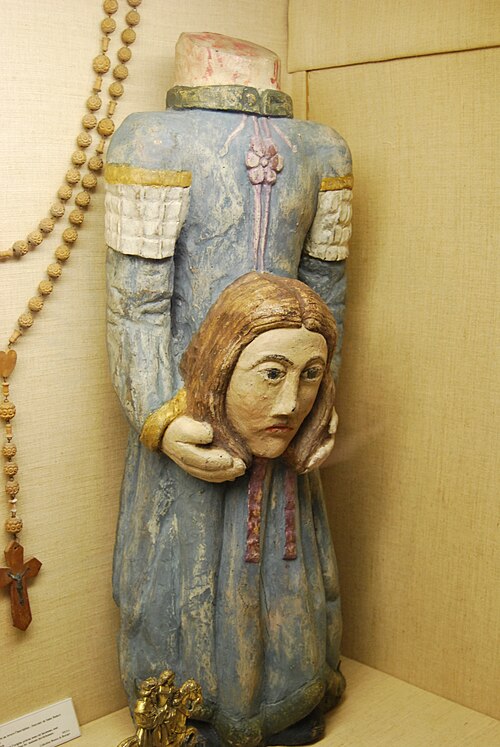
She was born to a poor but devout family in the village of Villemont, near Bourges, and at seven consecrated her virginity to God. According to some accounts, her mere presence cured the sick and drove out devils. In time she became a beautiful girl, but remained just as pure and earned her living as a shepherdess. One spring day in 880, as she was tending her sheep, she was noticed by a passing nobleman, the son of the count of Poitiers. Struck by her beauty and popularity, he approached her but was rejected. He argued with her to no avail, and so decided to abduct her. At night he came and took her by force, but she struggled so violently that she fell from his horse as they were crossing a stream. The abductor, enraged, beheaded her with his sword and rode off.
According to the fully developed legend, Solange's severed head invoked three times the Holy Name of Jesus and, like Saint Denis and other saints of Gaul, Solange picked up her head in her own hands and walked with it as far as the church of Saint-Martin in the village of Saint-Martin-du-Crot, which now bears the name of Sainte-Solange, the only commune in France with this name, and there dropped truly dead. A cult grew up around her at once, and many miraculous cures were attributed to her. In 1281 an altar was erected in her honour in that church, which kept her severed head as a relic and began to call itself the church of Saint Solange, while a nearby field where she had prayed came to be called the “Field of Saint Solange.” It was the habit of the locals, in times of great stress, to form a procession through Bourges with the reliquary of the head before them and to invoke her against drought. A procession in her honour is still held at Bourges, though with fewer and fewer participants; in some neighbouring towns, Pentecost processions in her honour were popular until the 1970s. Her feast in the Roman Catholic Church is 10 May.
Commemorated the same day May 10
 Simon the ZealotApostle · The ApostleMay 10
 Isidora of TabennaFool-for-ChristMay 10
 Comgall of BangorVenerable · Abbot of BangorMay 10
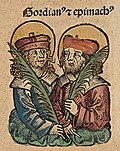 Gordianus and EpimachusHoly MartyrsMay 10
 Aurelian of LimogesSaint · Bishop of LimogesMay 10
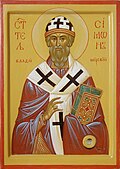 Simon of VladimirSaint · Bishop of Vladimir and SuzdalMay 10
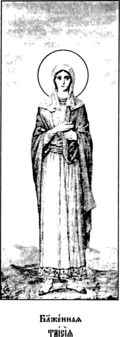 Taisia of EgyptVenerableMay 10
- Hesychius of AntiochMartyr · SenatorMay 10
- Synesius IvanovVenerable · Schema-archimandrite of IrkutskMay 10
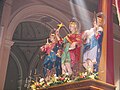 Alphius, Philadelphus and CyrinusHoly Martyrs · Martyrs of SicilyMay 10
- Isidore of AlexandriaSaintMay 10
- Acacius of NicomediaMartyrMay 10