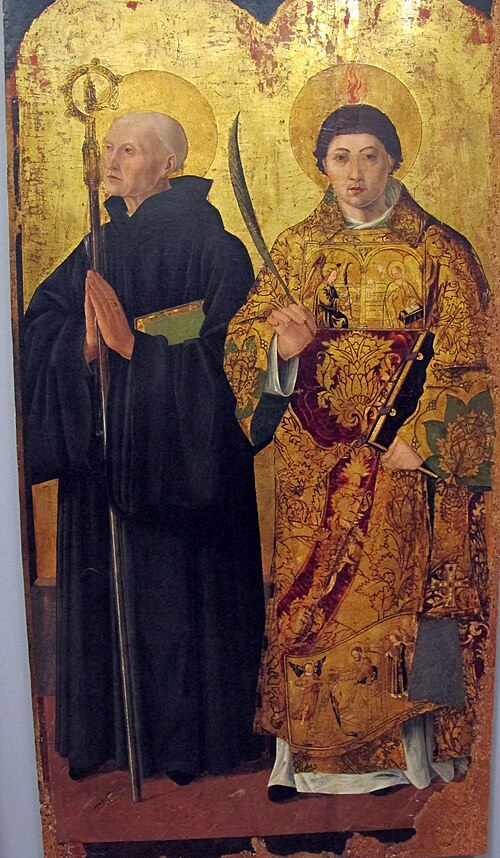
Martyr
Sosius of Misenum
Deacon of Misenum
Deacon of Misenum, martyred at Pozzuoli with Saint Januarius in Diocletian's persecution.
- Feast
- September 23old style October 6
- Reposed
- 3054th century
- Place
- Pozzuoli
- Order
- Martyrs
Life
Saint Sosius (in Italian Sosso, Sossio or Sosio) was a deacon of Misenum, an important naval base of the Roman Empire in the Bay of Naples. He was born around 275 and suffered with Saint Januarius at Pozzuoli during the persecution of Diocletian, on 19 September 305. The Church commemorates him on 23 September, the day on which his body was translated to Misenum.
The tradition of his martyrdom
Most of what is known comes from a tradition preserved in the so-called Atti Bolognesi (the Acts of Bologna). According to it, during the persecution of Diocletian, Januarius, bishop of Benevento, left his see and came to Pozzuoli without making his identity known. His presence nevertheless became known to the Christians of the area, and Januarius kept in contact with Sosius, deacon of Misenum, as well as with the deacon Festus and the lector Desiderius.
According to the tradition, Sosius prepared for the priesthood in the company of Januarius. One day, as he read the Gospel at the Liturgy, Januarius saw a bright red light and a dove hovering above his head, and understood that Sosius would suffer martyrdom.
Soon the authorities learned that Sosius was a Christian. The judge Dragontius condemned him to be killed by bears in the local amphitheatre. On hearing of the arrest, Januarius, Festus and Desiderius took the risk of visiting him in the prison at the sulphur mines of Pozzuoli, near the volcano Solfatara. The authorities found that they too were Christians and threw them to the beasts. As a modern account, quoting a contemporary, says, the animals came near the saints, lay down at their feet and refused to harm them. All of them, together with Sosius, were then condemned to be beheaded.
While the others were being led to execution, the deacon Proculus of Pozzuoli and the laymen Eutyches and Acutius protested the sentence. For this they too were beheaded near the Solfatara, on 19 September 305. The saints of Pozzuoli are commemorated on different days: Januarius on 19 September, Festus and Desiderius on 7 September, Sosius on 23 September, and Proculus, Eutyches and Acutius on 18 October.
Veneration
His remains first stayed at Misenum (today Miseno). After the town was destroyed by the Saracens, its people moved to the newly founded town of Frattamaggiore. They carried the saint's veneration with them and made him the patron of the town, but left his relics behind. The Benedictines found them at Miseno and in 910 placed them in the convent of Santi Severino e Sossio in Naples. The deacon John wrote a history of Saint Januarius and his companions, in which, as an eyewitness, he describes this transfer.
From there the veneration spread to various parts of Campania and Lazio and even to Africa. After Napoleon suppressed the convent, the relics were brought to Frattamaggiore, where they are still kept in the basilica dedicated to him. A village in the province of Avellino bears the name San Sossio Baronia.
Commemorated the same day September 23
 Adomnán of IonaVenerable · Abbot of IonaSep 23
 Constantius of AnconaVenerable · Monk of AnconaSep 23
 Proietto of ImolaSaint · Bishop of ImolaSep 23
 PolyxeneMartyrSep 23
- XanthippeMartyrSep 23
 BarypsabasHieromartyr · Keeper of the Blood of ChristSep 23
- Tychon the AthoniteVenerable · Monk of KapsalaSep 23
- Andrew of SyracuseMartyrSep 23
- Anthony of SyracuseMartyrSep 23
- Antoninus of SyracuseMartyrSep 23
- CissaVenerableSep 23
- ComnatSaintSep 23