Righteous
Abel
The Righteous
Second son of Adam and Eve, righteous before God, killed out of envy by his brother Cain.
- Reposed
- 3825 BC39th century BC
- Order
- The Righteous
Life
The Righteous Abel is, according to the book of Genesis, the second son of Adam and Eve, a shepherd, killed out of envy by his elder brother Cain. He is the first man whose death Scripture recounts, and in Christian tradition the first persecuted righteous man and the first martyr. His name in Hebrew, Hevel, means breath, a vapour that vanishes, and points to how brief his life was.
Abel's offering
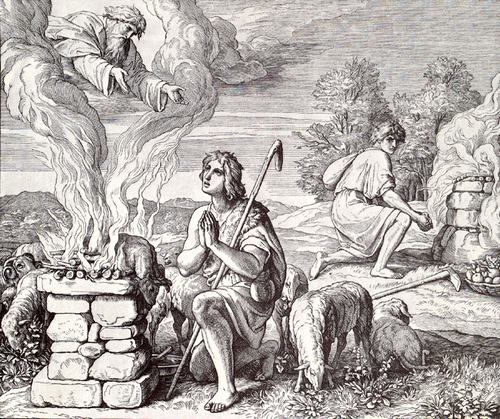
Genesis says that Abel was a keeper of sheep, while Cain tilled the ground. Both brought an offering to God, the first offerings mentioned in the Bible. Abel brought from the firstborn of his flock and of their fat, Cain from the fruit of the ground. The Lord had regard for Abel and his gifts, but for Cain and his offering He had no regard.
Scripture does not say why Abel's offering was accepted, so the interpretations vary. The Epistle to the Hebrews says that by faith Abel offered God a better sacrifice than Cain and through it received witness that he was righteous. Saint John Chrysostom pointed out that Abel brought of what he had best, the firstborn. An old tradition, recalled by Christian interpreters, says that fire came down from heaven and consumed his offering, a sign that God had accepted it.
The murder
Cain was very angry and his face fell. The Lord urged him to master the sin crouching at the door, but Cain called Abel into the field and killed him. This is the first killing and, at the same time, the first fratricide in biblical history.
The Lord asked Cain where his brother was, and Cain answered: I do not know; am I my brother's keeper? God told him that the voice of Abel's blood cried to Him from the ground. Cain was condemned to be a fugitive and a wanderer on the earth and received a mark, so that no one who found him would kill him. Abel left no descendants. Adam and Eve then had Seth, another offspring in place of Abel, in whose line, Scripture says, men began to call on the name of the Lord.
In the New Testament and the Fathers
Christ the Lord recalls the blood of righteous Abel when He rebukes the scribes and Pharisees: that on you may come all the righteous blood shed on the earth, from the blood of righteous Abel (Matthew 23:35; Luke 11:51). Saint John writes in his first epistle that Cain slew his brother because his own deeds were evil and his brother's righteous. The Epistle to the Hebrews says that Abel, though dead, still speaks by faith, and sets the blood of Christ's sprinkling above that of Abel (Hebrews 11:4; 12:24).
The holy Fathers saw in Abel a foreshadowing of Christ: a shepherd of sheep, an offerer of a pure sacrifice, a righteous man who endured a violent death. Saint Augustine called him the first persecuted righteous man, whose sacrifice and death prophesied of Christ, not by word but by deed.
Commemoration
The Orthodox Church commemorates Abel among the righteous of the Old Testament, on the Sunday of the Holy Forefathers (two Sundays before the Nativity of the Lord) and on the Sunday of the Holy Fathers, before the feast. Judaism and Islam know him too; in Islamic tradition his name is Habil, and a shrine near Damascus, Nabi Habil, is shown as his tomb.