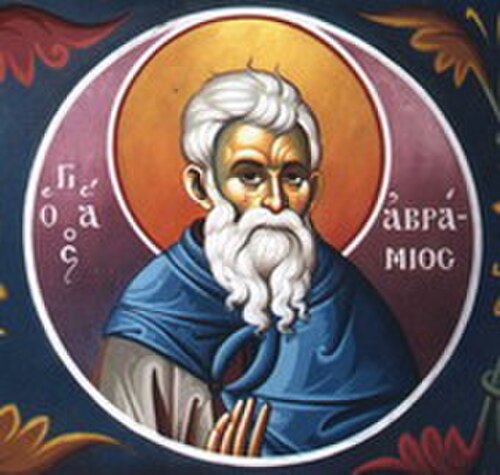
Venerable
Abramius the Recluse
Hermit of Edessa
Hermit and ascetic from Edessa, c. 290 to 360, the same as Abraham of Kidunaia.
- Feast
- October 29old style November 11
- Reposed
- 3604th century
- Place
- Lampsacus
- Order
- Venerables
Life
Saint Abramius the Recluse (c. 290 - 360), also called Abraham of Kidunaia, was a hermit and ascetic of Edessa in Mesopotamia. He is commemorated on 29 October, by the old calendar (11 November by the new), together with his niece Mary; he is not to be confused with Saint Abramius of Rostov, a Russian archimandrite commemorated on the same day.
Life
Abramius was born in Edessa (today Şanlıurfa, in Turkey), around 290, of very pious parents. From childhood he went to church with love. His parents wanted to marry him and found him a girl; he at first resisted, but, unable to grieve them, he agreed. The sources disagree on the moment of departure: according to one, on the wedding day he left his fiancée and went to the shore of the Sea of Marmara, near Lampsacus (now Lapseki), where he lived in a cave; according to the Greek synaxarion, a week after the wedding he left his wife and withdrew to the desert of Osroene; according to the Serbian source, on the seventh day after the wedding he went out of the city and gave himself to Christian struggle. His relatives were greatly grieved, but accepted his decision and left him to live in the solitude of prayer, without disturbing him. After his parents' death he distributed to the poor all the great fortune inherited, leaving himself nothing, for fear that his mind might cling to some earthly thing.
He struggled fifty years and in all that time went out among people only twice. The first time to turn to God a village in which all were pagans; his fame as a spiritual guide had reached the capital, so the bishop of Edessa visited him and entrusted to him the Christianization of the inhabitants of the town of Beth-Kidouna, called in the Greek Life "Tainia". The bishop wanted to make him priest in that very village, but Abramius resisted; he had to accept, however, and remained a time in the village as priest, where he built a beautiful church, in which he offered prayers to God daily and gathered the scattered people. The pagans for this reason put him in chains and drove him out of the village, throwing stones after him, but he came back. Tormented, hunted, dragged, beaten, covered with stones, hungry and thirsty, he was not angry at them and did not lose heart, but bore all, did not fall into despair, but burned still more with love for God and pity for the erring. He begged and taught the old as parents, the young as brothers, the children as sons, though he was mocked and reviled by them. By his faith, prayer and abstinence he succeeded in turning them, bringing them into the church and cleansing them of idolatrous impurity, baptizing them all in the name of the Father and of the Son and of the Holy Spirit. When he had finished, he withdrew to continue his struggle.
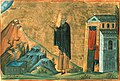
His second going out among people was to save his erring niece Mary, who had taken refuge with him and whom he had set on the path of ascetic life; therefore Abramius is depicted in Christian iconography and book illumination teaching his niece, as in the "Illustrated Menologion for October" preserved in the National Library of Vienna. He turned her to the good way and resumed his labor of solitude. He died in peace, at a very great age, in the year 360 (the Serbian source says in the seventieth year of his life). He was proclaimed a saint by the Orthodox Church, as was Mary, and their memory is celebrated together on 29 October.
Veneration
The Orthodox churches have dedicated to him 29 October by the old calendar, that is 11 November by the new. In Russia the saint is venerated as a shepherd, that is, protector of sheep and small livestock. Among the Serbs, Avramiev-dan is a family slava, especially in the lower Drina valley: west of the Drina the families that keep this slava are most numerous around Šekovići, Srebrenica, Vlasenica, Zvornik and Bijeljina; east of it in Sokol, Rađevina, Jadar, Mačva, Šabac. More families with this slava are also in the Valjevo Kolubara and Podgorina, and in Srem; a few families are also in Semberija, Banat, Belgrade, the Šumadija Kolubara and central Bosnia. In the 1880s, in the whole Dabar-Bosnia metropolis, only 38 families kept this slava, of whom 35 (92%) lived around Srebrenica and Vlasenica, in eastern Bosnia; without doubt this region, together with the Zvornik area, was the cradle from which the families that celebrate Saint Abramius spread in Bosnia, Serbia and other regions.
Commemorated the same day October 29
 Abraham of RostovVenerable · Archimandrite of RostovOct 29
 Abraham the RecluseVenerableOct 29
- Remigius of LyonSaint · Archbishop of LyonOct 29
 Timothy of EsphigmenouVenerableOct 29
- GavdeliaSaintOct 29
- Serapion of ZarzmaVenerableOct 29
- Abundius of PalestrinaSaintOct 29
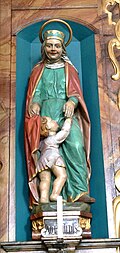 AchahildisSaintOct 29
- Aedh GlastuirSaintOct 29
- Agatha of AglomazovMartyrOct 29
- Alexis of AglomazovMartyrOct 29
- Anastasia LebedevaMartyrOct 29