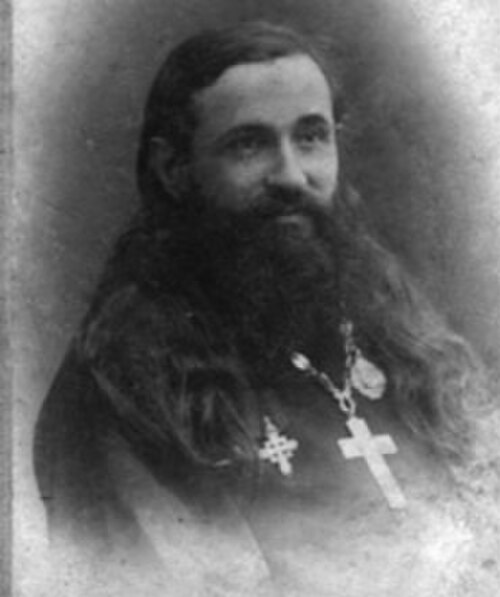
Hieromartyr
Alexander Glagolev
Priest and professor
Priest and philosopher of religion, professor at the Kyiv Theological Seminary, born in 1872 and died in 1937.
- Reposed
- 193720th century
- Place
- Kyiv
- Order
- Martyrs
Life
Holy Hieromartyr Alexander Glagolev was an archpriest, theologian and professor at the Kyiv Theological Academy who lived from 1872 to 1937. He was a great scholar of the Old Testament and of ancient languages, and for many years served at the Church of Saint Nicholas the Good in the Podil district of Kyiv.
The Church honours him as a pastor who defended the truth and the innocent, and who gave his life in Kyiv's Lukianivka prison during the Soviet persecution. In 2019 he was numbered among the locally venerated saints of the diocese of Kyiv.
Family and studies
Alexander Alexandrovich Glagolev was born on 14 February 1872 in the village of Pokrovskoye in Tula province, in a priest's family descended from the minor nobility of that province. He finished the Tula seminary in 1894 and the Kyiv Theological Academy in 1898 as Candidate of Theology.
He stayed on at the academy as a scholar preparing for a professorship. In 1900 he became Master of Theology with a thesis on the Old Testament teaching about angels.
Professor A. A. Olesnitsky wrote that the work was remarkable for its richness and depth and was a real contribution to Russian theology, which had until then lacked any serious study of angels. Much later Archpriest Alexander Men noted that Glagolev had examined every name for the angels in Scripture, from the "sons of God" to the seraphim and cherubim, and at times anticipated the conclusions of modern biblical scholarship.
The scholar
From 1899 he taught Hebrew and biblical archaeology at the Kyiv Academy, from 1900 as docent and from 1906 as extraordinary professor. From 1910 he held the second chair of Old Testament Scripture.
His colleagues esteemed him so highly that in September 1907, at the first election of a rector in the academy's history, they chose him. The Holy Synod, however, did not confirm the election, holding that the academy should be led by a monk.
He knew eighteen ancient and modern languages, and even in old age was learning Italian. He served on the commission for a scholarly edition of the Slavonic Bible, contributed to the Orthodox Theological Encyclopedia, and wrote commentaries for the "Explanatory Bible" edited by A. P. Lopukhin, among them on the books of Kings, Tobit, Proverbs, the Song of Songs, several of the minor prophets and the Catholic Epistles.
He also wrote studies on charity among the ancient Hebrews, on the Levites, on levirate marriage, on the book of Leviticus and on the Burning Bush.
Defender of the innocent
In 1903 he was ordained priest, and in 1914 he was raised to archpriest. In the autumn of 1905, when pogroms against the Jews broke out in Kyiv, Father Alexander and his friend Archpriest Mikhail Edlinsky went out into the raging crowd with a small procession, in vestments, carrying a cross and banners.
The procession moved through Kontraktova Square towards the Jewish shops, and the priests urged the crowd not to commit this evil and unchristian deed. Some recognised their pastors and took off their hats, and the crowd gradually dispersed. This happened more than once.
In 1909 he published "The Old Testament and Its Abiding Significance in the Christian Church", firmly rejecting the attempts of antisemitic writers to discredit it. In the case of Menahem Mendel Beilis, tried in 1913, he was called as an expert and showed that the Law of Moses forbids the shedding of human blood and the eating of any blood, and that rabbinic writings do not set this commandment aside.
His testimony contradicted the ritual murder accusation on which the whole case rested and helped bring about Beilis's acquittal. Many also remembered the help he gave to the poor of Kyiv, Jews and Muslims alike.
Priest in war and revolution
According to some military records, during the First World War he served for a time as chaplain of the Kargopol Dragoon Regiment and received the Order of Saint Anna, though these records also contain details that do not match his known biography.
He served at the Church of Saint Nicholas the Good in Podil. The priest Sergei Sidorov recalled meeting him there during the civil war: a small, slightly stooped priest whose face shone with quiet joy, who bowed before the icons as if receiving a blessing from the saints. Sidorov said he had never seen in anyone so vivid a sense of the unseen world.
Friend of the Bulgakov family
Father Alexander was close to the Bulgakov family. The writer Mikhail Bulgakov's father, Professor Afanasy Bulgakov, was his senior colleague at the academy and a parishioner of Saint Nicholas the Good.
In 1913 Father Alexander married Mikhail Bulgakov to his first wife, Tatiana Lappa. The writer later made him the model for Father Alexander in the novel "The White Guard", the only character in the book under his real name, a priest of Saint Nicholas the Good who encourages the hero not to give way to despondency.
Confessor under Soviet rule
After the Bolsheviks came to power he continued to serve at Saint Nicholas the Good, and after the church was closed, in 1934 or 1935, at the Church of Saint Nicholas on the Embankment. In the early 1920s he gave lectures to the academy's students in secret.
After the rector, Bishop Vasily (Bogdashevsky), was arrested in 1923, he in effect carried out the rector's duties. After the academy was finally closed in 1924, he taught at theological and pastoral courses.
In the early 1930s he was evicted from his home and moved into a tiny room on the landing of the wooden stairs leading up to the church bell tower. In 1931 he was arrested on a charge of belonging to the "True Orthodox Church" and spent half a year in Lukianivka prison.
His granddaughter, Magdalina Glagoleva-Palian, remembered that crowds came to his church from all over the city and from elsewhere. Many then visited him at home, despite the cramped room and difficult approach, seeking comfort, spiritual counsel and help. Parishioners recalled how he consoled the suffering, prayed for the sick and lifted up the downcast.
Family
His wife, Zinaida Petrovna, was the daughter of the librarian of the Kyiv Academy and died on 9 December 1936. They had three children: Alexei, Sergei and Varvara.
Their son Alexei (1901–1972), also a priest, saved Jews in Kyiv during the Second World War. In 1992 he and his family were recognised by Yad Vashem as Righteous Among the Nations.
Last arrest and death
On 20 October 1937 Father Alexander was arrested again, charged with belonging to a "fascist organisation of churchmen", and imprisoned at Lukianivka. A fellow prisoner, the priest Kondrat Kravchenko, testified that he was interrogated eighteen times, and during the night interrogations was forced to stand for hours with his head thrown back.
According to the official account, he died in prison on 25 November 1937 of uraemia and heart failure. He was buried in a common grave in Lukianivka Cemetery.
Veneration
Many years later his relatives placed in Lukianivka Cemetery a cross with a lectern bearing the Gospel words about the blessedness of those persecuted for righteousness' sake. On 30 January 2002, on the centenary of his son's birth, a memorial plaque to the priests Alexander and Alexei Glagolev was placed on the wall of the Kyiv-Mohyla Academy.
On 3 April 2019 the Holy Synod of the Ukrainian Orthodox Church numbered him among the locally venerated saints of the diocese of Kyiv as a hieromartyr, and included him in the Synaxis of the Saints of the Kyiv Theological Academy.