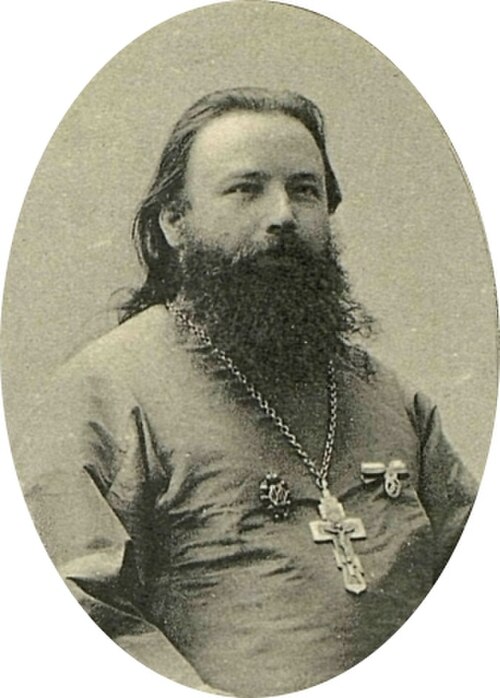
Saint
Alexander Veraksin
Priest from the Vilna governorate and member of the Third State Duma, who died in 1918.
- Reposed
- 191820th century
- Place
- Cherkasy
Life
Alexander Veraksin was a priest of the Vilna governorate and a member of the Third State Duma, killed in 1918. His glorification as a new martyr was made by the Council of Bishops of the Russian Orthodox Church Outside of Russia (ROCOR) in 1981, that is before the reunion of 2007. Our sources do not show a canonization by the Moscow Patriarchate, so his standing across the Orthodox Churches remains unclear.
He was born on 22 October 1872. He graduated from the theological school at Polotsk and the seminary at Vitebsk (1894). He was Orthodox and held 300 desyatinas of church land. In 1896 he was ordained priest and served in the Disna and then the Sventsiany districts, being at the same time a teacher of religion in folk schools and head of a teachers' school.
In 1905, on the proposal of Archbishop Nikandr of Lithuania and Vilna, he moved as priest to the Berezvech convent, where he also headed a school for women teachers. He compiled a historical study of the monastery, printed in 1910. He also served as psalm-reader at the church of Saint George in the village of Kitskovo, Sebezh district.
He was chairman of the Glubokoe section of the Union of the Russian People and a member of the Russian Assembly. In 1907 he was elected a member of the Third State Duma by the Russian rural population of the Vilna governorate, belonging to the right-wing faction. He sat on the commissions for local self-government, for public education and the managing commission, and took an active part in drafting the law on parish church schools. He wrote in right-wing newspapers, Zemshchina and Russkoe Znamya. In 1910 he was elected candidate member of the Main Council of the Union of the Russian People, then an honorary member with the rights of a founding member. He was married.
According to the historian Mikhail Polsky, he was killed by revolutionaries in 1918 in the Kiev governorate, hanged on the gate of his own house. His place of death appears in the sources as Cherkasy. In 1981 the Council of Bishops of ROCOR glorified him among the new martyrs and confessors of Russia. Among his writings is the study The Berezvech Monastery of the Lithuanian Diocese, Disna District (Vilna, 1910). The sources give no day of commemoration.