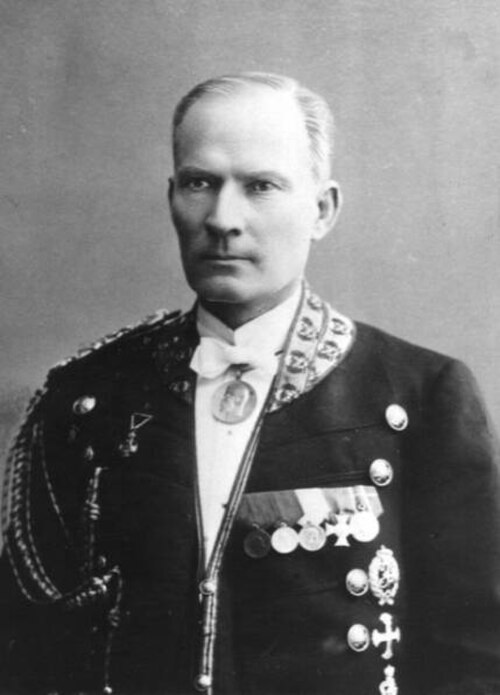
New Martyr
Alexei Trupp
Footman of the imperial family
Latvian footman of Tsar Nicholas II, shot at Yekaterinburg on July 17, 1918 with the imperial family.
- Reposed
- 191820th century
- Place
- Yekaterinburg
- Order
- Martyrs
Life
Aloysius (Alexei) Yegorovich Trupp (in Latvian Alois Laurs Trups, 1856 to 1918) was the head footman of Emperor Nicholas II, of Latgalian descent, from present-day Latvia, and a Roman Catholic by religion. He stayed beside the imperial family in exile, unpaid, and was shot with it in the Ipatiev House at Ekaterinburg in the night of 16 to 17 July 1918. The Russian Orthodox Church Outside Russia canonized him in 1981 as a martyr, along with the others killed, though he was a Catholic, at a time when that Church was not in communion with the Moscow Patriarchate. The Russian Orthodox Church of the Moscow Patriarchate canonized the imperial family in 2000 as passion-bearers, but not its servants.
Childhood
By the baptismal record, Alois Laurs Trups was born on 8 August 1856 (other sources also give 8 April and 8 November), in the village of Kalnagals, in the Rezhitsa district, Vitebsk province (today Ošupe parish, Madona region, Latvia), in a Catholic family of well-off peasants, Juris and Anna Trupp. He was baptized in the church at Barkava by the priest Erik Mažinovsky. His parents strove to give their children an education and Alois finished the parish school at Barkava in 1866.
At Petersburg
On 1 January 1878 he entered the Semyonovsky Life Guards regiment as a private. He did well, was promoted non-commissioned officer and passed into the reserve on 23 March 1883. It is believed that Alois, a tall, blue-eyed blond, as were chosen for the Semyonovsky regiment, was noticed by Empress Maria Feodorovna, who ordered him taken into the palace service as a footman. He was engaged above the establishment on 8 April 1883 and entered on it on 2 September 1886.
He became a man close to the imperial family, who could be trusted. In a photograph at Tsarskoe Selo of 1902, he holds the bridle of Grand Duchess Tatiana Nikolaevna's pony. Being counted in the "mobile staff", he accompanied the tsar's family on journeys. In the summer of 1910 Trupp was in the emperor's suite that came to Riga on the yacht "Standart" for the opening of the monument to Peter I. The footman received 360 roubles a year, but life at court was self-sufficient, with uniform, food and lodging provided. All his life Alois remembered his homeland, Latgalia, and helped acquaintances who turned to him. His relatives recalled that he sent his brothers from Saint Petersburg a threshing machine and other farm machinery and helped them rebuild their houses after the great fire of 1900. He kept out of political life, because he valued his service and was a responsible man.
Trupp collaborated with the Latgalian enlighteners, the Skrinda brothers, Benedict (a priest) and Anton (a doctor). During leave at home he even took part in an event they organized on 16 August 1909 at Bukmuiža, in which Alois played the role of an officer in a prepared play. He last came to his native places in 1912. His brothers Jazeps and Pēteris had inherited from their father 50 hectares of land but lived poorly. Alois dreamed of buying them land, but the First World War began. His family life did not work out: after his career was nearly broken by a liaison with the wife of a colleague, Alois remained unmarried.
Last years with the imperial family
After Nicholas II's abdication he could no longer pay his servants. A. E. Trupp, the valet T. I. Chemodurov, the cook I. M. Kharitonov, the maid A. S. Demidova and the doctor E. S. Botkin stayed to work unpaid. They followed the former emperor into exile of their own will, unlike many other courtiers.
When it was decided to send the family from Tobolsk to Ekaterinburg, Nicholas II, Alexandra Feodorovna and Maria Nikolaevna left for Ekaterinburg, leaving the other children in Trupp's care at Tobolsk. A month later he accompanied, among others, the Tsarevich Alexei and his sisters Olga, Tatiana and Anastasia, taken by the steamer "Rus" from Tobolsk to Tyumen, and from there by train to Ekaterinburg. On arrival, on 24 May 1918, he replaced in the Ipatiev House the valet Chemodurov, ill and sent to the prison hospital. During this time Trupp served as Nicholas II's valet and helped the whole family in household matters, among other things passing them money, though the servants were searched from time to time. From Ekaterinburg he sent several letters to relatives.
When the shooting of the tsar's family was decided, the question of destroying the servants was discussed, and it was decided to spare the kitchen boy L. Sednev, as one of the participants, M. A. Medvedev (Kudrin), recalled. About the rest it was decided that from the start they had been offered to leave the Romanovs, some went, and those who stayed said they wished to share the monarch's fate. Let them share it. A receipt of Trupp's survives, that he voluntarily continues to serve the tsar's family, submits to all orders and demands of the Ural Regional Soviet and of the commandant of the house and "considers himself in the same condition as the Romanov family". In the night of 16 to 17 July 1918 Trupp was shot with the family of Nicholas II and the other attendants, the physician Botkin, the maid Demidova and the cook Kharitonov.
Burial and canonization
Trupp's remains were identified by an examination of 1991 to 1998. On 17 July 1998 the remains of the members of the former imperial family and their attendants were buried in the Cathedral of Saints Peter and Paul in Saint Petersburg, in the Chapel of Saint Catherine the Martyr. On Trupp's coffin, unlike the others, a Catholic four-armed cross was placed.
In 1981 A. E. Trupp was canonized, with all the victims of the Ekaterinburg murder, by the Russian Orthodox Church Outside Russia, together with the family of Nicholas II and those near it, among them not only the Catholic Aloysius Trupp but also the Lutheran reader E. A. Schneider, the Russian teacher of Empress Alexandra Feodorovna, killed by the Bolsheviks on 4 September 1918 at Perm. The motive for the decision was the precedents of canonizing victims of persecution who had not received baptism, for example pagans who joined Christians at execution, as with the Forty Martyrs of Sebaste. To justify canonizing non-Orthodox, the bishops of the Russian Church Outside Russia wrote that these people, being devoted to the tsar, had been baptized by their martyr's blood and were worthy to be canonized with the family. The Russian Orthodox Church, canonizing the imperial family in 2000, did not mention in its decision those near it, among them A. E. Trupp. On 16 October 2009 the Prosecutor General's Office of the Russian Federation decided to rehabilitate 52 repressed associates of the imperial family, among them A. E. Trupp.
For his faultless service he received several distinctions, among them a dark bronze medal in memory of the coronation of Alexander III and Maria Feodorovna (1884), the badge of the emperor's guard of honour, the badge for excellent marksmanship and a silver medal of the king of Denmark, received in 1892, and the title of honorary citizen. In the film "The Romanovs: A Crowned Family" (2000) the role of Trupp is played by the actor Viktor Teider.