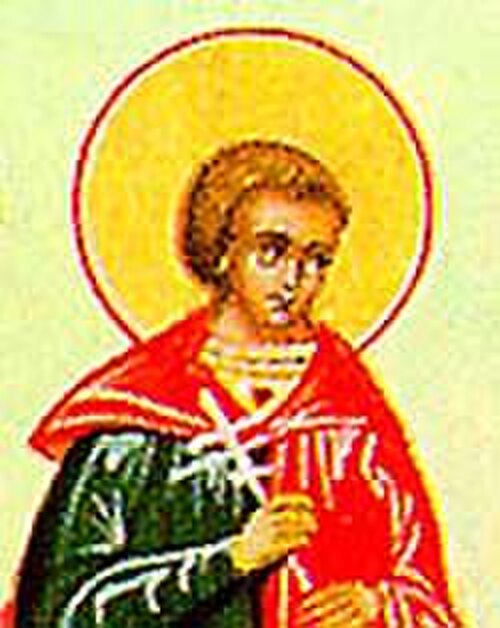
Martyr
Amphian
Martyr of Caesarea in Palestine
Martyr of Caesarea in Palestine who died in Galerius' persecution, commemorated on April 2.
Life
Holy Martyr Amphian was a young Christian of Lycia, put to death at Caesarea in Palestine in the persecution of Galerius (according to the Serbian source, of Maximian), around the year 305 or 306. He is commemorated on 2 April, together with Aedesius, sometimes called his brother; the Serbian source commemorates both on 2 April (15 April by the Gregorian calendar). The old martyrologies had him on 5 April, but the Bollandists give 2 April as the correct day. The years 287 and 305 on the record fit the English source.
He was a native of Lycia (according to the Serbian source, of Patara), of wealthy and distinguished parents, who gave him the best education in rhetoric, law and philosophy at the famous school of Berytus in Phoenicia. While he was away at school he became a Christian. His parents resisted his efforts to bring them to Christianity, and so Amphian withdrew to Cappadocia; according to the Serbian source, he secretly withdrew, with his brother Aedesius, to Caesarea in Palestine, to the presbyter Pamphilus, known for holiness and spiritual learning, from whom they received Christian instruction and practised ascetic labour. Of Amphian it was said that in body he was 20 years old, but in mind and heart like a hundred.
Pamphilus was at Caesarea at the time of Amphian's martyrdom, expounding Holy Scripture, and the young Amphian was one of his disciples; he lived in the house of Eusebius, but gave no hint of his resolve to make a public protest, which led to martyrdom. According to the legend he was only 18 when he entered the temple at Caesarea, where the prefect Urbanus was offering sacrifice. He seized the outstretched hand that held the incense and reproached the magistrate for his idolatry. The guards fell upon him furiously and, after cruelly torturing him, flung him into a dungeon. The next day he was brought before the prefect, torn with iron claws, beaten with clubs and burned over a slow fire, then sent back to confinement. The Serbian source says that they wrapped his feet in cotton and set them alight. After three days he was again taken from prison and thrown into the sea with stones tied to his feet (according to the Serbian source, a stone round his neck). Eusebius, an eyewitness, says that at that moment an earthquake shook the city, and the sea cast the body up on the shore.
Aedesius, according to the Serbian source, was first sent to the copper mines in Palestine, then taken to Egypt. At Alexandria he struck across the face an official, Hierocles, who had gathered in the square Christian nuns, virgins and honourable women and was giving them over to the dissolute for abuse. For this he was tortured and drowned in the sea, like his brother Amphian. Both died around 306.
Commemorated the same day April 2
 Æbbe of ColdinghamVenerable · Abbess of Coldingham PrioryApr 2
 Theodosia of TyreMartyr · Virgin of TyreApr 2
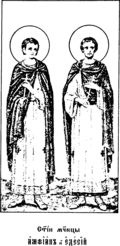 Amphianus and AedesiusHoly Martyrs · Brothers of PataraApr 2
- Victor of CapuaSaint · Bishop of CapuaApr 2
- Gregory of NicomediaVenerable · Hieromonk and asceticApr 2
- Titus the WonderworkerVenerableApr 2
- Giorgi MatskvereliVenerableApr 2
- Abundius of ComoSaint · Bishop of ComoApr 2
 BronachVenerableApr 2
 Constantine I of ScotlandPassion-Bearer · King of ScotsApr 2
- EuthaliaSaintApr 2
- LonochilusHoly VenerablesApr 2