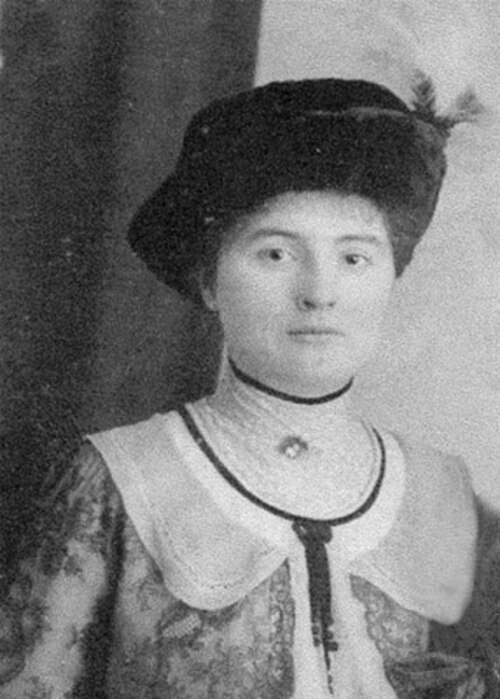
New Martyr
Anastasia Hendrikova
Lady-in-waiting to the Tsarina
Lady-in-waiting to Tsarina Alexandra, arrested by the Bolsheviks and shot near Perm in 1918.
- Reposed
- 191820th century
- Place
- Perm
- Order
- Martyrs
Life
Countess Anastasia Vasilievna Hendrikova (1887 to 1918) was lady-in-waiting to Tsarina Alexandra Feodorovna and one of the members of the Russian imperial household who followed the family into exile. Arrested by the Bolsheviks, she was shot outside the city of Perm in the autumn of 1918, together with Catherine Schneider. The Russian Orthodox Church Outside Russia canonized them as martyrs in 1981, together with the Romanov family and the servants killed at Ekaterinburg. At that time that Church was not in communion with the Moscow Patriarchate, and the Patriarchate, canonizing the imperial family in 2000, did not name the servants; her canonization is therefore only that of 1981.
Family and court service
Anastasia was born on 23 June 1887 to Count Vasily Alexandrovich Hendrikov, Grand Master of Ceremonies of the imperial court, and Princess Sofia Petrovna Gagarina. She belonged to the Russian nobility and was descended, according to the sources, from the sister of Tsarina Catherine I, the wife of Peter the Great. In 1910 she was appointed lady-in-waiting to Tsarina Alexandra and became a kind of unofficial governess to the four grand duchesses.
In exile
After the revolution of 1917 she remained devoted to the Romanov family and went with it into exile, first to Tobolsk, then to Ekaterinburg, although she was anxious for her own family. Her sister, Alexandra Balashova, affectionately called "Inotchka", was ill with tuberculosis. Baroness Sophie Buxhoeveden, another lady-in-waiting, wrote that the two sisters were all the world to each other and that Anastasia's dark eyes glowed when she heard news of her sister. From Inotchka's bedside she had hurried back to Tsarskoe Selo, when she learned of the revolution, to be beside the Tsarina in her danger. Now she rarely had news.
Buxhoeveden believed Anastasia knew of the danger. By her account, the thought of approaching death was so settled in her that it no longer frightened her. She was very pretty and looked younger than her twenty-eight years, but welcomed the thought of death, weary of life and detached from earthly things. The Bolsheviks forcibly separated her from the Romanov family at Ekaterinburg and, after its murder, she was sent to Perm. In the prisoners' railway car with her were other members of the household, among them Catherine Adolphovna Schneider, the Empress's reader. At Perm the women were placed in one cell, in the tower of the former prison castle, where especially dangerous political prisoners had earlier been held.
Last days and death
On 3 or 4 September 1918 (the sources differ) a group of prisoners, six women and five men, was gathered in the prison office with their belongings. Among them were Anastasia, Schneider and the Tsar's elderly valet, Alexei Volkov, aged sixty. They were guarded by twenty-two guards, none of them Russian, led by a chief dressed as a sailor. Volkov, who later escaped, recalled that a guard first told him they were being taken to the "house of arrest", then told Anastasia they were going to the central prison and from there to Moscow. She repeated the conversation to the others and made the sign of the cross with her fingers. Volkov took the gesture as an assurance that they would not be shot.
They were lined up in the street, two by two, men in front and women behind, and led to the edge of town along the road leaving Perm. After a few kilometres the guards politely offered to carry their bags, so as to seize them first and not share them later with others. Volkov understood they were being taken to the place of execution and, at the first chance, ran. A bullet whistled past his ear. Behind him he heard the shots that killed the others, Anastasia among them. According to the Russian sources the prisoners were brought to an embankment between two irrigation fields filled with filthy water, set with their backs to the guards and shot at close range or, to save bullets, killed with blows of rifle butts. The bodies were thrown into the ditches of the fields, used as a dump, and barely covered with earth.
The remains and remembrance
The Whites found the bodies of Anastasia and Catherine Schneider in May 1919. Anastasia's body was reburied on 16 May 1919, by Christian rite, in a wooden common crypt in the New All Saints (Egoshikha) Orthodox cemetery. After the Bolsheviks regained the city, the graves were levelled, and their place was indicated only approximately.
On 16 October 2009 the Prosecutor General's Office of the Russian Federation decided to rehabilitate 52 repressed associates of the imperial family, among them Anastasia Hendrikova. In October 2012, on the initiative of parishioners from several churches of Perm and with the blessing of Metropolitan Methodius, a veneration cross was set up at the burial place. In 2020 the exact site of the grave, believed to hold the bodies of the courtiers, was found by analysing a photograph of the 1919 funeral. The identity of the remains was established by forensic examination, comparing anthropological data and injuries with historical documents. On 29 May 2024 the Metropolis of Perm announced the consecration, on 9 June, of a memorial at the actual burial place, thus recognizing that the remains found had been identified.