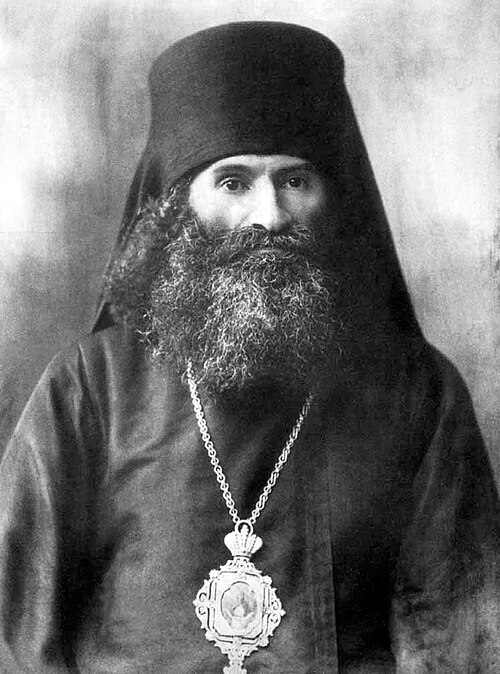
Hieromartyr
Andronik of Perm
Archbishop of Perm
Archbishop of Perm, born Vladimir Nikolsky, who died a martyr in 1918 in the early years of Soviet power.
Life
Saint Andronik, Hieromartyr, archbishop of Perm, in the world Vladimir Alexandrovich Nikolsky, was killed in the summer of 1918, in the first months of Soviet power. The Russian Church canonized him in August 2000.
He was born on 1 August 1870 in the village of Povodnevo in the province of Yaroslavl, in the family of a reader at the church of the Transfiguration. He graduated from the Yaroslavl seminary in 1891 and entered the Moscow Theological Academy. On 1 August 1893 he was tonsured a monk with the name Andronik and ordained deacon on 6 August; on 22 July 1895 he was ordained priest. In 1895 he finished the Academy with a thesis on “The teaching of the early church on the Eucharist as a sacrifice, in connection with redemption.” He was assistant inspector at the seminary of Kutaisi, then teacher of homiletics and inspector at the missionary seminary of Ardon.
The Japanese mission
In September 1897 he was named a member of the mission to Japan, under Bishop Nicholas Kasatkin, later canonized as Saint Nicholas of Japan. He set out from Saint Petersburg on 21 September, and from Odessa on 26 October with Archimandrite Sergius Stragorodsky, through Italy, Greece and North America, visiting the catacombs and tombs of martyrs. They arrived in Japan on 26 December. He wrote a book about the journey, “A Missionary Journey to Japan” (Kazan, 1899). Because of his health, weakened by the difficulties of acclimatization, and after news of his father's death, he returned to Russia; from 1899 to 1900 he was rector of the missionary seminary at Ardon, and from 1900 rector of the seminary at Ufa. On 5 November 1906 he was consecrated first bishop of Kyoto, living at Osaka, where most of the Orthodox faithful lived. There he found the community in a sorry state: no more than ten people attended church, and a single reader chanted at the choir. He began his ministry by visiting the faithful in their homes every evening, getting to know their families, speaking with them, preaching and learning their needs. During his ministry the number of those attending services grew greatly, and a large choir sang at services. Missionary work in a climate hard to bear, however, again worsened his health. On 27 May 1907 he left Japan. In October 1907 he was sent to Kholm to replace Bishop Eulogius, then was bishop of Tikhvin, the first vicar of the Novgorod diocese.
Bishop of Perm
On 30 July 1914, eleven days after the start of the First World War, he was appointed bishop of Perm and Solikamsk. He labored with great zeal for a million and a half inhabitants and 570 churches. In the first year of the war he took special interest in the life of the monasteries and visited the Belogorsky and Shamarsky monasteries and the Tabor hermitage. In the summer of 1916 he went to the army headquarters near Saint Petersburg, where Tsar Nicholas II was, to warn him about Rasputin, but was not taken seriously. The tsar nevertheless received gladly the gift brought on behalf of the people, a pair of soldier's boots provided to the army by the province of Perm.
In 1917 he became bishop of Perm and Kungur and one of the seven hierarchs of the pre-conciliar synod for the Local Council of the Russian Church in Moscow. He was very active at the Council, from August 1917 until April 1918. On 25 January 1918, in a written appeal, he urged the faithful to defend the Church's heritage from looters. He was a firm supporter of the tsar and held monarchy suitable for Christians, but not tyranny: the tsar should listen to his people. In February, in the Perm region, the Bolsheviks began to loot churches and monasteries. After the Council's session he returned to Perm, where Patriarch Tikhon raised him to the rank of archbishop. On Holy Thursday the Bolsheviks searched his residence, but he remained calm and celebrated the services of Holy Week and Pascha. Pressure on the Church grew. At last he was arrested at midnight on 4 July 1918 (17 July on the new calendar), and the clergy of Perm halted all services in the region until 13 July. He was killed on 7 July 1918, by old-style dating.
Commemorated the same day June 7
 Marcellinus of RomeSaint · Bishop of RomeJun 7
 Cyriacus of RomeHieromartyr · Deacon of RomeJun 7
 Joannicius RudnevSaint · Metropolitan of Kiev and GaliciaJun 7
 Daniel of ScetisVenerableJun 7
 Paisios BasiasVenerableJun 7
- Benjamin LukaninHieromartyr · PriestJun 7
- Abramius of KozheozeroVenerableJun 7
- Alexander MakhetovHieromartyrJun 7
- Alexander OsetrovHieromartyrJun 7
- Alexander PreobrazhenskyHieromartyrJun 7
- Alexander ZuevMartyrJun 7
- Anacletus of RomeSaint · Bishop of RomeJun 7