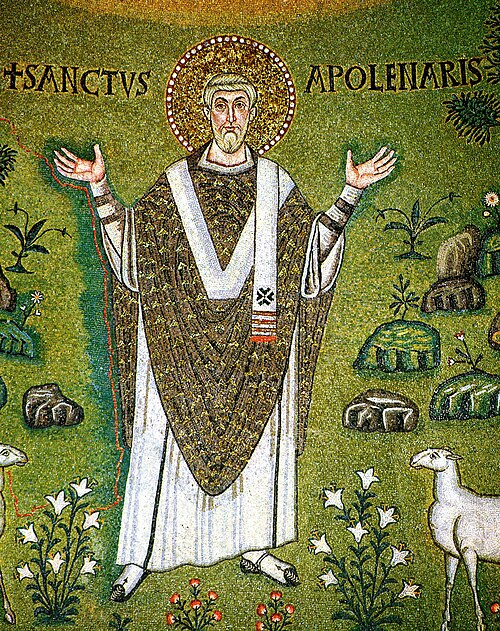
Hieromartyr
Apollinaris of Ravenna
Bishop of Ravenna
First bishop of Ravenna, of Syrian origin, killed for his faith in the early Christian centuries.
Life
The Holy Hieromartyr Apollinaris was, according to tradition, the first bishop of Ravenna, of Syrian origin. He is commemorated by the Orthodox Church on 23 July, and by the Catholic Church on 20 July (and on 23 July, in the Martyrology).
Life according to tradition
His native place is not known with certainty, but he was probably from Antioch of Syria. It is not certain that he was one of the seventy-two disciples of the Lord, but he was apparently a disciple of Saint Peter, who is said to have ordained him and sent him as first bishop of Ravenna, in the time of the emperor Claudius. According to his Life, Apollinaris came to the city as a stranger and was lodged by the soldier Irenaeus, whose blind son he healed; then, healing also the wife of a tribune, he made a church in his house, serving and baptizing citizens. In the first twelve years he ordained for the Church of Ravenna two presbyters and deacons and six other clergy. When the community grew, Apollinaris was brought before the governor Saturninus, who, with the priests of the Capitol of Ravenna, wished to force him to bow to a statue of Zeus. Because he refused, he was savagely beaten, bound by the feet, dragged out of the city and left on the seashore as dead; the disciples took him and hid him in the house of a believing widow.
He continued to preach and was persecuted several times by pagans. The faithful built a small church on the shore, where he served and baptized. He was expelled twice, preached in Emilia, returned to Ravenna, was seized again, beaten, tortured, put in chains in a dungeon and, after four days, put aboard a ship for Greece, where he preached in the same way, worked miracles and suffered; when his very presence made the oracles fall silent, he was savagely beaten and sent back to Italy. According to the Serbian sources, the ship was wrecked in a storm and only Apollinaris was saved, with two soldiers, who were baptized, and three clergy; then he preached in the Balkans, down to the Danube, and in Thrace. After three years he was sent back to Italy and returned, the fourth time, to Ravenna, to the joy of the faithful.
In the time of Vespasian the pagans wrote to the emperor, accusing him of magic; the emperor answered that he should not be killed but asked to sacrifice, or be driven from the city. But at the city gates, probably at Classis, he was attacked and beaten savagely, and lived seven days more, foretelling that persecution would increase, but the Church would triumph. He died after over twenty-eight years of shepherding, around the year 75 (other scholars place him later, under Septimius Severus).
Veneration and relics
His Life was written around the middle of the seventh century, probably by Bishop Maurus of Ravenna, to show the early origin of his see. Veneration spread from Ravenna: popes Symmachus and Honorius I supported it in Rome, King Clovis dedicated a church to him near Dijon, and in Germany it came through monasteries. His relics were kept in the basilica of Sant’Apollinare in Classe, at the site of his martyrdom (consecrated in 549); in 856 they were moved to Sant’Apollinare Nuovo, because of pirates. Portions are at Remagen and Düsseldorf in Germany, at Dijon and at Reims. He is patron of Ravenna, Remagen and Düsseldorf. In icons he is shown in a white habit with a black cross, with a bishop’s staff and a club.
Commemorated the same day July 23
 Trophimus and TheophilusHoly MartyrsJul 23
- ThyrsusSaintJul 23
- Anna of LeucateVenerableJul 23
- Michael of VyaznikiVenerable · Chain-wearerJul 23
- BanbhnatSaintJul 23
- Caencomhrac of Inis EndaimhSaintJul 23
- CroinseachSaintJul 23
- FethchuSaintJul 23
- Fuillen of Ath an EichSaintJul 23
- LassarSaintJul 23
 Liborius of Le MansSaint · Bishop of Le MansJul 23
- Michael TroitskyHieromartyrJul 23