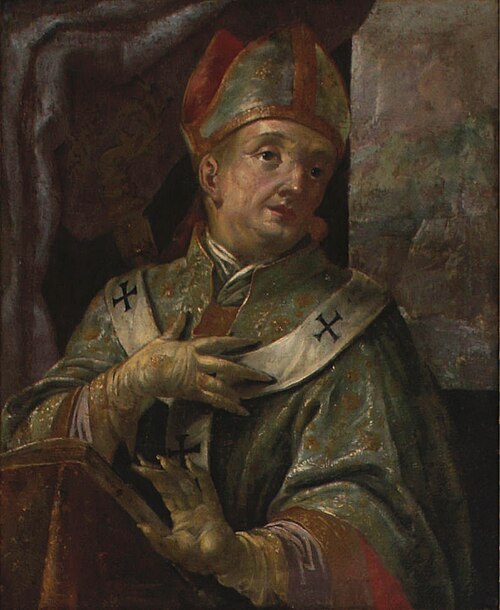
Saint
Arbeo of Freising
Bishop of Freising
Bishop of Freising from 764 and early medieval author, who died in 784.
- Reposed
- 7838th century
- Place
- Merano
- Order
- Hierarchs
Life
Arbeo of Freising was bishop of Freising from 764 until his death in 783 or 784, and an author of the early Middle Ages, often counted as the first named author in German. He is venerated as a saint in the Catholic Church on 4 May.
Early life
He was born in 723 or earlier, probably at Mais near Merano in South Tyrol, of the noble Bavarian Huosi family. He is thought to be the very child whom Saint Corbinian rescued from the floodwaters of the river Passer, according to the saint's own life. He was raised by Erembert, Corbinian's brother and bishop of Freising, became a Benedictine monk, studied for a long time in northern Italy and joined the clergy of Freising. From 754 he was archpriest and notary of the episcopal chancery under Bishop Joseph, who, with the support of the Bavarian dukes Odilo and Tassilo III, founded several monasteries. In 763 Arbeo became abbot of the newly founded monastery of Scharnitz in North Tyrol, and soon afterward, in 764 or 765, he succeeded Joseph in the see of Freising.
Bishop of Freising
As bishop he moved the relics of Saint Corbinian from the church of Saint Valentine at Mais to Freising and placed them in a tomb, the Sepulchrum Corbiniani, which he built in the church of the Mother of God between 765 and 768. Through many donations he increased the holdings and rights of the diocese and the influence of the bishop. He founded several monasteries: Schäftlarn, Innichen in the Pustertal (769) and Schliersee in Upper Bavaria (779). Innichen, built on land given by Duke Tassilo III when Arbeo was abbot of Scharnitz, later became the centre of missionary work among the Slavs of those parts, which intensified under his successor, Atto. About 770 he moved the monastery of Scharnitz to Schlehdorf. By 783 there were more than a dozen monasteries on the lands of Freising. He took part in Bavarian synods, at Dingolfing (about 770) and perhaps at Neuching (about 772). The support that some attribute to him for Charlemagne in the conflict with Duke Tassilo III is debated; what is certain is that under Arbeo Frankish political and church influence grew at Freising and relations with Tassilo worsened, and in 782 he yielded the see to the abbot of Schlehdorf, Atto. He died on 4 May and was buried in the cathedral of Freising.
The scholar
Under the influence of Bishop Virgil of Salzburg, Arbeo enlarged at Freising the monastic school, the scriptorium and the cathedral library, which he founded. From his school came figures such as Arn of Salzburg and Leidrad of Lyon. In 764-769 the Codex Abrogans was made under his direction, a glossary in Latin and Old High German, perhaps the first surviving book in German. He wrote the lives of two saints venerated in the region: Emmeram of Poitiers, honoured at Regensburg (the “Vita Haimhrammi”), and Corbinian, first bishop of Freising (the “Vita Corbiniani”), which preserves valuable information on early Bavarian history. After the life of Corbinian twenty frescoes were painted in the cathedral of Freising. The Catholic Church venerates him as a saint on 4 May.