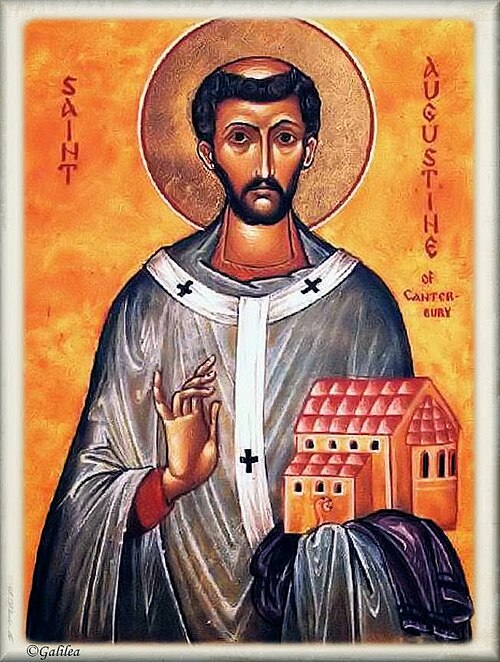
Saint
Augustine of Canterbury
First Archbishop of Canterbury
Monk sent by Pope Gregory the Great to preach to the Anglo-Saxons, archbishop from 597.
Life
Augustine of Canterbury was a monk of Rome, sent by Pope Gregory the Great to preach the Gospel to the Anglo-Saxons, and the first archbishop of Canterbury, from 597. He is called the Apostle of the English. He lived before the Great Schism of 1054, and so he is honoured as a saint of the undivided Church, in Orthodox calendars such as that of the Orthodox Church in America and in the Greek synaxarion. He is commemorated on 26 May.
Sent to Britain
Born at the beginning of the sixth century, according to tradition in Italy, Augustine was prior of the monastery of Saint Andrew in Rome, whose abbot was Gregory himself. According to the historian Bede, Gregory, still a deacon, had seen in Rome some fair-haired slave boys brought from the island of Britain and learned that they were Angles, still pagans. So he longed to Christianize them. Once pope, he chose Augustine in 595 to lead the mission, called the Gregorian mission.
With some forty companions, among them Laurence, his future successor, Augustine set out. Before reaching Britain the missionaries were seized by fear and halted. Augustine was sent back to Rome to ask leave to return, but Gregory refused and urged them by letter to persevere.
The mission in Kent
The missionaries landed in 597 on the island of Thanet, in the kingdom of Kent. King Ethelbert, whose wife Bertha was a Frankish Christian, received them kindly. At first he was in no hurry to give up the pagan faith, but he promised not to hinder them from preaching and to give them what they needed. At Canterbury he gave them the church of Saint Martin, built in Roman times, where the queen often prayed.
From this base the monks preached, baptized and served the Liturgy. The king soon received Baptism, with thousands of his subjects. Augustine was consecrated bishop at about the same time, according to Bede by the archbishop of Arles, though Orthodox sources name either Etherius or his successor, Saint Virgilius. In a letter of 598 Gregory says that more than ten thousand people had been baptized. A mass baptism took place at Christmas of 597.
Questions to Gregory
Augustine sent to Rome questions about the order of the new Church: its organization, baptism, marriage, Holy Communion and the celebration of the Liturgy. Gregory's replies, preserved in Bede under the name Libellus responsionum, were among the most cited writings of the age. In 601 the pope sent more missionaries, with letters of encouragement, sacred vessels, vestments, relics and books, and with the pallium, the sign of an archbishop.
Buildings at Canterbury
Augustine built Christ Church, the forerunner of today's cathedral, consecrated on 9 June 603 according to the Anglo-Saxon Chronicle. He also founded the monastery of Saints Peter and Paul, outside the city walls, later called Saint Augustine's Monastery, where the archbishops and the kings of Kent were to be buried. He helped the king draft the first Anglo-Saxon laws and founded a school.
In 604 he consecrated Mellitus as bishop of London and Justus as bishop of Rochester. Bede says that Augustine, with the king's help, recovered a church built by Roman Christians at Canterbury, but it is not clear whether he rebuilt it or only consecrated it afresh.
The disagreement with the Celtic Christians
Augustine could not bring into unity the Christian communities that followed Celtic customs, in Wales and Dumnonia. Differences arose over the date of Easter and the tonsure of clerics. In 603 he met some of their bishops. Before the meeting, they are said to have asked a holy hermit whether to accept him as leader, and the hermit answered: if he rises when he sees you, accept him; if he remains seated, he is arrogant and unfit to guide you. Augustine did not rise. The dispute remained unsettled, and the differences with the Celtic Church were resolved only at the Synod of Whitby, in 664. Orthodox sources note that Augustine was perhaps too insistent on conformity to Roman custom, but add that Celtic resentment of Rome's authority also played its part in the conflict.
Repose and relics
Known in his lifetime as a wonderworker, Augustine fell asleep in the Lord on 26 May 604, though some sources give 605. He was laid to rest at the entrance of the unfinished church of Saints Peter and Paul. When the church was dedicated, in 613, his relics were placed inside. An epitaph was carved on his tomb, saying that here lies the Lord Augustine, first archbishop of Canterbury, sent by blessed Gregory, who with the help of God and by miracles led King Ethelbert and his people from the worship of idols to faith in Christ.
The monastery where he rests is today in ruins. The story of his mission was written down by Saint Bede, commemorated on 27 May, in his Ecclesiastical History of the English People.
Commemorated the same day May 26
 EleutheriusSaint · Bishop of RomeMay 26
 Carpus of BeroeaApostle · Of BeroeaMay 26
 RegintrudSaintMay 26
- Zachary of VienneHieromartyr · Bishop of VienneMay 26
- John the PsychaiteConfessorMay 26
- Alexander of ThessalonikiNew MartyrMay 26
- AberciusMartyr · Son of the Apostle AlphaeusMay 26
- DamianSaint · Companion of FugatiusMay 26
- Eucaerius and Seventeen CompanionsHoly HieromartyrsMay 26
- ExuperantiusVenerableMay 26
- Felicissimus and CompanionsHoly MartyrsMay 26
- Fugatius and DamianHoly HierarchsMay 26