Righteous
Azor
Ancestor of the Lord
Ancestor of the Lord according to the flesh, son of Eliakim and father of Zadok in the Gospel of Matthew.
- Reposed
- 372 BC4th century BC
- Order
- The Righteous
Life
Holy Forefather Azor is mentioned in the Gospel of Matthew (1:13-14) as an ancestor of the Lord according to the flesh, son of Eliakim and father of Zadok, in the line of Zerubbabel. The Orthodox Church honours him among the holy forefathers of Christ, on the Sunday before the Nativity of the Lord. In the Old Testament scriptures his name does not appear.
In the Gospel
Matthew shows that Azor was the son of Eliakim and the father of Zadok, of the tribe of the patriarch Judah, and through this of the line of David. His name is found nowhere in the Old Testament as a descendant of Zerubbabel, nor is that of the son Abiud from whom he descends. It is thought that Abiud may be Obadiah, son of Arnan, in the first Book of Chronicles (3:21). Some biblical scholars consider Matthew's genealogy more theological or symbolic than historical and see in it a union of the priestly and royal lines of Israel in Jesus. Robert Gundry believes the name Azor may be a shortened form of Azariah, a name common in the priestly line of Levi, and that Zadok would be Zariah. Tradition puts the start of Zerubbabel's time in 539 BC and the death of Azor, the third generation after Zerubbabel, in 372 BC. The length of this span for four people makes scholars think that an exact list would have more generations, and in Luke's genealogy the names are more numerous. William Albright thought that names which repeated or resembled each other were at times merged.
Veneration
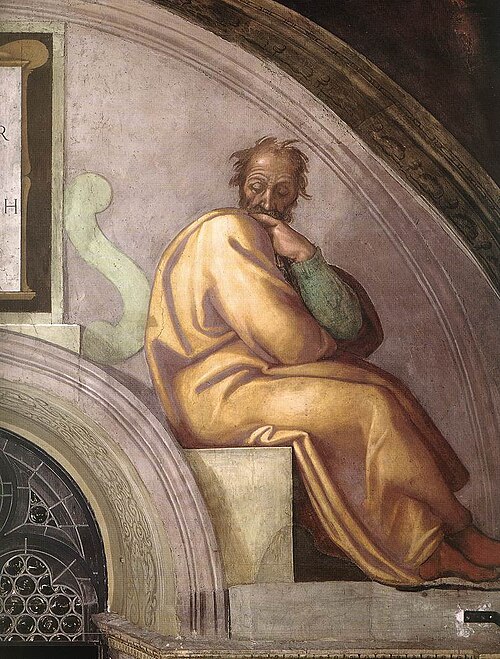
Azor is shown in many churches, in stained glass and lunettes, in the line of the ancestors of Jesus, from Abraham to David. One of the best known is Michelangelo's depiction of Azor and Zadok, in the Sistine Chapel. Our sources say he is held a saint by the Churches of the East and remembered on the Sunday of the Holy Fathers before Christmas, between 18 and 24 December, while a Greek source says the Sunday of the Holy Forefathers. A Book of Adam and Eve, which is not part of Scripture, says that Azor's wife was named Lebaidah, daughter of the high priest Jehoiada II. These accounts have no place in the teaching of the Church.