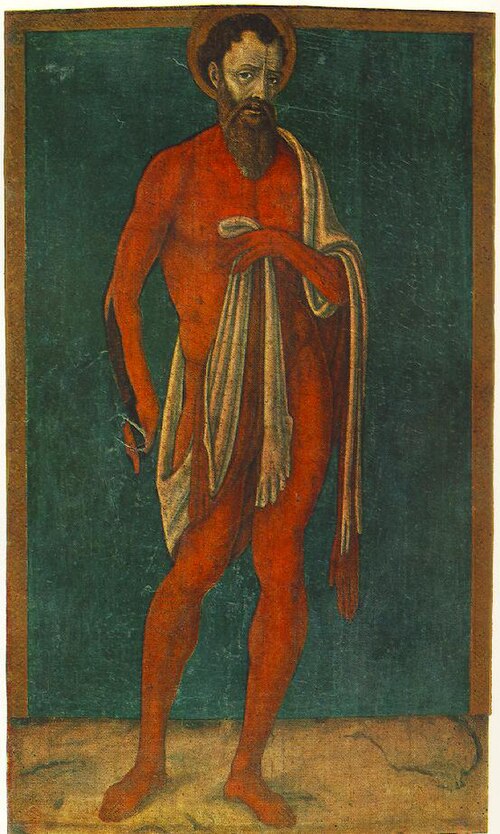
Apostle
Bartholomew
The Apostle
One of the Twelve, who preached the Gospel in Armenia and died a martyr.
Life
The holy Apostle Bartholomew was one of the twelve apostles of Christ. The tradition of the Church identifies him with Nathanael of Cana in Galilee, whom the Lord called "an Israelite indeed, in whom is no guile". He preached the Gospel in Asia Minor, in India and in Armenia, and ended his life as a martyr.
The call
The name Bartholomew means "son of Talmai" and appears in the lists of the apostles in the Gospels of Matthew, Mark and Luke beside Philip. For this reason tradition regards him as the Nathanael of the Gospel of John. Philip told Nathanael that they had found the One of whom Moses and the prophets wrote, Jesus of Nazareth. Nathanael doubted that anything good could come from Nazareth, but he came and saw. When the Lord told him that He had seen him under the fig tree before Philip called him, he confessed: "Rabbi, You are the Son of God, You are the King of Israel." After the Resurrection Nathanael was among the disciples fishing on the Sea of Tiberias when the Lord appeared to them.
Preaching the Gospel
The Orthodox synaxarion says that after Pentecost the lot fell to Bartholomew and Philip to preach in Syria and Asia Minor. With them travelled Philip's sister, the virgin Mariamne. They passed through many cities, were stoned and imprisoned. At Hierapolis they destroyed, by prayer, a huge viper worshipped by the pagans, and baptized the blind man Stachys after healing him of forty years of blindness. The prefect condemned them to death: Philip was crucified head downward and died, while Bartholomew was taken down in time. He made Stachys bishop of Hierapolis and went on.
The historian Eusebius of Caesarea and Saint Jerome testify that Bartholomew reached India, where he left the Gospel of Matthew. The Greek synaxarion likewise says he gave it to the Indians. Scholars still discuss where this "India" lay.
Armenia and martyrdom
According to the synaxarion, the apostle then came to Greater Armenia, where he healed the daughter of King Polymius of demons. The king wished to reward him, but the apostle refused the gifts, seeking only the salvation of souls. Polymius, his wife and his daughter were baptized, followed by people from more than ten cities. Through the plots of the pagan priests, the king's brother Astyages seized him in the city of Alban and crucified him head downward. The apostle went on preaching from the cross. At last, by Astyages's order, his skin was flayed and his head cut off. The Greek tradition names the place Albanopolis. Scholars note, however, that no Armenian king named Polymius is known and that other accounts give other names; the synaxarion keeps the names handed down by tradition.
Other accounts of his end exist, among them that he was thrown into the sea. The Armenian Church honours him, together with the holy Apostle Thaddeus, as one of its founders.
Relics
Believers laid the body in a leaden coffin. Around 508 the relics were moved to Dara in Mesopotamia. When the Persians took the city in 574, the Christians fled with them toward the Black Sea but had to abandon the coffin, and the pagans cast it into the sea. By the power of God it came to the island of Lipari. The OCA synaxarion says that after the Arabs took the island the relics were moved to Benevento, and in the tenth century a part reached Rome. Wikipedia gives the move to Benevento as 838 and the gift of a portion to Rome as 983, where it rests at San Bartolomeo all'Isola on the Tiber Island. A fragment of the skull is kept at Frankfurt am Main, in the cathedral that bears his name. Saint Joseph the Hymnographer received part of the relics and built a church in the apostle's honour near Constantinople.
Veneration
The Church celebrates him on 11 June with the Apostle Barnabas, on 25 August at the translation of his relics, and on 30 June in the Synaxis of the Twelve Apostles. The Coptic Church commemorates him on the first day of the month of Thout.
Commemorated the same day June 11
 BarnabasApostle · Apostle of the SeventyJun 11
 Martyrs of ChinaHoly New MartyrsJun 11
 Maximus of NaplesConfessor · Bishop of NaplesJun 11
- AgathaMartyrJun 11
- AgathaMartyrJun 11
- Agatha HoMartyrJun 11
- Agatha RuiMartyrJun 11
- AlexanderMartyrJun 11
- AlexandraMartyrJun 11
- AlexandraMartyrJun 11
- Alexandra LiMartyrJun 11
- Alexei Danilov Zhang FurongMartyrJun 11