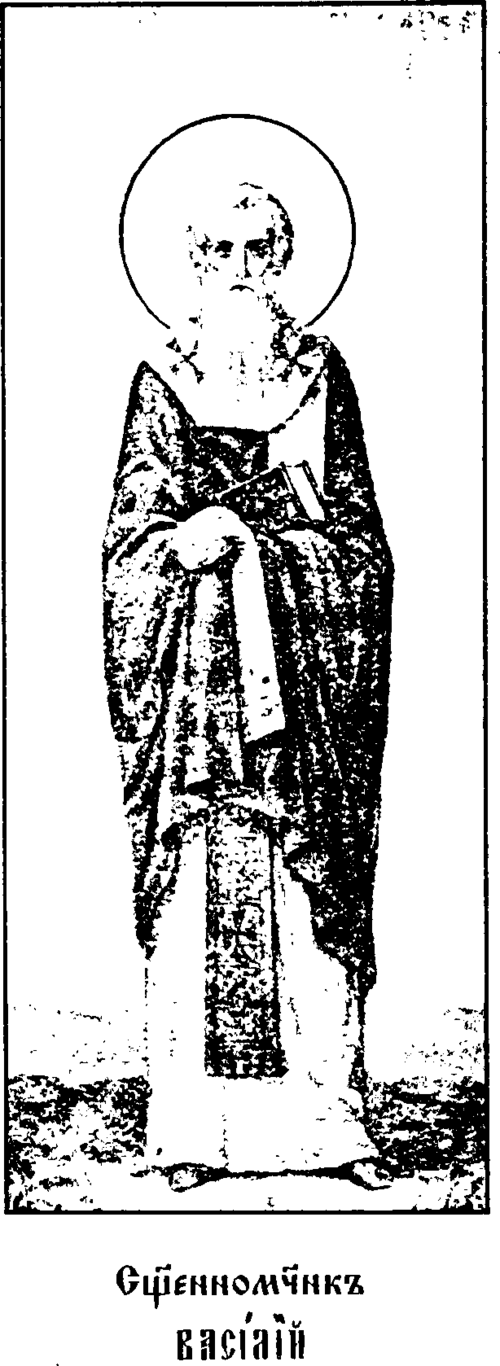
Hieromartyr
Basil of Amasea
Bishop of Amasea
Bishop of Amasea in Pontus, martyred under Licinius according to Eusebius's Chronicle in Jerome's version.
Life
Saint Basil was bishop of Amasea, a city in Pontus, in Asia Minor, at the beginning of the fourth century. He suffered for Christ under the emperor Licinius, around the year 322, and is commemorated in the Greek synaxaria on 26 April.
The shepherd of Amasea
The name of Basil of Amasea is found among the signatures of the bishops who attended the councils of Ancyra and Neocaesarea, about the year 314 and after. Saint Athanasius the Great mentions Basil of Pontus among the bishops of the early fourth century who held firmly that the Son is of one substance with the Father. The historian Philostorgius says he was at the Council of Nicaea, but the signature of Eutychianus appears there as bishop of Amasea, so this seems to be a mistake.
The persecution of Licinius
Eusebius of Caesarea relates that under Licinius Christians were treated with great cruelty, above all in Amasea and the other cities of Pontus, and that the governor inflicted the punishments of criminals on several bishops. The Chronicle of Eusebius, in the Latin version of Saint Jerome, says that Basil of Amasea died a martyr in the reign of Licinius.
The Serbian tradition adds the story of Glaphyra, a maiden in the empress's service, who fled the palace at Nicomedia to keep her purity and was warmly received by Bishop Basil in Amasea. Her letter to the empress fell into the hands of Licinius, who ordered both her and the bishop to be brought to Nicomedia. Glaphyra had died in the meantime, so the soldiers brought only Basil, bound.
After prison and torments the saint was beheaded and his body was cast into the sea. According to tradition, his clergy, guided by an angel, found his body near Sinope, drew it from the water with fishermen's nets and carried it to Amasea, where they buried it in the church he had built. The Ukrainian tradition adds that the relics gave off a sweet fragrance.
It should be said that the Acts of his martyrdom, supposedly written by an eyewitness, the presbyter John, are not considered authentic, and their narrative is legendary. The historical witness stops at his martyrdom under Licinius.
Commemoration
The Orthodox Church honours him on 26 April, the day on which the Roman Martyrology also remembers him. In Serbia his day is the slava of the cartwrights, among them those of the old Belgrade quarter of Palilula.
Commemorated the same day April 26
 AnacletusSaint · Bishop of RomeApr 26
 Stephen of PermSaint · Bishop of PermApr 26
- Glaphyra of AmaseaSaintApr 26
- The 6,000 Martyrs of GarejaHoly Venerable MartyrsApr 26
- Joanikije of DevičVenerableApr 26
- Anatolius the SinaiteVenerable · of Mount SinaiApr 26
- Becan of CluainSaintApr 26
- BidofyddSaintApr 26
- CalandionVenerableApr 26
- Cas of BenncharSaintApr 26
- Clarentius of VienneSaint · Bishop of VienneApr 26
- ConanSaintApr 26