
Venerable
Benedict Biscop
Founder of Wearmouth-Jarrow
Anglo-Saxon abbot, founder of Monkwearmouth-Jarrow and of its famous library, who died in 690.
- Feast
- January 12old style January 25
- Reposed
- 6907th century
- Place
- Monkwearmouth-Jarrow Abbey
- Order
- Venerables
Life
The Venerable Benedict Biscop was an Anglo-Saxon abbot of the seventh century, founder of the monasteries of Wearmouth and Jarrow in Northumbria and of their famous library. The Church remembers him as the one who brought to the British Isles the faith, learning and crafts of Rome and Gaul.
He was born around 628 to a noble Northumbrian family, with the name Baducing, and for a time served as a thegn of King Oswiu. At the age of twenty-five (about 653) he set out for Rome with his friend Wilfrid; Wilfrid was held up at Lyon, and Benedict reached the goal alone. He returned to England full of zeal for the good of the English Church. He made a second journey to Rome twelve years later, and on the way back stayed at Lérins, the island off the Provençal coast where the Rule of Saint Benedict was already followed. There, between 665 and 667, he learned monastic life, took monastic vows and the name Benedict.
A third journey to Rome brought him to Pope Vitalian, who in 669 entrusted him with accompanying the new archbishop, Theodore of Tarsus, to Canterbury. Theodore made him abbot of the monastery of Saints Peter and Paul at Canterbury, where he remained for two years.
In 674 King Ecgfrith granted him land for a monastery. Benedict went to the Continent to bring masons in the pre-Romanesque style and, later, glaziers. On his fifth and last journey to Rome, in 679, he brought books for a library, relics, craftsmen and a privilege from Pope Agatho for the monastery. He also engaged Abbot John, arch-cantor of Saint Peter's in Rome, to teach the monks Roman chant. The king was so pleased with the fruit of the monastery of Saint Peter at Wearmouth that in 682 he gave him land at Jarrow, where Benedict raised a second monastery, Saint Paul, with Ceolfrid as abbot, who left Wearmouth with twenty monks. For his community he drew up a rule based on that of Saint Benedict and on the customs of the seventeen monasteries he had seen. His pupil Bede tells that he built them in stone, a novelty in Britain, and that glass was a novelty in seventh-century England.
The library, gathered on his travels (about 250 titles, including scripture, church writings, classical and secular works), grew in time into one of the largest of the age; here the Venerable Bede wrote his works, and the manuscripts copied there were prized all across Europe, among them the Codex Amiatinus, the oldest surviving complete Latin Bible.
For the last three years of his life he was bedridden, bearing his illness with faith. He fell asleep on 12 January 690. A homily of Bede shows that he was honoured very early; his cult spread more widely after the translation of his relics to Thorney. He is venerated by the Catholic Church, the Church of England and the Orthodox Church, and is commemorated on 12 January.
Commemorated the same day January 12
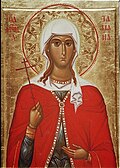 Tatiana of RomeMartyrJan 12
- Caesaria the ElderVenerable · Abbess at ArlesJan 12
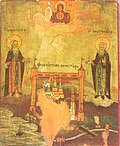 Martinian of BelozerskVenerable · Abbot of Ferapontov MonasteryJan 12
- Barses of EdessaSaint · Bishop of EdessaJan 12
- Eutropius and TigriusHoly MartyrsJan 12
 Anna Makkavaiou of Asia MinorVenerable · Nun in DramaJan 12
- Galaktion of BeloozeroFool-for-Christ · Fool for ChristJan 12
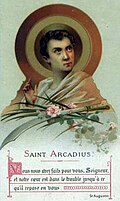 Arcadius of MauretaniaMartyrJan 12
- AthanasiusConfessorJan 12
- Baoithin son of NeamhnannSaintJan 12
- Conan of Ae'gSaintJan 12
- Cuimmein of Drum DruithSaintJan 12