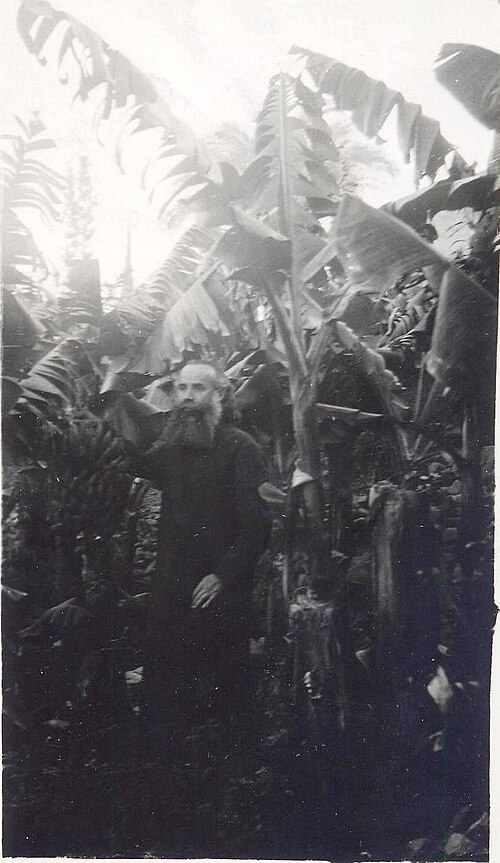
Hieromartyr
Boris of Nevrokop
Metropolitan of Nevrokop
Metropolitan of Nevrokop of the Bulgarian Church, born in 1888, who died in 1948 in the village of Kolarovo.
- Reposed
- 194820th century
- Place
- Kolarovo
- Order
- Martyrs
Life
Holy Hieromartyr Boris of Nevrokop was a hierarch of the Bulgarian Orthodox Church, born in 1888 and killed in 1948. He was Metropolitan of Nevrokop from 1935 to 1948, a deeply learned pastor who built dozens of churches and spoke thirteen languages.
After the Communists came to power he fearlessly opposed the persecution of the Church. On 8 November 1948 he was killed in the village of Kolarovo, and Metropolitan Michael of Dorostol called him "the conscience of the Bulgarian Church".
Early life and studies
Vangel Simov Razumov was born on 26 October 1888 (8 November in the new calendar) in the village of Gyavato near Bitola, then in the Ottoman Empire and now in North Macedonia. His parents were devout people.
His father, Simeon, died in 1903 in the Ilinden uprising, fighting in the band of Georgi Sugarev, and his native village was burned. Even so, Vangel continued his schooling in Gyavato and Constantinople, and in 1904 he completed the third class of the Bulgarian gymnasium in Adrianople.
From the autumn of that year, with a scholarship from Exarch Joseph I, he studied at the Bulgarian Theological Seminary in Constantinople, graduating in 1910.
Monk and scholar
On 10 July 1910, in the Church of Saint Stephen in Constantinople, Metropolitan Hilarion of Nevrokop tonsured him a monk with the name Boris, in honour of Saint Boris, the prince who baptised the Bulgarian people. On the same day he ordained him hierodeacon, and for a year Boris served in the chapel of the Exarchate.
In 1911 he went on to the Faculty of Theology at the University of Czernowitz (Chernivtsi), then in Austria-Hungary, graduating in 1914 (other sources say 1915). Besides Bulgarian, he knew Church Slavonic, Russian, Greek, German, French, Italian, English, Turkish, Romanian and Hungarian.
From the autumn of 1914 to the summer of 1915 he taught at the priests' school at Bachkovo and at the Plovdiv seminary. He then studied philosophy at the universities of Vienna and Budapest and received the degree of Doctor of Theology from Czernowitz.
Priest in Budapest
On 25 November 1917 he was ordained hieromonk by Metropolitan Maxim of Plovdiv. The Holy Synod then sent him to Hungary, where until 1922 he led the Bulgarian church community in Budapest.
Service in Sofia
After his return to Bulgaria, on 22 July 1922 he was raised to archimandrite by Metropolitan Stefan of Sofia. From May 1923 to September 1924 he was protosyngellos of the Metropolis of Sofia.
From 1924 he headed the cultural and educational department of the Holy Synod, and from 1925 he was also rector of the Saint Alexander Nevsky Cathedral. In 1926 he was appointed rector of the Sofia Theological Seminary.
The young rector restored the seminary buildings, which had been damaged in the years when the school was taken from the Church, and introduced strict order and discipline. In 1931 he gave the seminary 5,000 leva for a prize to the graduate with the best results, exemplary conduct and Christian life.
Bishop of Stobi
On 14 December 1930, in the Saint Alexander Nevsky Cathedral, Archimandrite Boris was consecrated titular Bishop of Stobi. He remained rector until November 1931, and on 31 May 1931 he laid the foundation stone of the Church of Saints Cyril and Methodius in Budapest.
From November 1931 to February 1935 he was chief secretary of the Holy Synod. In 1932 he was entrusted with a mission to Jerusalem for the negotiations to lift the schism declared by the Patriarchate of Constantinople against the Bulgarian Church. The talks, begun on 12 April, were finally concluded only on 22 February 1945.
Metropolitan of Nevrokop
On 17 February 1935 Bishop Boris was elected Metropolitan of Nevrokop and was canonically confirmed on 24 February. With his wide learning he carried on a rich spiritual and educational work in his diocese.
For easier administration he moved the seat of the diocese from Nevrokop to Gorna Dzhumaya (now Blagoevgrad). He founded many Orthodox youth societies and in a short time built more than twenty churches.
He wrote handbooks on education and composed an akathist to Saint John of Rila. During the war, from 1941, he also had temporary charge of the diocese of Drama, restored by the Bulgarian Exarchate in the territories annexed by Bulgaria.
Confessor before Communism
After the coup of 9 September 1944 Metropolitan Boris stood firmly against atheist Communist ideology. He spoke often of the terror against the clergy in the Soviet Union and wrote an article titled "Martyrdom" after the bombing of the Sveta Nedelya Cathedral in Sofia.
He also resisted the new authorities' attempts to impose a Macedonian national identity on the faithful of his diocese, whom he regarded as Bulgarian. He fought for the return of confiscated church property and for religious teaching in schools, reprinting his 1928 pamphlet "The Crisis in Our School", which argued that the school instructs but does not form character.
On 29 September 1948 he sent the Holy Synod a letter of protest against the abuses of the Communist authorities in his diocese. The regional committee of the Communist Party declared him "enemy number one of the people's power", and the party's official newspaper attacked him in an article calling him an unworthy servant of the Church. He was subjected to constant harassment and threats of violence.
Martyric death
On 8 November 1948, after serving the Divine Liturgy for the consecration of the Church of Saint Demetrius in the village of Kolarovo near Petrich, Metropolitan Boris was killed by Iliya Stamenov, a defrocked priest from the village of Harsovo. The sources state that the killer was an agent of the Communist authorities.
The murder was part of the regime's growing pressure on the Bulgarian Church and was meant to intimidate the other bishops. At his funeral Metropolitan Michael of Dorostol and Cherven called Metropolitan Boris the conscience of the Bulgarian Church.
Veneration
Metropolitan Boris was buried in the Church of the Entry of the Mother of God into the Temple in Gorna Dzhumaya, now Blagoevgrad.
On 31 March 2016, at the request of Metropolitan Seraphim of Nevrokop and ahead of the seventieth anniversary of his death, the Holy Synod of the Bulgarian Orthodox Church blessed the start of the inquiry for his canonisation. On 10 November 2018 the Bulgarian Old Calendar Orthodox Church glorified him as a hieromartyr in the Cathedral of the Dormition of the Mother of God.