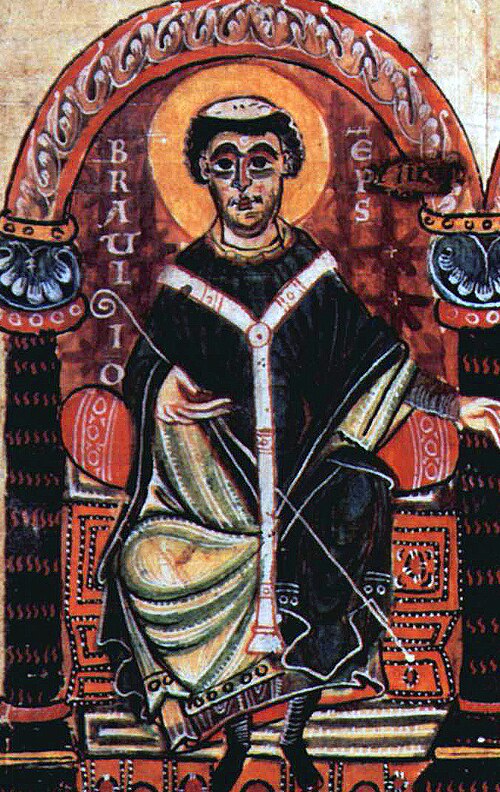
Saint
Braulio of Zaragoza
Bishop of Zaragoza
Bishop of Zaragoza and learned cleric in the Visigothic kingdom, who died in 651.
Life
Saint Braulio was bishop of Zaragoza in the Visigothic kingdom of Spain and one of the most learned clerics of his day. As pastor and as writer, the Church remembers him among the finest figures of the Visigothic kingdom of the fifth to eighth centuries. He fell asleep in 651.
He was born around 585-590 to a noble Hispano-Roman family. His father, Gregory, was bishop of Osma; his sister and two brothers also held important places in the Church. Under the guidance of his older brother John, elected bishop of Zaragoza in 619, he received his first schooling, and then went to Seville, to the monastic school founded by Saint Isidore. In 610 he took the monastic habit. He was ordained by Isidore in 624 and served in Seville. In 626 he returned to Zaragoza and was archdeacon to his brother; after his brother's death, in 631, he was elected bishop in his place.
He was known for the austerity of his life, for almsgiving and preaching, and was adviser to several Visigothic kings, among them Chindasuinth, on whose advice the king's son Recceswinth was made associate king. He worked with Isidore to bring the Visigoths from Arianism. It is said that he urged Isidore on in his great work, the Etymologies, which Isidore sent him for correction; Braulio divided it into its twenty books and added a life of Isidore and a list of his writings. He took part in the councils of Toledo in 633, 636 and 638, and on behalf of the whole Iberian clergy he answered Pope Honorius I, who had accused them of neglecting their pastoral duties. A particular concern was that some baptised Jews had returned to their former faith.
His surviving works include the life of Saint Emilian of Cogolla (written between 639 and 640, at his brother's request) and a hymn in his honour, forty-four letters, discovered in the eighteenth century at León (addressed to Isidore, Taio, Fructuosus of Braga, the pope, and the kings Chindasuinth and Recceswinth), and some scholars also attribute to him the Acts of the Martyrs of Zaragoza. Toward the end of his life he lost his sight. He was buried where the church of Nuestra Señora del Pilar now stands (the tomb was found in 1290); his pupil Taio succeeded him. He is patron of Aragon and of the University of Zaragoza. His memory is kept on 26 March.
Commemorated the same day March 26
 CastulusMartyrMar 26
 Basil the YoungerVenerable · Visionary of ConstantinopleMar 26
 Emmanuel of SirmiumMartyrMar 26
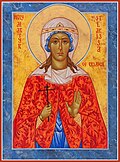 LarissaMartyr · Gothic martyr of CrimeaMar 26
 Malchus of SyriaVenerableMar 26
- AbippusSaintMar 26
- Alla of GothiaMartyrMar 26
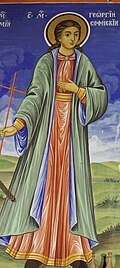 George the Elder of SofiaNew Martyr · New Martyr of SofiaMar 26
- 26 Martyrs in the CrimeaHoly MartyrsMar 26
- Abibas of GothiaMartyrMar 26
- Abraham of LatrosVenerableMar 26
- Agathon of GothiaMartyrMar 26