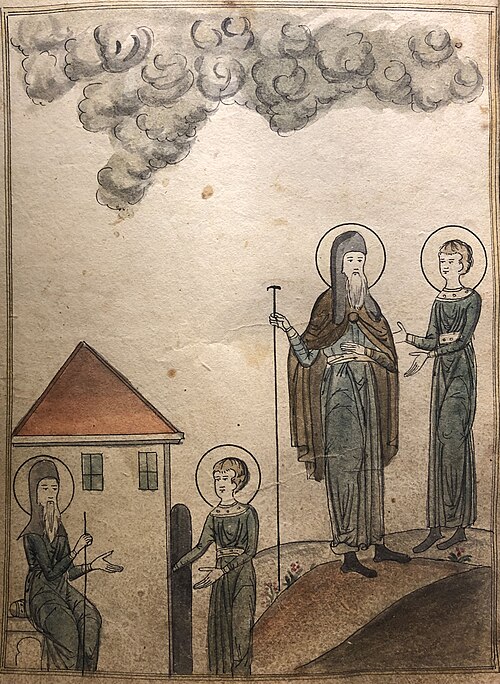
Venerable
Basil the Younger
Visionary of Constantinople
Byzantine holy man and visionary of the 10th century, whose life was written by his pupil Gregory.
- Feast
- March 26old style April 8
- Reposed
- 95210th century
- Place
- Constantinople
- Order
- Venerables
Life
Saint Basil the Younger was an ascetic and visionary of Constantinople in the first half of the tenth century, renowned for his austerity, his healings and his gift of foresight. He is called “the Younger” to distinguish him from earlier ascetics of the same name. His life, written by his disciple Gregory, contains the famous account of the aerial toll-houses through which the soul of his servant Theodora passed and Gregory's vision of the Last Judgement, which deeply influenced Orthodox piety and iconography. He is commemorated on 26 March.
The hermit taken for a spy
In his youth Basil lived as a hermit in a frontier region of Asia Minor, feeding on herbs. Envoys of Emperor Leo VI saw him as they passed, overgrown with hair and dressed in rags, and took him for a spy. Around 896 he was brought to Constantinople, and the emperor sent him to be questioned by his confidant Samonas. Asked who he was, the saint replied only that he was a stranger and a sojourner on earth.
He was tortured but kept silent at every question. When Samonas called him impious, Basil answered that the impious were those who, like Samonas, spent their lives in every kind of impurity. Rebuked in public, Samonas ordered him to be hung head downward with his hands and feet bound behind him. The torture was so cruel that the onlookers began to murmur against Samonas. When he was taken down after three days, Basil was alive and unharmed. Samonas ascribed the miracle to sorcery and threw him to a hungry lion, but the lion did not touch him and lay down peacefully at his feet. He was then thrown into the sea, but two dolphins caught him and carried him ashore at the Hebdomon, near Constantinople.
The seer of Constantinople
Basil entered the city and near the Golden Gate met a man named John who was sick with fever, whom he healed in the name of the Saviour. At John's request he settled in the house of John and his wife Helena, a poor couple. After their deaths he lived in the house of Constantine Barbaros in the Arkadianai quarter, where he spent most of his life, apart from a week in the Great Palace and a short stay with the brothers Anastasios and Constantine Gongylios, from Paphlagonia, near the harbour of Eleutherios.
News of his life and miracles spread, and the sick and those thirsting for guidance came to him. He had the gift of foresight: he rebuked sinners, bringing them to repentance, and foretold what was to come. Many officials and even members of the imperial family came to him for counsel. In the Great Palace he rebuked Emperor Romanos I Lekapenos for greed and lust, and the emperor, indulgent towards monks, took no offence. He persuaded a certain Kosmas, who aspired to the imperial throne, to give up worldly cares and become a hermit near Nicomedia.
The life says that he foretold the revolt of Constantine Doukas in 913, the birth of the future Emperor Romanos II and the attack of the Rus' fleet on Constantinople in 941, four months in advance. The plot of Romanos Saronites, son-in-law of Romanos I, was also revealed to him; he tried to dissuade him but was treated cruelly.
The disciple Gregory
Among those who visited him was Gregory, who became his disciple and later wrote a detailed life of his teacher. Many scholars consider him a layman with an estate near Rhaidestos in Thrace, though the text rather suggests that the land belonged to his master; some copies call him a monk.
The life tells how once at an inn Gregory found a costly belt lost by the innkeeper's daughter and kept it, intending to sell it and give the money to the poor. On the way home he lost it along with other things. In a dream Basil showed him a broken pot and taught him that whoever steals even so worthless a thing will be punished fourfold, and that he who hid another's belt would be judged as a thief, so he must return what he had found.
The toll-houses of Saint Theodora
When Theodora, the old woman who had served Basil, died, Gregory wished to know what had become of her soul and often begged the saint to reveal it to him. Through Basil's prayers Gregory saw Theodora in a dream, and she told him how her soul had passed after death through the aerial toll-houses and how Basil's prayers had helped her.
The vision begins in Basil's house, where Theodora was dying, surrounded by demons holding records of all her sins. When her soul left her body, two angels weighed her good deeds against her sins, until Basil came and laid down a bag full of gold, his prayers, to cover the debt of her sins. Then the angels rose with her through the air, passing through twenty or twenty-one toll-houses, each guarded by demons and devoted to a particular sin. From the fifth toll-house her good deeds no longer sufficed, and she passed only by Basil's gold. The angels told her that at baptism every person receives a guardian angel who records his good deeds, and that sins can be blotted out, while we live, only through confession and repentance; the most dangerous toll-house is that of fornication. Theodora passed all the toll-houses, entered heaven and beheld God. The Church honours her as Saint Theodora of Constantinople.
The vision of the Judgement
The life also relates that Gregory was tempted by the thought that the Jewish people had remained God's chosen. He confessed his doubt to his spiritual father, who rebuked him sharply, showing him that those who rejected and crucified the Son sent by the Father had turned away from God. Gregory asked for a sign to strengthen him and received a vision of the resurrection of the dead and the Last Judgement, which by its themes and images has been compared with the Apocalypse. This part influenced Old Russian literature and the iconography of the Last Judgement.
Repose
Basil reposed in deep old age on 26 March, during Lent, in 944 or 952. The life says that he was buried by Constantine Barbaros in a church of the Mother of God on the Asian shore of the strait; according to other sources he was buried in the monastery of the Chartophylax, near the monastery of Saints Florus and Laurus. The Russian pilgrim Anthony of Novgorod wrote around 1200 that his relics were at Chrysopolis, adding that this saint had written about the Last Judgement.
The life and its scholars
The life was probably composed between 956 and 959 and survives in 24 manuscripts from the twelfth to the nineteenth century, the fullest being the sixteenth-century manuscript in the Synodal Library in Moscow; a critical edition appeared only in 2014. In the fourteenth century it was translated into Middle Bulgarian by a Father Peter, a translation discovered in 1975 at Saint Catherine's Monastery on Sinai. Of the nearly three hundred printed pages of the Moscow version, 38 concern Theodora's toll-houses and 162 the vision of the Judgement.
The life reflects many events in Byzantium in the first half of the tenth century: the revolt of Constantine Doukas in 913, the death of Emperor Christopher Lekapenos, the Hungarian invasion of the Balkans and the attack of the Rus' fleet in 941. Some chronological inconsistencies, such as the fact that Samonas became parakoimomenos only in 907, have led some scholars to doubt the historicity of the account; others think that the author used Basil's life above all to speak about the mysteries of the life to come.
From the second half of the seventeenth century the Life of Basil the Younger found a second life among the Old Believers, who awaited the end of the world; in the seventeenth to nineteenth centuries hundreds of copies were made, many illustrated with dozens or even more than a hundred miniatures.
The saint's image
The painter's manual of Dionysius of Fourna describes him with a curly greying beard. Later Russian manuals show him as an old man, his face pale and dry from long fasting, his hair tangled and grey, his beard short, barefoot, in a single garment, with a lion beside him, with the look of a man raised in the desert. An iconographic guide of 1910 proposed that he be painted holding a scroll with his sayings. In Russian Menaion cycles his image rarely appears, because his commemoration on 26 March falls on the Synaxis of the Archangel Gabriel, which takes precedence.
The Church commemorates Saint Basil the Younger on 26 March (8 April in the New Style).
Commemorated the same day March 26
 Braulio of ZaragozaSaint · Bishop of ZaragozaMar 26
 CastulusMartyrMar 26
 Emmanuel of SirmiumMartyrMar 26
 LarissaMartyr · Gothic martyr of CrimeaMar 26
 Malchus of SyriaVenerableMar 26
- AbippusSaintMar 26
- Alla of GothiaMartyrMar 26
 George the Elder of SofiaNew Martyr · New Martyr of SofiaMar 26
- 26 Martyrs in the CrimeaHoly MartyrsMar 26
- Abibas of GothiaMartyrMar 26
- Abraham of LatrosVenerableMar 26
- Agathon of GothiaMartyrMar 26