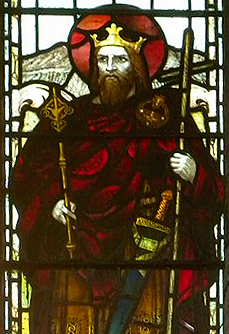
Right-Believing
Brychan of Brycheiniog
King of Brycheiniog
Legendary king of Brycheiniog in mid Wales in the fifth century.
- Feast
- April 6old style April 19
- Reposed
- 4805th century
- Place
- Talgarth
Life
Brychan of Brycheiniog was a legendary fifth-century king of the kingdom of Brycheiniog (Brecknockshire) in the heart of Wales, regarded as the patriarch of great families of saints. Tradition remembers him on 6 April.
According to Celtic hagiography, he was born in Ireland, the son of Prince Anlach and Marchell, heiress of the Welsh kingdom of Garthmadrun. When his father died, Brychan returned there and changed the name of the land to Brycheiniog. The name Brychan is the Welsh form of the Irish name Broccán, and in some sources it is written Brocanus, Braccan, Brachan, Brecin or Breccan. His mother's line is traced to an "Annun the Black, king of the Greeks", a link that the Welsh sources do not explain. His education was entrusted to a certain Drichan.
In the Life of Saint Cadoc written by Lifris around 1100, Brychan fights Arthur, Cai and Bedwyr because King Gwynllyw of Gwynllwg had abducted his daughter, Saint Gwladys, from his court at Talgarth.
He is said to have been married three times, to Prawst, Banhadlwedd and Gwladys, and to have had a very large family. The number of his children varies in the sources between twelve and sixty-three, the most common being twenty-four. There are two main lists, one Welsh and one Cornish, which do not agree. Most of the children seem to have travelled from Brecon to evangelise Cornwall and north Devon, where they are venerated today. Among them are Saints Cynog, Dwynwen, Keyne, Nectan, Morwenna, Mabyn and Tydfil. The number seems to have grown over time, as more and more people wished to claim descent from one of the "Holy Families of Britain".
The traditional literature does not call him a saint but a patriarch, and no church bears his name. A fifteenth-century stained glass window in the church at St Neot in Cornwall is said to show a crowned king with eleven children in his arms, but a modern guide describes it as "God with souls in his lap".
Commemorated the same day April 6
 MethodiusEqual-to-the-Apostles · Apostle to the SlavsApr 6
 Eutychius of ConstantinopleSaint · Patriarch of ConstantinopleApr 6
 Sebastian of KaragandaVenerable · ArchimandriteApr 6
 Aphonius of NovgorodSaint · Metropolitan of NovgorodApr 6
- Jacob BoykovHieromartyr · PriestApr 6
- John BoykovHieromartyr · PriestApr 6
- 120 Martyrs of PersiaHoly MartyrsApr 6
- AedhechSaintApr 6
- Aelfstan of RamsburySaint · Bishop of RamsburyApr 6
- Amandus of GhisalbaMartyr · Martyr of GhisalbaApr 6
- Archilius of RomeMartyrApr 6
- BerchanVenerableApr 6