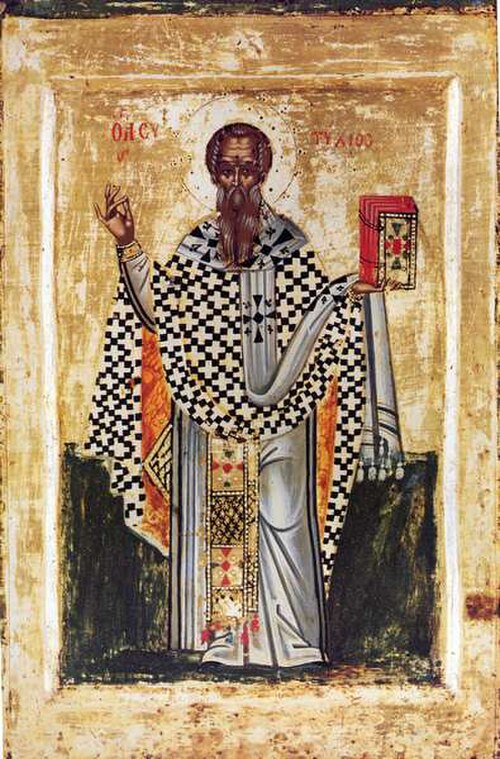
Saint
Eutychius of Constantinople
Patriarch of Constantinople
Patriarch of Constantinople from 552 to 565 and again from 577 to 582, who died in 582.
Life
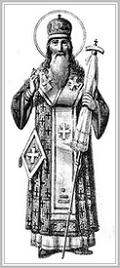
Saint Eutychius, hierarch, was patriarch of Constantinople from 552 to 565 and again from 577 to 582. His patriarchate, in the time of the emperor Justinian, was marked by disputes with both the imperial and the papal power. He fell asleep in 582. He is commemorated on 6 April.
Youth
His life is well known, because a full biography was written by his chaplain, Eustathius, and has come down to us intact. He was born around 512 in a village of Phrygia, called Theium, the son of Alexander, a general in the army of the renowned commander Belisarius, and of Synesia. He received his first teaching and upbringing from his grandfather on his mother’s side, the priest Hesychius, then, at twelve, was sent to Constantinople to learn further. The Serbs relate that, in a game with children of his age, each wrote on a stone his name and the rank he would have in life, and Eutychius wrote: “Eutychius patriarch.” He made progress in the sciences, but then decided to give his life to monasticism. He withdrew to one of the monasteries of Amasea and was tonsured a monk at thirty, and for his austere life was made archimandrite of the monasteries of Amasea.
First patriarchate
In 552, the metropolitan of Amasea being ill, he sent Eutychius in his place to Constantinople, for the preparations of the Fifth Ecumenical Council. According to tradition, seeing the young archimandrite, the aged Patriarch Menas prophesied that he would be patriarch after him. When Theodore of Mopsuestia, Ibas of Edessa and Theodoret of Cyrus, regarded as orthodox but close in some respects to Nestorius, were discussed before the emperor, Eutychius said that even a dead man may be condemned, giving as example King Josiah, who had the bones of idol-worshippers dug up and burned. Menas died in 552 and, on the same day, according to the saint’s life, the apostle Peter appeared to the emperor Justinian in a vision, pointing to Eutychius, and said that he be made bishop. He was set on the throne in 552.
The Fifth Ecumenical Council
Pope Vigilius was at Constantinople when Eutychius became patriarch. Eutychius sent him word of his appointment and a fully orthodox confession of faith, and the pope urged him to gather and preside over the council that was to judge the Three Chapters controversy. Vigilius first gave, then withdrew his consent. In spite of the pope’s refusal, the council met on 5 May 553 at Constantinople, and Eutychius stood at the head of the assembly, with Apollinarius of Alexandria and Domnus of Antioch. At the second session the pope excused himself again, on the ground of illness. Eutychius’ subscription to the decisions of the council, which ended on 2 June 553, is a summary of the decrees against the Three Chapters; the council was later recognized as the Second Council of Constantinople. Later Vigilius too accepted the decision. Eutychius composed the decree of the council. In 562 or 563 he reconsecrated the church of Hagia Sophia, after the damage of the earthquake of 558.
Arrest and exile
But in 564 Eutychius clashed with Justinian, who had adopted the belief of the Aphthartodocetae, whose teaching was that Christ’s body was incorruptible and subject to no pain. Eutychius showed in a long address that this does not agree with Scripture, but the emperor insisted that he subscribe. Not accepting a compromise, he was ordered arrested. On 22 January 565, while he was celebrating the feast of Saint Timothy, soldiers entered the patriarchal residence and the church beside it and took him away. He was taken to a monastery, then to Saint Osias, near Chalcedon. The charges brought against him were trivial: that he used ointments, ate “delicate meats” and prayed long. Summoned three times, he answered that he would come only if he were judged canonically. He was condemned in absence and sent to the island of Prinkipo, then to his monastery at Amasea, where he stayed twelve years and five months. It is said, by the belief of Christians, that there he worked miracles, healing the sick by prayer and anointing with oil.
His return
After the death of John Scholasticus, whom Justinian had set on the throne, the people of the city demanded Eutychius’ return. In October 577 the emperors Justin II and Tiberius sent a delegation to Amasea. It is told that, as he entered the city, the crowd met him with cries of “Blessed is he who comes in the name of the Lord” and “Glory to God in the highest”. As at the entrance of the Lord into Jerusalem, he entered on an ass’s colt, over garments spread on the ground, the crowd carrying palms. The next day he was honoured by the two emperors at the church of the Mother of God at Blachernae, then went up to Hagia Sophia and blessed the people; he distributed Holy Communion for six hours, because all wished to receive it from his hand. It seems that in this second patriarchate he introduced into the Liturgy the hymn “Of Thy mystical supper”.
His end
Towards the end of his life he held the opinion that after the resurrection bodies will be subtle and lighter than air. The future Pope Gregory the Great, then the pope’s envoy at Constantinople, opposed this view, and the emperor Tiberius mediated; as it is told, Eutychius, on his deathbed, took hold of the skin of his hand and confessed that we shall rise in this flesh. He fell asleep on 5 April 582, at about seventy.
Commemorated the same day April 6
 MethodiusEqual-to-the-Apostles · Apostle to the SlavsApr 6
 Brychan of BrycheiniogRight-Believing · King of BrycheiniogApr 6
 Sebastian of KaragandaVenerable · ArchimandriteApr 6
 Aphonius of NovgorodSaint · Metropolitan of NovgorodApr 6
- Jacob BoykovHieromartyr · PriestApr 6
- John BoykovHieromartyr · PriestApr 6
- 120 Martyrs of PersiaHoly MartyrsApr 6
- AedhechSaintApr 6
- Aelfstan of RamsburySaint · Bishop of RamsburyApr 6
- Amandus of GhisalbaMartyr · Martyr of GhisalbaApr 6
- Archilius of RomeMartyrApr 6
- BerchanVenerableApr 6