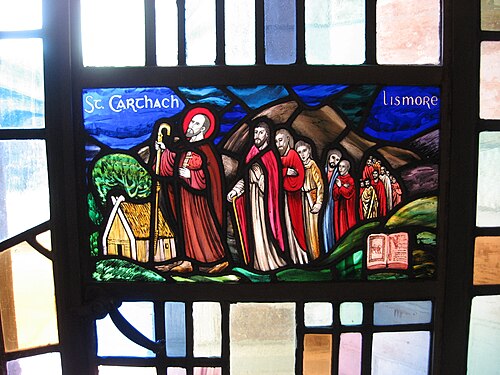
Venerable
Carthach the Younger
Abbot of Lismore
An Irish abbot also called Mochuda, founder of the monastery of Lismore, who reposed in 638.
- Feast
- May 14old style May 27
- Reposed
- 6387th century
- Order
- Venerables
Life
Saint Carthach the Younger, also called Mochuda or Mo Chutu, was an Irish abbot, the founder of the monastery of Lismore in County Waterford. His Life has come down in several Irish and Latin versions that seem to derive from a Latin original of the 11th or 12th century. He died on 14 May 637 or 638. A French source calls him by turns monk, priest, hermit, abbot and bishop.
He was born in Kerry around 555. He was first a farm hand and swineherd; while minding the animals he was drawn by the singing of a man of God who was passing with a few brothers: this was Saint Carthach the Elder, who used to sing psalms on the road. The young man wanted to meet him. Carthach the Elder became his spiritual father. Mo Chutu became abbot of the monastery of Rahan, in the territory of the southern Uí Néill, and composed for his monks a rule, an Irish metrical poem of 580 lines divided into nine sections, a notable literary relic of the early Irish Church.
According to the Annals of Ulster, he was expelled from the monastery during the Easter season of 637. The incident has been connected with the Easter controversy: trained in Munster, Mo Chutu may have supported the Roman reckoning, which would have brought him into conflict with adherents of the "Celtic" reckoning in Leinster. After his expulsion he and his monks went to the Déisi, stopped at Ardfinnan, reached a peaceful land agreement with their king, and founded monastic cells there, then, further south, the great monastery of Lismore. The Lives pass lightly over his earlier misfortune and instead stress his resistance to the oppressive Uí Néill rulers and his joyful reception among the Déisi. Lismore flourished after him, withstood the depredations of the Vikings and benefited from the generosity of the kings of Munster. His day in the Irish martyrologies is 14 May; the same day appears in the Great Synaxaristes of the Orthodox Church. He is honored as a saint of the undivided Church.
Commemorated the same day May 14
 Constantius of CapriSaint · Patron of CapriMay 14
 Isidore of RostovFool-for-Christ · Fool for Christ of RostovMay 14
 Leontius of JerusalemSaint · Patriarch of JerusalemMay 14
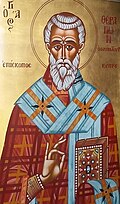 TheraponHieromartyrMay 14
- Pontius of PradlevesMartyrMay 14
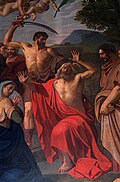 Pontius of CimiezMartyrMay 14
- Alexander of ConstantinopleMartyrMay 14
- Alexander of PereyaslavlSaintMay 14
- AnthonyHieromartyrMay 14
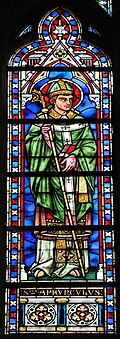 Aprunculus of LangresSaint · Bishop of LangresMay 14
- AristotleMartyrMay 14
- Barbarus of ConstantinopleMartyrMay 14