Martyr
Claudia of Rome
A woman martyr of Rome, who suffered for Christ.
- Feast
- December 24old style January 6
- Era
- unknown
- Order
- Martyrs
Life
Holy Martyr Claudia of Rome was the mother of the holy venerable martyr Eugenia and wife of Philip, the governor of Egypt. The Azbyka page mentions her in the life of the venerable martyr Eugenia of Rome and the martyrs Protus, Hyacinth and Claudia.
Eugenia, a Roman by birth, lived at Alexandria, where her father, Philip, had been sent by the emperor Commodus (180-192) as governor of Egypt. She received an excellent education, was of good character and beauty, and many young nobles sought her hand, but she did not wish to marry. Reading the Epistles of the holy Apostle Paul, she turned with all her soul to Christianity and, secretly from her parents, dressed in men's clothes and accompanied by two slaves, Protus and Hyacinth, withdrew to a monastery of men. There, with her slaves and companions, she received holy Baptism from Bishop Helenus, to whom she had been revealed in a vision, and he blessed her to struggle in the monastery as the monk Eugenius.
By her labours Eugenia gained the gift of healing. A rich young widow, Melania, came to her for help; seeing the young monk, she was kindled with an unclean desire and, rejected, invented a slander of attempted violence. Eugenia was brought before the governor of Egypt, that is, her own father, and had to reveal her secret. Her family rejoiced to find the one they had long mourned, and after a time all received Baptism. But Philip was removed from office on a denunciation by pagans, and the Christians of Alexandria chose him as their bishop. The new governor, fearing the anger of the people, did not condemn him openly but sent assassins; as the bishop was praying alone he was wounded, and after three days he died as a martyr.
Left a widow, Claudia went with her daughter and servants to her estate near Rome. There Eugenia continued the monastic life, brought many virgins to Christ, and Claudia set up a guest house and served the widows. After a few quiet years the emperor Gallienus (260-268) began a persecution again, and many Christians found shelter with the saints Claudia and Eugenia. The saints Protus and Hyacinth were beheaded after, on their entering the idol temple, the idol fell and broke. Saint Eugenia, brought by force into the temple of Diana, saw the shrine collapse before she entered. Thrown into the Tiber with a stone round her neck, she came out unharmed, and unharmed also from fire. Then she spent ten days in a pit, where the Saviour appeared to her and announced that she would enter the Kingdom of Heaven on the day of the Nativity of the Lord. In 262, when the feast came, the executioner killed her with the sword. Soon Saint Claudia also received the crown of martyrdom; the venerable martyr Eugenia had told her beforehand of the day of her death.
Saint Claudia is commemorated on 6 January, in the new style. The life of Saint Eugenia is also found in the Lives of the Saints by Saint Dimitry of Rostov.
Commemorated the same day December 24
 AdamRighteous · The First-CreatedDec 24
 EveRighteous · The First MotherDec 24
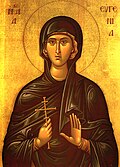 Eugenia of RomeVenerable MartyrDec 24
 Innocent BedaVenerable Martyr · ArchimandriteDec 24
- Nicholas the MonkVenerableDec 24
- Socius and TheocliusHoly MartyrsDec 24
- AchaicusMartyrDec 24
- Agapios PapantonopoulosSaintDec 24
- Agapius the YoungerVenerableDec 24
- Alberic of GladbachVenerableDec 24
- AphrodisiusVenerableDec 24
- BitimionVenerableDec 24