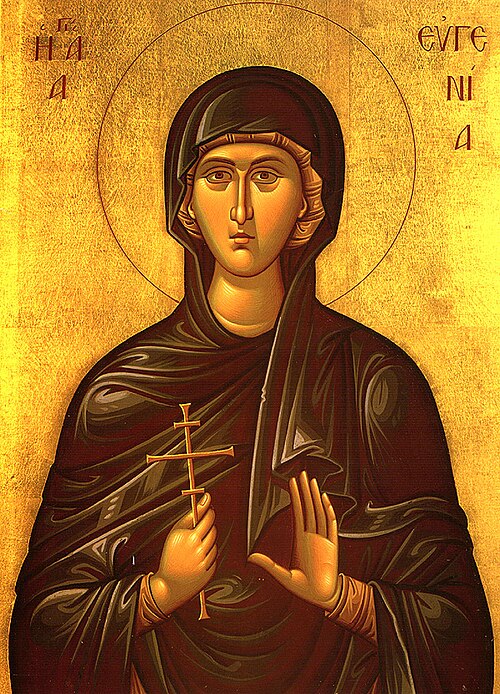
Venerable Martyr
Eugenia of Rome
Roman martyr of the third century, venerated in East and West, put to death around 258.
- Feast
- December 24old style January 6
- Reposed
- 2583rd century
- Place
- Rome
- Order
- Martyrs
Life
Saint Eugenia of Rome, venerable martyr, lived in the third century and was martyred at Rome about the year 258. She is venerated in East and West, and in the Orthodox Church she is commemorated on 24 December, the eve of the Nativity, the day on which, according to her Life, she received the crown of martyrdom. Her story, with few sure historical data, was widely spread from the fifth century.
The calling
According to her Life, Eugenia was the daughter of Philip, a man of rank sent by the emperor Commodus to govern Egypt, and of Claudia. The family moved from Rome to Alexandria. The girl was beautiful, wise and learned in Greek and Latin literature, and she rejected all suitors, thinking good deeds above high birth. Reading the epistles of the Apostle Paul and the story of Saint Thecla, she desired to be a Christian. With two servants, Protus and Hyacinth, who had been raised with her, she left home secretly, dressed in men's clothing, for a monastery of men. There Bishop Helenus of Heliopolis, called Elias in other sources, to whom her secret had been revealed, baptised all three and blessed her to live as the monk Eugene.
The monk Eugene
Through her ascetic labours Eugenia received the gift of healing. At the death of the abbot the monks chose her as successor, though for a long time she refused. A rich and noble woman, Melanthia, healed by her with the sign of the cross, fell in love with the young monk and, being rejected, accused him before the governor of trying to force her. The governor was Philip himself, who did not know she was his daughter. Before the tribunal Eugenia revealed her identity. The family who had mourned her received her with joy, and later all were baptised. Philip was chosen bishop of Alexandria and was killed during prayer by assassins sent by the new governor. According to some sources fire from heaven consumed Melanthia and her house.
Martyrdom at Rome
In the time of the emperor Gallienus, after Philip's death, Eugenia returned with her mother and brothers to Rome and continued the monastic life, bringing many maidens to Christ. With Protus and Hyacinth she enlightened Basilla, a young noblewoman, who received baptism and was killed by the sword because she refused marriage. Protus and Hyacinth were taken to sacrifice in a temple, where the idol fell down, and were beheaded. Eugenia was brought to the temple of the goddess Diana, which collapsed before she entered. Thrown into the Tiber with a stone around her neck, she remained unharmed, and the same in fire, and in the heated bath the furnaces went out. She was then shut in a dungeon or pit, where, according to her Life, the Saviour appeared to her and told her that she would enter the Kingdom of Heaven on the day of His Nativity. On that day, in the year 258 according to some sources, an executioner killed her with the sword. Her mother, Claudia, also received the crown of martyrdom soon after.
It is to be noted that the story has anachronisms: Commodus reigned almost a hundred years before Valerian and Gallienus.
Veneration
The martyrology of Jerome says that Eugenia was buried at Rome, on the Via Latina, in the cemetery of Apronian, where a basilica was built which was restored by several popes and then disappeared. Her relics are today in the church of the Twelve Holy Apostles in Rome, and small parts are at the monastery of Saint Barbara in Cyprus, at the monastery of the Life-giving Spring on Andros and at the Holy Trinity in Koropi, in Greece. Her veneration is attested by mosaics at Ravenna, Naples, Poreč and in Greece, and hymns in her honour were written by Venantius Fortunatus and others. The Roman Catholic Church keeps her feast on 25 December, and the Armenian Church on 23 January.
Commemorated the same day December 24
 AdamRighteous · The First-CreatedDec 24
 EveRighteous · The First MotherDec 24
 Innocent BedaVenerable Martyr · ArchimandriteDec 24
- Nicholas the MonkVenerableDec 24
- Socius and TheocliusHoly MartyrsDec 24
- AchaicusMartyrDec 24
- Agapios PapantonopoulosSaintDec 24
- Agapius the YoungerVenerableDec 24
- Alberic of GladbachVenerableDec 24
- AphrodisiusVenerableDec 24
- BitimionVenerableDec 24
- Bruno of OttobeurenVenerableDec 24