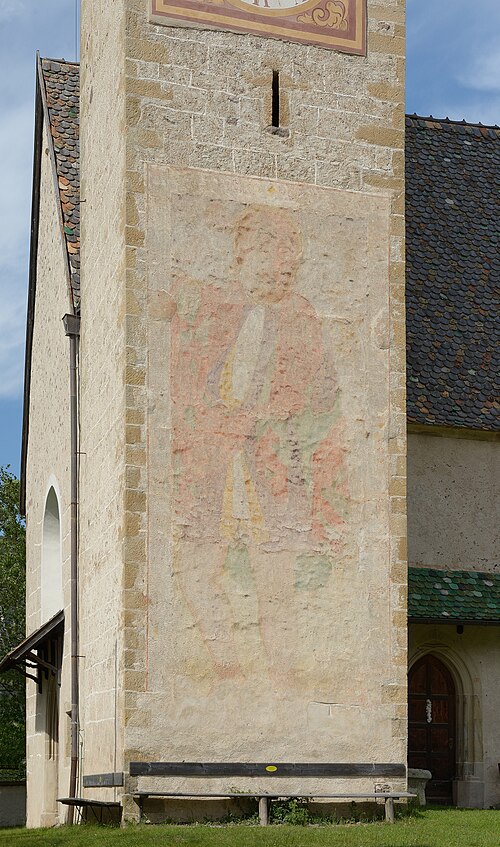
Saint
Constantine of Dumnonia
A British king of the 6th century, venerated as a saint in the British Isles.
- Born
- 5206th century
Life
Constantine is the name of one or several British or Pictish saints. One Constantine, king and martyr of Scotland, venerated in Cornwall and Wales on 22 March, in Scotland on 24 March and in Ireland on 31 March, lived between 520 and 576 or 588. The sources give no Orthodox act of canonization, and his life rests on legend, so we present him as a saint of tradition in the British Isles, of uncertain identity.
Some historians identify him with the king of Dumnonia of the same name. According to tradition, he was the nephew of King Arthur, whose crown he inherited. He was married to the daughter of the king of Brittany and led a life full of vice and greed, until Saint Petroc (commemorated on 4 June) turned him to the Lord. Constantine was a weak ruler. After his wife's death he is said to have yielded his throne to his son Geraint in order to go to repentance in the monastery of Saint Mochuda at Rahan, in Ireland.
In the monastery, keeping his origin secret, he did menial work, carrying grain to the mill for seven years. But his origin was discovered, and the abbot sent him to study for the priesthood, and he was ordained. Constantine became a missionary among the Picts in Scotland, first under Saint Columba, then under Kentigern, bishop of Glasgow. He preached in Galloway and founded a monastery at Govan, near the river Clyde, of which he was abbot. In old age, on the way to Kintyre, he was attacked by pirates, who cut off his right hand, and he bled to death. He is regarded as the first martyr of Scotland.
In Cornwall two places bear his name: one on the river Helford, the other near Padstow. In the first the church was larger and belonged to a monastery until the eleventh century. He was also patron of the churches at Milton Abbot and another place in Devon. The Life of Saint Constantine is in the Aberdeen Breviary under 11 March. According to this legend, Constantine was king of the Britons, in youth led an immoral life, then repented and went to preach among the Picts, who tortured him cruelly and killed him. It is not clear whether he has any connection with the king Constantine of whom Gildas writes, accusing him of debauchery and levity (in the Annals of Cambria, under 589, is entered "the conversion of Constantine to the Lord").
The Irish martyrologies mention a Scottish king Constantine, son of Fergus, who lived in the sixth and seventh centuries and was linked with Saint Mochuda, founder of the monastery of Cúl Raithin. The Martyrology of Cashel calls him "the abbot of Cúl Raithin". Already in the Martyrology of Tallaght (ninth century) doubt is expressed as to which Constantine is commemorated on 11 March ("either Constantine the Briton, or Constantine son of Fergus"). In any case, the Constantine whose name is remembered on 11 March has no connection with the Pictish king Constantine, son of Cináed, killed in 875.