Saint
Corbinian of Freising
First Bishop of Freising
Frankish bishop, a hermit near Chartres for fourteen years, sent to Bavaria by Pope Gregory II.
- Feast
- September 8old style September 21
- Reposed
- 7308th century
- Place
- Freising
- Order
- Hierarchs
Life
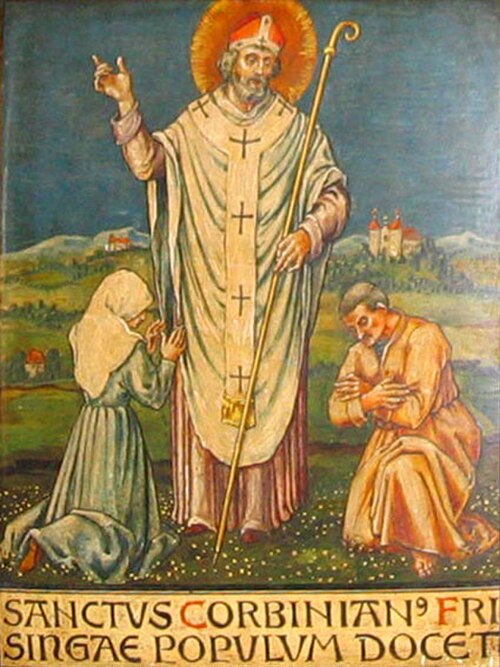
Saint Corbinian of Freising, hierarch, was a Frankish bishop, the first shepherd of Freising in Bavaria, in the early eighth century. After fourteen years of hermit life near Chartres, he went on pilgrimage to Rome, whence Pope Gregory II sent him to preach in Bavaria. He fell asleep in 730 and is venerated as a saint in the West. His commemoration is on 8 September, and on 20 November the translation of his relics is celebrated.
Beginnings
He was born and baptised Waldegiso at Châtres, near Melun, in Frankish territory, after his father, who may have died when the child was small. His mother, Corbiniana, soon gave him her own name, Corbinian. Nothing more is known of his childhood. The earliest source is his Life written by Bishop Arbeo of Freising.
Corbinian lived fourteen years as a hermit at Châtres, on the road to Orléans, near a church dedicated to Saint Germain. His fame gathered disciples and drew him away from his solitude. From devotion to the Holy Apostle Peter he decided to go to Rome, with some disciples. At Rome Pope Gregory II urged him to use his gifts to preach in Bavaria. Corbinian, who may already have been a bishop or was consecrated then by the pope, was sent to the Frankish duke Grimoald of Bavaria and probably arrived there in 724.
The monastery at Freising
On a hill near Freising, where there was already a place of worship, the saint raised a Benedictine monastery and a school, which after his death were governed by his brother Erembert. The monastery was dedicated first to Saint Vitus, then to Saint Stephen, and in the eleventh century became Weihenstephan Abbey. In 738, when Saint Boniface organised the Church in the duchy of Bavaria by four dioceses, Erembert was chosen the first bishop of Freising.
Exile
Soon after his arrival Corbinian reproved Grimoald's marriage to Biltrudis, his brother's widow, though the duke had already repented of this sin. The duke's anger and the hatred of his wife, who regarded him as a foreign intruder, turned against him, and she plotted to have him killed. Corbinian fled from Freising to South Tyrol, to Kuens near Merano, until Grimoald was killed and Biltrudis carried off by invaders, in 725. He returned at the call of Huebert, Grimoald's successor, and continued his apostolic work at Freising until his death in 730.
Corbinian's bear and veneration
The saint's symbol is the saddled bear. According to his Life, on the road to Rome a bear killed his pack horse, and the saint ordered it to carry his load. Arrived at Rome, he let it go, and the bear returned to its forest. The story is interpreted as a parable of Christianity taming the ferocity of paganism and laying the foundation of a great civilisation in Bavaria, and the bear under its pack is also the image of the bishop who bears the burden of his ministry. The bear appears on the arms of the city of Freising and was adopted by Pope Benedict XVI, when he was archbishop of Munich and Freising.
The saint's body, buried at his wish at Kuens near Merano, was moved to Freising in 769 by Bishop Arbeo and lies now in the crypt of the cathedral of the city. His feast is kept at Munich and Freising on 20 November, at Bolzano and Bressanone on 9 September, and elsewhere on 8 September. According to a Russian source, Saint Corbinian is also commemorated in the calendar of the Romanian Orthodox Church, on 3 December.
Commemorated the same day September 8
 Sergius I of RomeSaint · Bishop of RomeSep 8
 Anastasius II of RomeSaint · Bishop of RomeSep 8
- Æthelburh of KentRight-Believing · Queen of NorthumbriaSep 8
 Celestina of RomeMartyrSep 8
- Giorgi MkheidzeVenerableSep 8
- Ioane MaisuradzeVenerableSep 8
- Athanasios of XirokriniSaintSep 8
- Ammon, Theophilus, Neoterius and twenty-two companionsHoly Martyrs · Martyrs of AlexandriaSep 8
- AmmoniusHieromartyr · Presbyter of AlexandriaSep 8
- ArtemidorusMartyrSep 8
- Basil RazumovHieromartyrSep 8
- Catha of Cluain EossainSaintSep 8