Saint
Cyril II of Kiev
Metropolitan of Kiev
Metropolitan of Kiev from 1242 until his death in 1281, under Mongol rule.
- Reposed
- 128013th century
- Place
- Pereslavl-Zalessky
- Order
- Hierarchs
Life
Saint Cyril II was metropolitan of Kiev and all Rus' in the time of the Mongol yoke, from about 1243 until his death in 1280 or 1281. He shepherded the Russian Church after Batu Khan's devastation of Kiev, travelled much through the Russian lands, set church order, founded new dioceses and obtained from the khans documents that protected the Church. He was close to Grand Prince Alexander Nevsky. The Russian Church honours him as a holy hierarch. The sources record for him a hard ministry, carried out between rival political powers.
From seal-keeper to metropolitan
In the Galician-Volhynian Chronicle he appears first as "Kurilo, the seal-keeper" of Prince Daniel of Galicia. He kept the prince's seal and ran his chancery, and the chronicle says he also led Daniel's army, which shows the trust he enjoyed. At the end of 1241, sent by Daniel and Vasilko to Bakota, he put the affairs of the place in order and investigated the abuses of the boyars. The chronicle tells that when the army of Prince Rostislav Mikhailovich came against the town, Kurilo went out with foot soldiers and forced Rostislav to withdraw beyond the Dnieper.
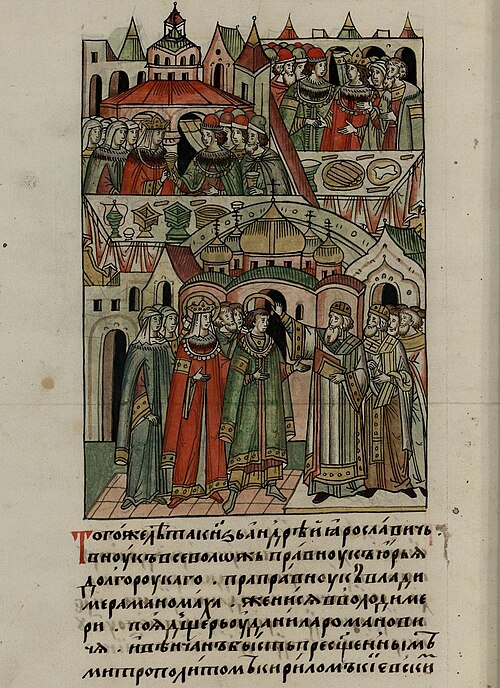
By about 1243 the chronicle already calls him metropolitan, although the official consecration came later. The see of Kiev had remained empty after Batu Khan took the city, and Cyril was elected by a council of bishops, with Daniel's support. In 1246 to 1247 he went to Nicaea, where the Patriarchate of Constantinople then was in exile, and was appointed metropolitan of Kiev and Rus' by Patriarch Manuel II. On the road he held, in 1246, talks with King Béla IV of Hungary, which ended in the marriage of a Hungarian princess to a son of Daniel. In 1250 he brought Daniel's daughter as wife to Grand Prince Andrei Yaroslavich of Vladimir.
Parting from Daniel and closeness to the North
Until 1251 he was close to Daniel, but then he parted from him, because Daniel was drawing near to the papal see and later received a royal crown from Rome (in 1253 by some sources, in 1254 by others). Cyril, as a representative of Greek Orthodoxy, did not support tendencies toward union with Rome. In 1251 he went to Novgorod, where he met Alexander Nevsky for the first time, and thereafter stayed almost continuously in north-eastern Rus', travelling constantly through the land and remaining long at Vladimir on the Klyazma. In 1252, when Alexander received from the khan the yarlyk for the rule of Vladimir in place of his brother Andrei, the metropolitan met him solemnly on his return from the Horde and seated him on the grand princely throne. Like Alexander, Cyril chose in his politics the path of recognizing Mongol rule and of resisting Catholic expansion from the West. To him are attributed the words with which in 1263 he announced to the people of Vladimir the death of Alexander Nevsky: "My dear children, know that the sun of the Russian land has set."
Historians do not agree on his place of residence. Soviet scholars believed that from about 1250 he moved definitively to Vladimir and only rarely went south to Kiev, but Joseph Fuhrmann (1976) and Donald Ostrowski (1993) showed, from the chronicles, that Kiev remained his residence de jure and de facto throughout his ministry, as in the early years of his successor Maximus. According to the Ukrainian source, after Alexander's death (1264) he lived again in Kiev, while keeping authority throughout Rus'. He seems to have been close to Khan Mengu-Timur, and the chronicles say that the khan and the metropolitan sent Bishop Theognostus of Sarai together to Emperor Michael VIII and the patriarch of Constantinople, with letters and gifts from each. The embassy probably took place around 1278, since Theognostus returned to Sarai in 1279. It appears that relations with Egypt were also mentioned in the talks.
His church work
In 1251 he appointed Dalmat bishop at Novgorod, in place of the dead Spiridon. It is believed that around 1252 he received from Batu a yarlyk that guaranteed the inviolability of the Orthodox Church; from 1267 the yarlyk given by Berke Khan is certainly preserved. In 1258 he founded the bishopric of Tver, and in 1261, with the help of Alexander Nevsky, the Orthodox diocese at Sarai, capital of the Golden Horde, which showed the prudence of the Russian Church toward the new conditions of coexistence with Mongol rule. In 1262 he appointed Ignatius bishop at Rostov, in place of the dead Cyril. In 1274 a council of bishops of the Russian Church was held at Vladimir, which put in order and restored church legislation, introducing the Serbian Nomocanon (Kormchaya), the most widespread later. In the same year Serapion of the Caves was appointed bishop at Vladimir, in place of Mitrofan, killed by the Mongols at the capture of Vladimir in 1238. In the winter of 1276, being at Kiev, he appointed Clement to Novgorod, in place of the dead Dalmat. In 1279 he obtained from Mengu-Timur a yarlyk that protected the faith and the rights of the clergy against the abuses of Mongol officials.
He tried to restore the ordinary life of the metropolis, disturbed by the Tatar-Mongol invasion, and travelled ceaselessly through Rus' to shepherd his flock. He appointed bishops at Vladimir, Rostov the Great and Sarai. He left a "Rule of Metropolitan Cyril". To him is also attributed the composition of a life of Daniel of Galicia, which became the basis of the Galician-Volhynian Chronicle.
Repose
The sources do not agree on the day of his death: the Russian source gives 6 December 1280, the English one 6 December 1281, and the Ukrainian one 21 November 1281. It took place at Pereslavl-Zalessky, during a council attended by the bishops of northern Rus', Clement of Novgorod, Ignatius of Rostov and Theodore of Vladimir, and by Grand Prince Dmitry Alexandrovich. His body was taken first to Vladimir, then to Kiev, where it was buried in the precinct of the Cathedral of Saint Sophia, like his predecessors. His ordinal has also been debated: the metropolitan Cyril of 1224 to 1233 is counted by some as Cyril I and this one as Cyril II, though others, on the basis of a hypothesis, call him the third. The official lists of the Church keep the traditional numbering.