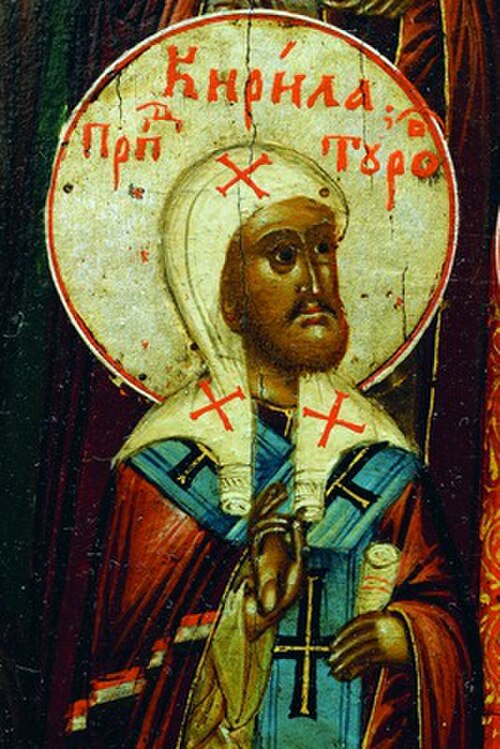
Saint
Cyril of Turov
Bishop of Turov
Bishop of Turov and church writer of Kievan Rus, author of sermons and prayers.
Life
Saint Cyril of Turov, called Kirill in Russian, was a bishop and church writer in Kyivan Rus’ in the twelfth century, known as one of its first and finest theologians. He is commemorated on 28 April.
What is known of his life
Very little is known of his life, since only a short Life survives, written after the middle of the thirteenth century, and many scholars dispute even the dates and his title. According to this Life, he was born around 1130 in the town of Turov, to a wealthy family, but he did not love riches and the glory of the world and sought above all to know the divine books. He received a good education, knew Greek and was familiar with Byzantine culture, above all poetry and rhetoric. Orphaned at about ten, he entered a monastery, was tonsured a monk at the monastery of Saints Boris and Gleb in Turov and after some years was made abbot of the monastery of Saint Nicholas. Then he left the leadership to another and, desiring a greater struggle, shut himself up on a pillar, that is, in a hermit’s cell, where he spent his time in fasting and prayer and wrote many books. He is counted among the first pillar-dwellers known in Rus’. His fame spread beyond Turov.
The bishop
At the request of the prince and the citizens he was chosen bishop of Turov, before 1169, and it is said that he took part, with the support of the metropolitan, in exposing the heresy of Bishop Fedor, who wished to tear the Metropolis of Kiev away from the Russian Church. After becoming bishop he showed himself above all as a writer and preacher. He is thought to have died around 1182, according to some views retired into a monastery at Turov, where in old age he is said to have written part of his prayers.
His writings
He left eight sermons for the feasts of the Church, among them for Palm Sunday, for Easter, for the Sunday of Saint Thomas, for the Sunday of the myrrh-bearing women, on the paralytic, on the blind man, for the Ascension and for the Council of Nicaea, along with the Parable of the Soul and the Body, the Tale of the Layman and the Monk and the Discourse on the monastic order, a letter to Archimandrite Basil of the Caves Monastery and some thirty prayers and canons. His Easter sermon, in which spring is an image of the Resurrection, remained the best known: there the winter of sin has melted through repentance, and the ice of Thomas’s unbelief melted when he touched the side of Christ. For centuries his writings were copied and imitated. The Life calls him a second Chrysostom.
Commemorated the same day April 28
 Vitalis of MilanMartyrApr 28
 Jason of ThessalonicaApostle · Apostle of the SeventyApr 28
 Valeria of MilanMartyr · Wife of Saint VitalisApr 28
 Sosipater of IconiumApostle · Apostle of the SeventyApr 28
 Theodora and DidymusHoly MartyrsApr 28
 Kerkyra of CorfuMartyr · Virgin of CorfuApr 28
- Mark the GalileanHieromartyr · Bishop of AtinaApr 28
- FaustianMartyr · Martyr of CorfuApr 28
 Isaiah of OstrogVenerable · Hermit of OstrogApr 28
- Maximus, Dadas and QuintilianHoly MartyrsApr 28
- Adalbero of AugsburgSaint · Bishop of AugsburgApr 28
- Anna ShashkinaMartyrApr 28