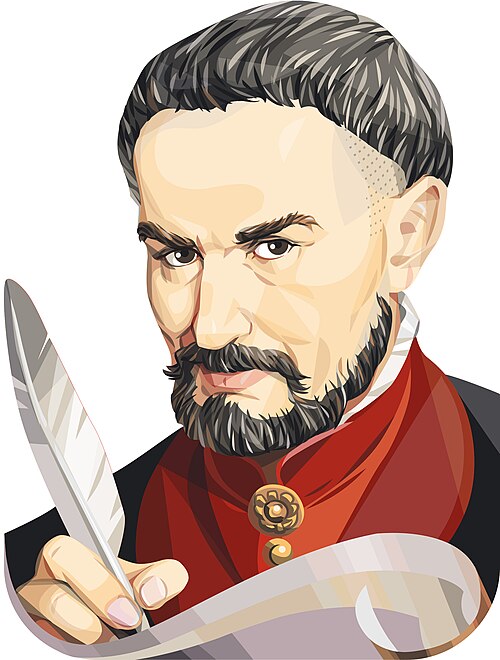
Passion-Bearer
Danylo Bratkovsky
Nobleman and poet from Volhynia, defender of Orthodoxy and of the Ukrainians, who took part in popular uprisings; he died in 1702.
- Reposed
- 170218th century
- Place
- Lutsk
- Order
- Martyrs
Life
Danylo (Daniil) Bratkovsky was a nobleman and poet of Volhynia, a prominent fighter for Orthodoxy, a defender of the rights of the Ukrainian population and a participant in the uprisings of Right-Bank Ukraine, executed at Lutsk on 15 November 1702. He was canonized as a passion-bearer on 27 June 2013 by the Local Council of the Ukrainian Orthodox Church of the Kyiv Patriarchate, a body not recognized by the canonical Orthodox Churches at that date. The sources available do not show a canonization by a canonical Church.
Life
He lived in the second half of the seventeenth century, born according to some sources around 1642 at Svyshchiv, today Vyshneve, Rivne region. His old family lived in the voivodeships of Bratslav and Volhynia and did not accept Catholicism. He himself actively opposed attempts to introduce the Union. He was cup-bearer of Venden and a public man, defender of the rights of Ukrainians at the noble assemblies of the Kiev region and Volhynia. He belonged to the Orthodox Brotherhood of the Exaltation of the Cross in Lutsk. When, at the beginning of the 1680s, the Catholic and Uniate clergy wished to gather at Lublin a council of union, a delegation of the Lutsk brotherhood, of which he was a member, swore to preserve whole the Church of the East, obedient to the four patriarchs, and to defend, without being drawn by flattery, promises or gifts and without yielding out of fear, even of death, all the dogmas and rites, from the great to the small, adding or omitting nothing. The same position he upheld at the noble assemblies.
The poet
In 1697 he printed at Kraków, in Polish with Ukrainian elements, the collection of verse The World Examined Part by Part, of satirical character: The Dispute of the Poor Man with the Lord, The Banquet at the Assembly, Equality. It is a sharp satire exposing the humiliated position of poor Orthodox Ukrainians in the Polish Commonwealth, where there were clear restrictions of estate and religion. The poet and thinker said that Catholics and Orthodox, rich and poor, are equal subjects of the life of the country. Long before Kotlyarevsky, he drew attention to the richness of the language, customs and culture of the people. The book was reissued at Lutsk in 2004, with a parallel Ukrainian translation.
Martyrdom and remembrance
To unite all Ukrainian forces in the struggle against the oppressors, in 1700 he visited Hetman Ivan Mazepa and took part in the uprising led by Semen Palii. He was arrested near Zaslav, and on 15 November 1702 he was executed at Lutsk, by the sentence of a Polish military court, cut down by the executioner in the market square. His figure inspired Mykhailo Starytsky's drama The Last Night. In Lutsk a street bears his name, and the townspeople honour his memory each year. Descendants of his live in Belgium and visited Volhynia in 2017.