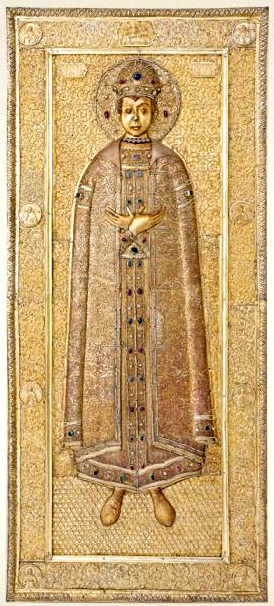
Passion-Bearer
Demetrius of Uglich
Tsarevich of Uglich
Youngest son of Ivan the Terrible, who died at Uglich in 1591 at the age of eight.
Life
Saint Dimitry, the right-believing Tsarevich of Uglich, last son of Ivan the Terrible, died at Uglich on 15 May 1591, at eight years old. His death, wrapped in mystery, was one of the causes of the Time of Troubles, and his name was taken by several pretenders to the throne. The Russian Church canonized him in 1606 as a right-believing martyr and commemorates him on 15 May (28 May in the new style), on 3 June (16 June), the day of the translation of his relics, and on 19 October, the day of his birth.
Life
He was born in 1582 of Ivan the Terrible’s last wife, Maria Nagaya; baptized Dimitry, in honour of Saint Demetrius of Thessalonica. He was their only child. Because he was born of a marriage not blessed by the Church (the Church counts only three marriages as lawful), he could be regarded as illegitimate and excluded from the succession. Ivan died in 1584, and the throne passed to Dimitry’s sickly brother, Feodor I; the country was governed by a regency council, headed from 1586 by Boris Godunov, Feodor’s brother-in-law. In 1584 Godunov sent Dimitry, with his mother and her brothers, into a kind of exile at Uglich, the tsarevich’s appanage. There they had no real power, which was in the hands of governors sent by the tsar. The tsarevich suffered, according to those around him, from “the falling sickness” (epilepsy).
Death
On 15 May 1591 Dimitry died at Uglich, of a knife wound to the throat, in unclear circumstances. His mother accused of the killing Boris’s men, Danila Bityagovsky and Nikita Kachalov, who were killed at once by the rioting crowd; fifteen were killed, among them the official sent from Moscow and a playmate of the boy. The commission sent from Moscow, headed by Vasily Shuisky, concluded, after hearing dozens of witnesses, that the tsarevich had wounded himself in an epileptic seizure, playing with a knife. Maria Nagaya was forcibly tonsured and sent to a remote convent; her brothers, into exile in Siberia. There were three explanations: killed by order of Godunov (accepted by historians such as Karamzin, Solovyov and Klyuchevsky), death by accident (Pogodin, Platonov and others), or the assassins mistook someone else for him and he escaped; the last explains the appearance of pretenders, but today’s historians consider it improbable. Modern scholarship tends to exonerate Boris.
Veneration
When Feodor died, in 1598, without children, Dimitry was dead, and Godunov took the throne. When political circumstances changed, Shuisky retracted his first conclusion and said Dimitry had been killed on Boris’s orders. On 3 June 1606 the relics were brought from Uglich to Moscow and placed in the church of the Holy Archangel Michael; they were found, after fifteen years, entire, and many miracles took place at his tomb. Tradition says that after death he appeared to a monk, foretelling the appearance of a false Dimitry, who would destroy the murderer Boris Godunov. The story of the killing underlies Pushkin’s play “Boris Godunov” and Mussorgsky’s opera.
Commemorated the same day June 3
 ClotildeRight-Believing · Queen of the FranksJun 3
 Kevin of GlendaloughVenerable · Founder of Glendalough AbbeyJun 3
- Achillas of AlexandriaSaint · Patriarch of AlexandriaJun 3
 Amphilochius of GlushitsaVenerable · Disciple of Dionysius of GlushitsaJun 3
 Dorotheos ProiosSaintJun 3
 Olivia of AnagniSaintJun 3
- Agapit of MarkushevoVenerable MartyrJun 3
- Joseph of ThessalonikiSaint · Metropolitan of ThessalonikiJun 3
- Cornelius of PadanVenerable · Founder of a hermitageJun 3
- Gregory of DerkosSaint · Hierarch of DerkosJun 3
- Adalbert of ComoSaintJun 3
- Adam the AbbotVenerableJun 3