Right-Believing
Dinar of Hereti
Queen of Hereti
Georgian princess of the Bagrationi dynasty and queen regnant of Hereti in the 11th century.
- Feast
- June 30old style July 13
- Reposed
- 100010th century
Life
Saint Queen Dinara (Dinar) of Hereti was a Georgian princess of the Bagrationi dynasty of Tao-Klarjeti and queen regnant of Hereti, in a time placed by the sources in the tenth century (the English-language source says the eleventh). The record gives the year 1000 for birth and death, which makes no sense. The Georgian Orthodox Church commemorates her on 30 June (13 July by the new calendar); our sources do not say when she was canonized.
Dinara was the daughter of the eristavt-eristavi (duke of dukes) Adarnase III of Tao, whose wife is not known. According to the Georgian Chronicles (Kartlis Tskhovreba), Queen Dinara, during the reign of her son Ishkhanik, converted Hereti to the Georgian Orthodox Church. King Ishkhanik and Queen Dinara took part in the ceremony organized on the occasion of the election of the new Catholicos of Albania in 962. After 1000, Queen Dinara of Hereti had no option but to join the united Georgia under King Bagrat. In the campaign of Bagrat III to the Kingdom of Hereti, the main representative of the Hereti ruling circles was Queen Dinara. Bagrat III captured her, and she must have been over 90 years old. G. M. Grigoryan believes that the grave discovered on the territory of the Vahanavank monastery near the city of Kapan, with the word Dinar written on it in the Armenian alphabet, is the grave of Queen Dinara.
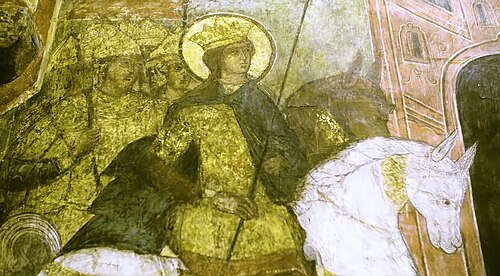
In Russia the story of Queen Dinara is recounted more closely in the chronicles, and the Tale of Tsaritsa Dinara may be about her. According to Movses Kaghankatvatsi, the Slavic tribes often raided Transcaucasia and, apparently, through them the information about the Iberian queen Dinara reached Russia. On the north wall of the Throne Hall in the Moscow Kremlin there is a fresco of the Holy Tsaritsa Dinara, depicted mounted on a white horse, victorious over the enemy.
Commemorated the same day June 30
 Donatus of MünstereifelMartyr · Martyr of the catacombsJun 30
 Peter of RostovVenerable · Tsarevich of the HordeJun 30
 Gervasios ParaskevopoulosVenerable · of PatrasJun 30
- Michael BaknanasNew Martyr · Gardener of AthensJun 30
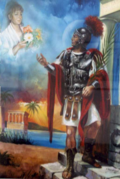 Basilides of AlexandriaMartyrJun 30
- Timothy PetropavlovskyHieromartyr · PriestJun 30
- 1040 MartyrsHoly MartyrsJun 30
- Alexis VvedenskyHieromartyrJun 30
- Alpinian and AustriclinianHoly Confessors · Priests, companions of Martial of LimogesJun 30
- Bertram of Le MansSaint · Bishop of Le MansJun 30
- CaolanSaintJun 30
- ClotsindisVenerableJun 30