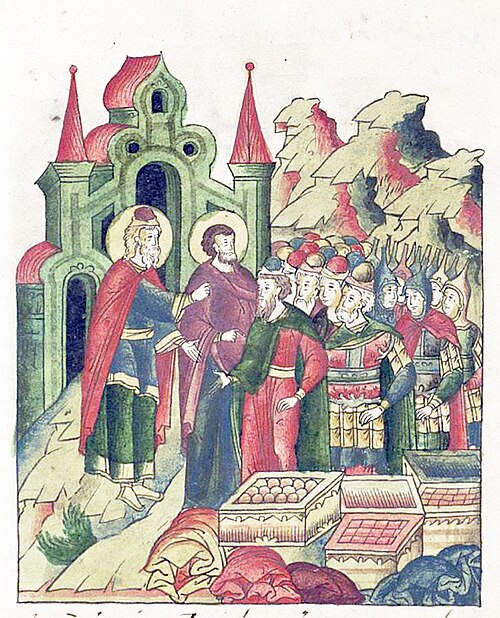
Saint
Eleazar
High priest, son of Aaron
Second high priest of Israel, son of Aaron and nephew of Moses, who succeeded his father in the priesthood.
- Reposed
- 1100 BC11th century BC
- Place
- Land of Israel
Life
Saint Eleazar was the second high priest of Israel, son of Aaron and nephew of Moses, who succeeded his father in the priesthood. He is commemorated on 2 September.
In the wilderness
Eleazar had several duties in the time of the Exodus: from the censers of the assembly of Korah he made the bronze covering of the altar, and he performed the rite of the red heifer. After the death of his elder brothers, Nadab and Abihu, he and his younger brother, Ithamar, were given charge of the sanctuary. His wife, one of the daughters of Putiel, bore him Phinehas, who was to succeed him as high priest. During the journey through the wilderness Eleazar was in charge of the oil for the lampstand, the incense, the daily grain offering and the anointing oil, and oversaw the carrying of the ark of the covenant, the table of the bread of the presence, the altar and the other furnishings of the tent, carried by the Kohathites, of the tribe of Levi. When Korah rebelled against Moses, Eleazar was commanded to take the rebels’ censers and hammer them into a covering for the altar, as a reminder that the priesthood belongs only to the descendants of Aaron.
High priest
On Mount Hor, Moses took the holy vestments from Aaron and put them on Eleazar, as successor to the high priesthood, before Aaron’s death. Eleazar held the office for more than twenty years. He took part, with Moses, in the numbering of the people and helped at the installation of Joshua. He also helped in the distribution of the land after the conquest. When he died he was buried at Gibeah, which had been given to his son Phinehas, in the hill country of Ephraim. The high priesthood stayed in the family of Eleazar until Eli, of the descendants of Ithamar, and was restored to the family of Eleazar in the person of Zadok, after Solomon drove out Abiathar. According to Jewish tradition he was buried at Awarta.