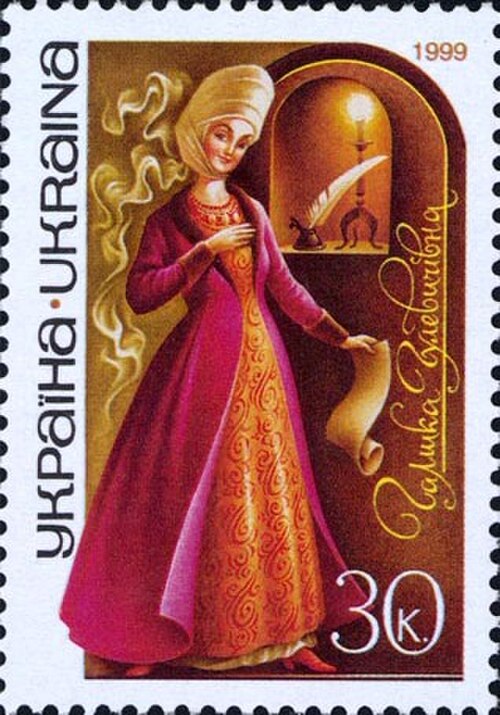
Right-Believing
Elizabeth Hulevych
Noblewoman and philanthropist of Lutsk
Ukrainian noblewoman and philanthropist of Lutsk in Volhynia, who died in 1642 and is venerated as a saint.
- Reposed
- 164217th century
- Place
- Lutsk
Life
The Holy Right-Believing Elizabeth Hulevych (Halshka Hulevychivna, in Polish Halszka Hulewiczówna) was a noblewoman and philanthropist of Lutsk, in Volhynia, founder of the Epiphany Monastery of the Kyiv Brotherhood and of the brotherhood school, from which the Kyiv-Mohyla Academy traces its history. She lived in the second half of the sixteenth century and the early part of the seventeenth and fell asleep in 1642, at Lutsk. The Orthodox Church of Ukraine canonized her in 2021 as a local saint and in 2022 for the whole Church.
Family
She came from the influential noble Hulevych family, known from the fifteenth century, of the Polish Nowina coat of arms, whose members held various offices in Volhynia and other lands of the Polish-Lithuanian Commonwealth, reached high church positions and owned many settlements. They probably originated from Galicia. Her grandfather, Fedir (Theodosius) Hulevych, was a Volhynian landowner, later ordained Orthodox bishop of Lutsk and Ostroh, and had five sons. Her father, Vasyl Hulevych, was deputy starost of Volodymyr and wojski of Volhynia; from his three marriages there remained, besides her, the sons Andrii, Mykhailo, Vasyl and Benedict and the daughters Maria and Anna. She was probably born in her father's village of Zaturtsi, in Volhynia, in the 1570s (around 1575 or 1577). As to schooling, one source says that her grandfather founded in the courtyard of Lutsk Castle a school for his grandchildren, with a teacher, Oles Yurkovsky, a graduate of the brotherhood school in Lviv; there she learned the foundations of the Orthodox faith, the grammar of her mother tongue, Greek and Latin, and afterwards the children were sent to the Ostroh Academy.
Marriages
In 1594 she married Krzysztof Pociej, son of Hypatius Pociej, land judge of Berestia and castellan, Orthodox bishop of Volodymyr and Berestia from 1593, one of the main initiators of the Union of Brest, later Uniate metropolitan of Kyiv. After her husband's early death, Halshka raised her daughter Kateryna alone, whom in 1615 she gave in marriage to the standard-bearer of Orsha, Mikolai Mleczko. In 1601 or 1602 (in one source, 1606) she married a second time, Stefan Lozka, marshal of Mozyr, of a wealthy noble family of Kyiv; she was then about thirty years old, he sixty. They had a son, Mykhailo, and lived in the family house on the Podil in Kyiv, not far from the town hall.
Her gift to the Church
At the end of the sixteenth century and the beginning of the seventeenth, printing houses and schools appeared in the Ukrainian lands, supported by philanthropists, among them Halshka. On 14 October 1615 she drew up and signed a deed of donation (fundusz), entered on 15 October in the books of the city of Kyiv, which gave it the force of law. By the donation, her house with its lands in Kyiv was given for the founding of a new monastery, a hospital and a school for children of all estates. It was to be, according to the deed, a stauropegial monastery with common life after the rule of Saint Basil the Great, a school for children, both noble and townspeople, and a hostel for spiritual pilgrims, all to be governed by the law of the Eastern Church of the Greek rite. The deed stated the boundaries of the estate, lying not far from Kontraktova Square. By the gift of Halshka Hulevychivna, the initiators of the Kyiv Brotherhood received an estate with land in Lower Kyiv, to build a monastery and a school. The development of the monastery was carried out by Isaiah Kopynsky, a monk of the Caves Monastery, who founded several monasteries in the Ukrainian lands and whose name is mentioned in the donation. The school could have been housed in the house of Halshka and Stefan Lozka, but the deed does not mention the building. Her gift made possible the opening of the Kyiv brotherhood school, which, after the reform of Petro Mohyla, would play an important role in the history of Ukrainian education and culture.
The original of the deed is not known to historians, and no copies of the seventeenth century have been found; the oldest document is a handwritten copy of the eighteenth century, kept in the central historical archive. The text was first published in 1846.
Last years
After the death of her second husband Halshka left all the estates to her son Mykhailo and returned to Lutsk, where she spent her last years; she fell asleep there in 1642, leaving, according to some sources, money also to the Lutsk brotherhood. She is venerated for her care for the growth of spiritual life and of enlightenment.