Righteous
Enoch
The Righteous
Patriarch before the flood who walked with God and was taken up without tasting death.
- Era
- 4th century
- Order
- The Righteous
Life
The Righteous Enoch was a patriarch before the flood, seventh from Adam, the son of Jared and the father of Methuselah. Scripture says that he walked with God and that he did not taste death, but God took him. The Orthodox Church remembers him on the Sunday of the Holy Forefathers, before the Nativity of Christ, and the Roman Catholic and Oriental Orthodox Churches also honour him as a righteous man and prophet.
Enoch in the Book of Genesis
Genesis 5 gives the list of the ten patriarchs from Adam to Noah, and Enoch is the seventh. He descended from Seth: the son of Jared, the grandson of Mahalalel, the great-grandson of Kenan. He must not be confused with Enoch the son of Cain, mentioned in Genesis 4.
Enoch was sixty-five years old when Methuselah was born, who would become the father of Lamech and the grandfather of Noah. After that, Scripture says, Enoch "walked with God" for three hundred years and had other sons and daughters. The phrase "walked with God" is repeated twice in his short account, and later it is said only of Noah. All his days were three hundred and sixty-five years, fewer than those of other patriarchs, who lived over seven hundred.
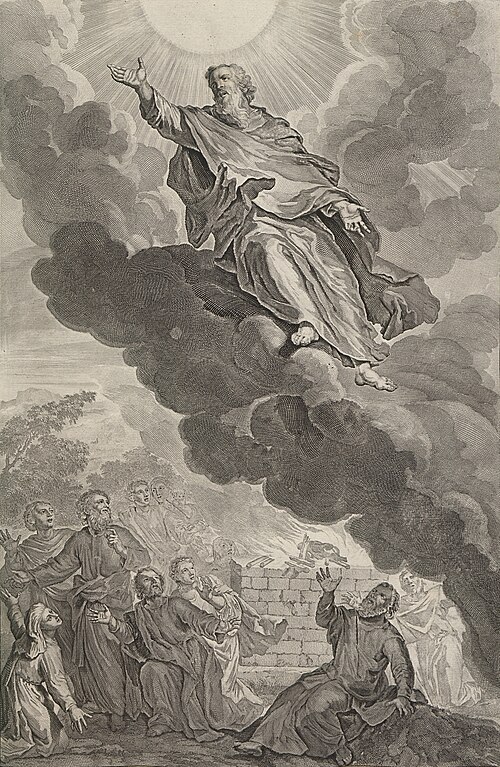
His story ends in a very short sentence: "And he was not, for God took him." Of the other patriarchs Scripture says "and he died"; of Enoch it does not.
Taken by God
The Greek translators of the Septuagint rendered "took him" with a verb meaning "moved from one place to another". The Wisdom of Jesus son of Sirach says that Enoch "pleased the Lord" and was translated, as an example of repentance for the nations. The Epistle to the Hebrews teaches: "By faith Enoch was taken up so that he should not see death, and he was not found, because God had taken him; for before he was taken he was commended as having pleased God." Luke names him in the genealogy of the Saviour (Luke 3:37).
The common reading in the Church is that Enoch was translated alive, like the Prophet Elijah later, and awaits in a place hidden from people the end of the ages. Some ancient Jewish interpreters read the text otherwise, as a swift death, and the difference shows in their commentaries.
The prophecy
The Epistle of Jude recalls a prophecy of Enoch, "the seventh from Adam": "Behold, the Lord comes with ten thousands of His saints, to execute judgment on all." These words are found in an ancient book that bears his name, the Book of Enoch, preserved in full in Ethiopic. The Ethiopian Orthodox Tewahedo Church receives it into its canon, but the other Orthodox Churches and the Churches of the West do not regard it as inspired. Fathers such as Justin Martyr, Irenaeus and Clement of Alexandria mentioned it with respect, but the Church did not receive it among the Scriptures. Two further apocrypha bear his name, the second and third books of Enoch.
The two witnesses
The Tradition of the Church links Enoch with Saint Elijah. Both were taken from the earth without tasting death, and many Fathers, among them Saint John of Damascus, saw in them the two witnesses of Revelation 11, who will preach repentance before the second coming of the Lord and be killed by the beast. This is a belief of the Church, not a dogma defined by a council.
Veneration
Enoch is remembered every year on the Sunday of the Holy Forefathers, before the Nativity of the Lord, together with the righteous of the Old Testament who awaited the coming of Christ. The service calls him a prophet and a righteous man who pleased God by faith.
In the Islamic tradition he is mentioned in the Quran under the name Idris, as a prophet and righteous man. Some Muslim accounts credit him with the discovery of writing and astronomy, which Scripture does not say.