Venerable
Erasmus of the Kiev Caves
Recluse of the Kiev Caves
Monk and recluse of the Kiev Caves Monastery between the 11th and 12th centuries, died around 1160.
- Feast
- February 24old style March 9
- Reposed
- 116012th century
- Order
- Venerables
Life
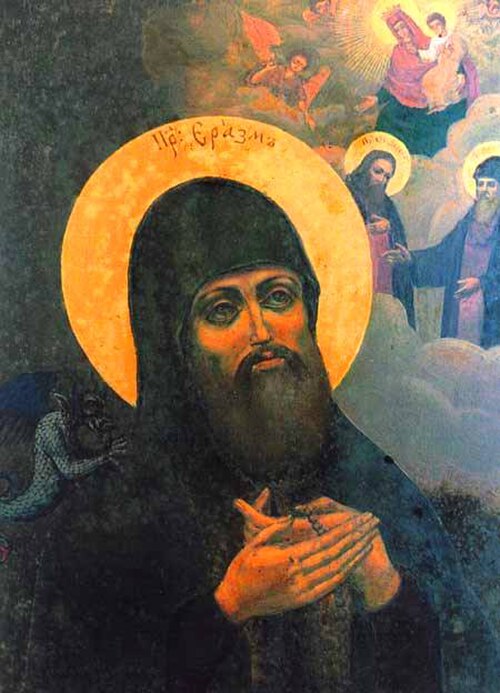
Venerable Erasmus of the Caves (called the Recluse, end of the eleventh to twelfth century, died about 1160) was a monk of the Kyiv Caves Monastery, depicted in the Caves Paterikon as a rich man who spent his fortune on church furnishings. He is commemorated (Old Style) on 24 February (25 in a leap year) and on 28 September, in the Synaxis of the Venerable Fathers of the Near Caves.
Life
His story is in the Caves Paterikon, written in 1222 to 1226: Erasmus "was very rich and all that he had he spent on church furnishings and bound many icons in silver". Left poor and despised by all, he fell into despair and thought that he would receive "no reward for the wealth spent, because he gave it to the church, not to almsgiving". He began to lead a careless life and fell gravely ill, lying eight days mute and blind. Then, rising, he told the monks gathered around him that in his illness he had had a vision: "Today Saints Anthony and Theodosius appeared to me and said: 'We prayed to God and the Lord has given you time for repentance.' And I saw the Holy Mother of God, holding in her arms her Son, Christ our God, and all the saints were with her. And she said to me: 'Erasmus. Because you adorned My Church and exalted it with icons, I will glorify you in the Kingdom of My Son, and the poor are always beside you. Only, rising from your illness, repent and receive the great angelic habit: on the third day I will take you to Me pure, you who loved the beauty of My house.'" After that Erasmus confessed his sins before the brothers, received the schema and on the third day died. He was buried in the Near Caves. The compiler of the Paterikon, Bishop Simon, says that he heard the story of Erasmus "from holy and blessed elders who were witnesses and eyewitnesses".
Veneration
The beginning of local veneration is not known. His name is in the menologia printed at the Caves Monastery, the "Poluustav" (1643) and the General Menaion (1680). The "Teratourgima" of Hieromonk Athanasius Kalnofoisky (1638) calls him a wonderworker. About 1643, under Metropolitan Peter Mogila, the canon of the Venerable Fathers of the Caves was composed, of which the second troparion of the seventh ode is dedicated to Erasmus: "Wise Erasmus, who spent your wealth on the adornment of God's temple, by your prayers show me a spiritual temple". Veneration in the whole Church began after the permission of the Holy Synod in the second half of the eighteenth century to include the names of some Kyivan saints in the general menologia.
Commemorated the same day February 24
 Modestus of TrierSaint · Bishop of TrierFeb 24
- Sergius of CappadociaVenerable MartyrFeb 24
- Petroniu TănaseVenerable · Elder of Prodromou SketeFeb 24
- Betto of AuxerreSaint · Bishop of AuxerreFeb 24
- Ciaran of UamhSaintFeb 24
- Cosconius of AsiaSaintFeb 24
- Cummene the WhiteVenerable · Abbot of IonaFeb 24
- Euethius of NicomediaMartyrFeb 24
- Heise of Airidh FodaSaintFeb 24
- Hippolytus of AfricaSaintFeb 24
- John DomovskyRight-Believing · Archpriest of Nakhichevan-on-DonFeb 24
- LiudhardSaint · BishopFeb 24