Right-Believing
Eupraxia of Ryazan
Princess of Ryazan
Wife of Prince Fyodor Yurievich of Ryazan, who died in 1237; she is venerated as a local saint in the Russian Church.
- Reposed
- 123713th century
Life
The right-believing Princess Eupraxia of Ryazan was the wife of Prince Fyodor Yurievich of Ryazan and died in 1237, at the Mongol invasion. She is honoured as a local saint in the Russian Church, as a martyr, in the synaxis of the saints of Ryazan. Our sources give no day of commemoration. There are doubts about her historical existence.
The story
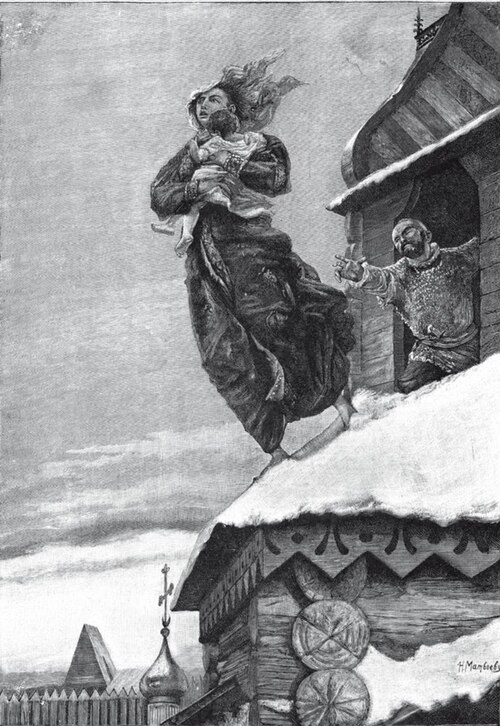
According to the Russian chronicles, Prince Fyodor was sent to negotiate with Khan Batu, who demanded that Fyodor's wife be given to him to marry. This was a custom among the Mongol conquerors, with many examples of warriors demanding the wife of a newly conquered vassal. Fyodor refused firmly and Batu had him killed. As Russian chroniclers and poets tell it, Eupraxia then took her own life, rather than fall into the captivity of Batu, during the Mongol invasion: she took her son in her arms and threw herself from a tower. The author of the Tale of the Destruction of Ryazan laments the martyrdom of Eupraxia.
Her story is part of the story of the icon of Saint Nicholas of Zaraisk. According to the Tale of Nicholas of Zaraisk, in 1225, in the city of Korsun (Cherson), the priest Eustathius, who served at the icon of Saint Nicholas, had a vision: in a dream, Saint Nicholas asked him to take his icon and carry it to the land of Ryazan, for there he wished to stay, work wonders and glorify the place. Awakened from the vision, Eustathius prayed, for he did not know where the land of Ryazan was or how to reach it. On the third night Nicholas appeared to him again and commanded him to set out without delay to the east, to the land of Ryazan. After an illness, Eustathius repented, bowed before the wonderworking icon and promised that he would do its will, and set out on the road at once.
Then Saint Nicholas appeared also to Prince Fyodor Yurievich of Ryazan and announced the coming of the icon: "Prince, go and meet my wonderworking image from Korsun, for I wish to stay here and work wonders." Awakened, Fyodor went to the place shown, saw from afar the light of the icon and bowed to it. From then on, by tradition, the icon worked many wonders. Nicholas of Zaraisk prophesied to Fyodor and his family a martyr's death for the faith and the Kingdom of Heaven. Together with the icon a library was brought to the land of Ryazan, and then Fyodor's bride arrived, the "Greek princess" Eupraxia.
The destruction of Ryazan
The Tale of the Destruction of Ryazan by Batu is the continuation of the Tale of Nicholas of Zaraisk. At the time of the Mongol-Tatar invasion, Khan Batu, hearing of her beauty, wished her to be brought to him. Prince Fyodor refused to take her to the Horde, for which he was killed by Batu's order. Learning of her husband's fate (according to other sources, after the conquest of the fortress by Batu, so as not to be left to disgrace), Eupraxia, together with her small son, Ivan Postnik, ended her days by throwing herself from the roof of the princely palace (according to other sources, from the bell tower of the church of Saint Nicholas). So the prophecy of Nicholas of Zaraisk was fulfilled. Princess Eupraxia, together with her son and husband, is honoured by the Russian Church as a martyr.
Doubts
The truth of this information is in doubt. Eupraxia could not have been a Byzantine princess: from 1204 to 1261 there existed the Nicaean empire, not the Byzantine one. The emperor Theodore Laskaris (1208 to 1222) had no porphyrogenita daughter named Eupraxia, and there are no documents about the marriage of a Nicaean porphyrogenita with the son of a prince of Ryazan. The source on her life, the Tale of Nicholas of Zaraisk, is a literary work, full of mythological details. By the sense of the text, the Tale of the Destruction of Ryazan is a continuation of the first, the fulfilment of the prophecies of Saint Nicholas. Her husband, Fyodor Yurievich (marriage around 1231), and her son Ivan Postnik Fyodorovich (born around 1231 and died in 1237) are named by the same source.