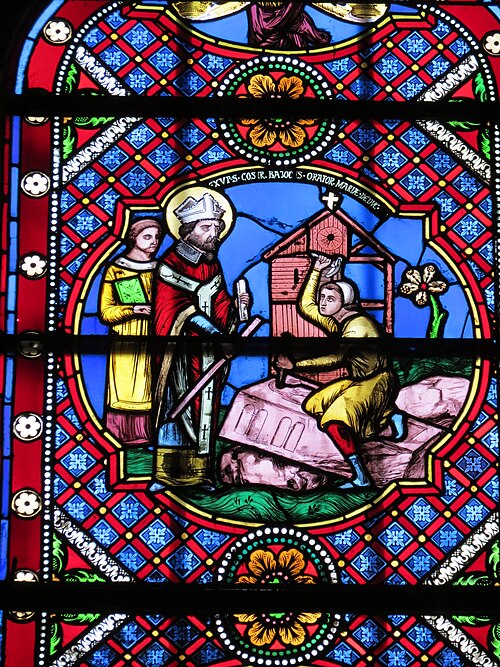
Saint
Exuperius of Bayeux
First Bishop of Bayeux
Venerated as the first bishop of Bayeux, from 390 to 405 by the usual dating.
Life
Saint Exuperius (Exupère), also called Spirius or Spire, is venerated as the first bishop of Bayeux. His episcopate is said to have lasted from 390 to 405, and his memory is kept on 1 August.
Little is known of his life. According to local tradition he was born in Rome into a rich and noble family and was sent to preach in the region of Bessin by Pope Clement I, back in the first century. The legend, found in fifteenth-century breviaries, makes Exuperius an immediate disciple of Clement and Saint Regnobert his own disciple. The Bollandists and the historian Jules Lair found little ground for this legend: Exuperius is thought to have founded the see of Bayeux only in the later fourth century, and after him the priest Reverendus worked to spread Christianity in the region. As Henry Wace remarks, this is only an instance of the tendency of the Gallic churches to claim an apostolic or near-apostolic origin.
He is said to have fought the idolaters who worshipped in the forest on Mount Phaunus, west of Bayeux. Among the miracles attributed to him is the deliverance, by prayer, from seven evil demons, which led to many conversions, among them that of his future successor, Regnobert. Tradition says he was famed as a healer in the Bessin, and many came to his chapel. He again delivered the people of the place from seven demons of evil, which brought a new wave of conversions, among them Saint Zeno of Bayeux, whom he made archdeacon.
In the time of the Viking invasions his relics were moved from Bayeux and eventually laid at Corbeil; the cathedral of Saint-Spire at Corbeil-Essonnes is dedicated to him. Because of this translation he is sometimes called bishop of Corbeil (Corbolium). The relics kept there were thrown into the Seine by the revolutionaries in 1793. In Brittany he is venerated as Dispar or Ispar, especially in Finistère.
Commemorated the same day August 1
 The Maccabean MartyrsHoly MartyrsAug 1
 Æthelwold of WinchesterSaint · Bishop of WinchesterAug 1
 Leo of MontefeltroSaint · First bishop of MontefeltroAug 1
 Bono of RomeHieromartyr · Roman priestAug 1
- Arcadius of BourgesSaint · Bishop of BourgesAug 1
 Dmitry PavskyHieromartyr · ArchpriestAug 1
- Alexander of PergeMartyr · FarmerAug 1
- Alim the MaccabeeMartyrAug 1
 AlmedhaMartyrAug 1
- Anthony the NewVenerable · the WonderworkerAug 1
- Antoninus the MaccabeeMartyrAug 1
- Attius of PergeMartyrAug 1