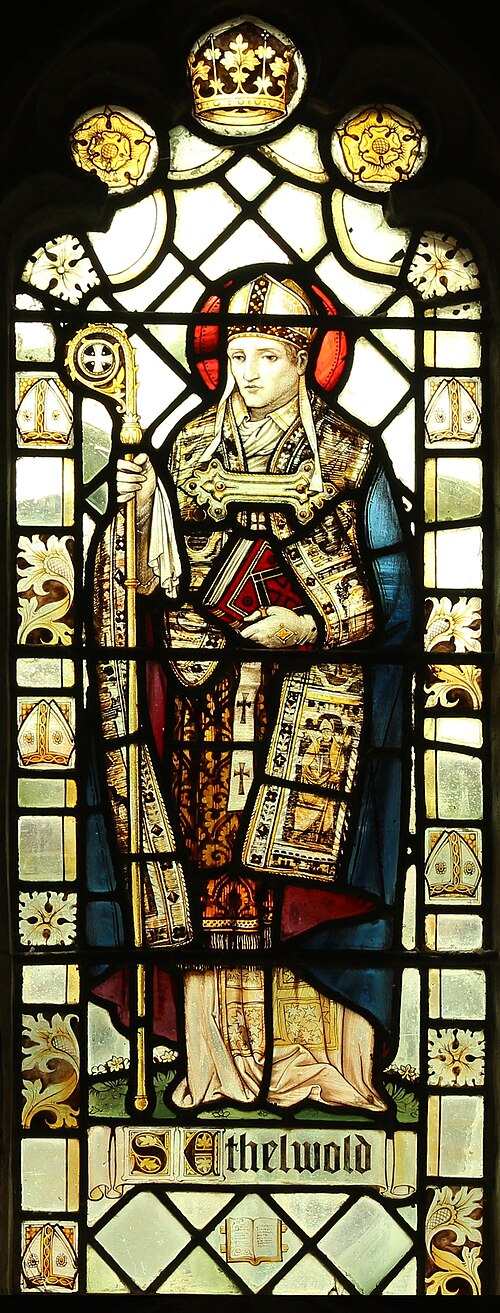
Saint
Æthelwold of Winchester
Bishop of Winchester
Bishop of Winchester from 963 to 984, a leader of the tenth-century monastic reform in England.
Life
Saint Æthelwold was bishop of Winchester from 963 to 984 and one of the leaders of the great monastic reform in tenth-century England. The Church remembers him as a pastor who renewed Benedictine monasticism, supported learning and the arts, and cared for the poor.
He was born between 904 and 909 at Winchester, of noble parents. From the later 920s he served at the court of King Athelstan, where he spent a long time as the king's inseparable companion, learning much from the king's counsellors. At the king's arrangement he was ordained priest by Bishop Ælfheah the Bald, on the same day as Saint Dunstan. After a time of study at Winchester he moved to Glastonbury, where Dunstan was abbot, studied grammar, metrics and the Fathers, and was made dean. In the time of King Eadred he wished to go to the Continent to learn monastic life there, but the king would not allow it and made him abbot at Abingdon, a place with a former monastery then served by secular priests. The years he spent there were very productive: he built a church, rebuilt the cloister and established the Benedictine rule, sending a monk to Fleury to learn the observance there. He taught the future King Edgar from boyhood, and stirred in him an interest in the rule of Saint Benedict.
On 29 November 963 he was consecrated bishop of Winchester, and the next year, with the support of King Edgar, he drove out the clerics of the Old Minster and New Minster and replaced them with monks from Abingdon. Between 964 and 971 he refounded the monasteries of Chertsey, Milton Abbas, Peterborough, Ely and Thorney and the nunnery of Nunnaminster. He was also zealous in recovering lands he believed had once belonged to monastic communities, using, say sources, doubtful charters, which made him enemies; he was fiercer against the secular clergy than the other reformers, Dunstan and Oswald of Worcester. He wrote King Edgar's Establishment of Monasteries and, as a political figure, backed Æthelred the Unready against Edward the Martyr, and was an adviser during his minority.
In the great famine of the tenth century he sold the gold and silver treasures of Abingdon Abbey to buy food for the poor, and used his own wealth and episcopal authority to free many serfs and slaves, earning the title friend of the poor. He fell asleep on 1 August 984. His life was written by his disciples Wulfstan and, more briefly, Ælfric the Grammarian, and his relics were moved shortly after his death. The Russian Orthodox Church commemorates him on 1 August and on the third Sunday after Pentecost, at the Synaxis of the Saints of the British Isles and Ireland.
Commemorated the same day August 1
 The Maccabean MartyrsHoly MartyrsAug 1
 Exuperius of BayeuxSaint · First Bishop of BayeuxAug 1
 Leo of MontefeltroSaint · First bishop of MontefeltroAug 1
 Bono of RomeHieromartyr · Roman priestAug 1
- Arcadius of BourgesSaint · Bishop of BourgesAug 1
 Dmitry PavskyHieromartyr · ArchpriestAug 1
- Alexander of PergeMartyr · FarmerAug 1
- Alim the MaccabeeMartyrAug 1
 AlmedhaMartyrAug 1
- Anthony the NewVenerable · the WonderworkerAug 1
- Antoninus the MaccabeeMartyrAug 1
- Attius of PergeMartyrAug 1