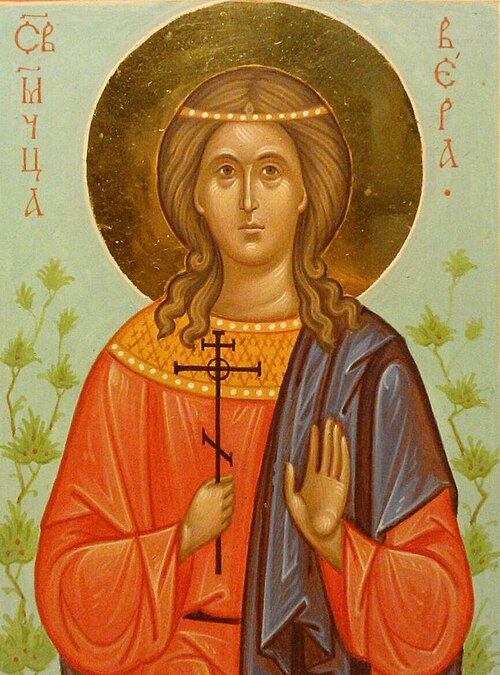
Martyr
Faith
Martyr of Rome
Daughter of Saint Sophia, martyred at Rome under Hadrian together with her sisters Hope and Love.
- Reposed
- 1302nd century
- Place
- Rome
- Order
- Martyrs
Life
Saint Faith, Martyr (in Greek Pistis, in Slavonic Vera), is, according to hagiography, a young Christian martyr of Rome in the second century, the daughter of Saint Sophia and sister of Hope (Elpis) and Love (Agape), the names of the three theological virtues. She is not to be confused with Saint Foy of Agen.
According to the legend she was brought up with her sisters in the religion of Christ and in the fear of God. About 137 the soldiers of the emperor Hadrian arrested them, for the fame of their piety had reached his ears. Amazed at the natural nobility that shone from the children, the emperor wished to adopt them; they and their mother refused. He had the girls appear separately, thinking that they dared to defy him out of mutual emulation; then he brought them together, but the girls prayed, holding each other's hands, and sang an Alleluia to the glory of Christ. The emperor then ordered them put to death, and Sophia encouraged her three daughters in their torments. Faith, aged twelve, was stripped and scourged, her breasts were cut off, from which milk flowed instead of blood, and the other tortures had no effect on her, for the power of God protected her. At last she was beheaded.
Their tombs were first placed in a crypt beneath the church later built in honor of Saint Pancras; pilgrims long visited the place, as shown by documents of the seventh century, among them an Itinerarium preserved at Salzburg and a list in the archive of the cathedral of Monza of oils gathered from the tombs of the martyrs and sent to Queen Theodelinda in the time of Gregory the Great. From the fourth century on, Christians often took at baptism names that recalled the Christian virtues, and Sophia, Hope and Love are attested as women's names in the inscriptions of the catacombs; the veneration of the three saints named for the three theological virtues probably arose in the sixth century on the basis of such inscriptions. In the Roman Martyrology they were commemorated on 1 August, but they have been removed from the official liturgical calendar of the Roman Church; their veneration continues, especially in Eastern Europe and Russia.