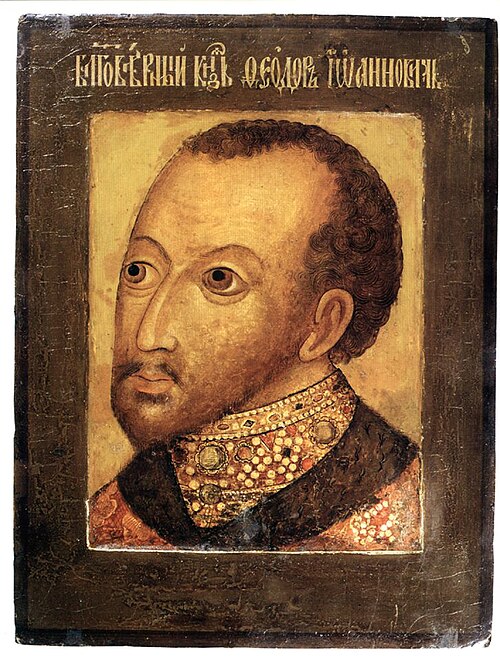
Right-Believing
Feodor I of Russia
Feodor I Ioannovich (Russian: Феодор I Иoаннович) or Fyodor I Ivanovich (Russian: Фёдор I Иванович; 31 May 1557 – 17 January 1598), nicknamed the Blessed (Блаженный), was Tsar of all Russia from 1584 until his death in 1598.
- Feast
- January 7old style January 20
- Reposed
- 159816th century
- Place
- Moscow
Life
Tsar Feodor I of Russia, called Feodor Ioannovich or the Blessed, was the last tsar of Russia of the Rurik dynasty (1584-1598), a son of Ivan the Terrible. Contemporaries described him as a quiet, merciful and very devout man, less suited to affairs of state, which were carried on in his name by his wife's brother, Boris Godunov. During his reign the Patriarchate of Moscow was founded. He is commemorated in the Great Synaxaristes on 7 January (old style).
Childhood
He was born in 1557 (the sources give 31 May or 11 May) as the youngest son of Ivan IV and Anastasia Romanovna. His mother died when he was three, and he grew up in the shadow of a distant father, frail in health and diffident by nature. He was far more pious than those around him: he spent hours in prayer and loved to visit churches, and sometimes rang the bells himself, whence the name Feodor the Bellringer. His elder brother, Ivan Ivanovich, died in 1581, killed by their father according to some accounts; Feodor thus became the heir. In 1580 he had married Irina Godunova, sister of the boyar Boris Godunov.
The reign
Ivan the Terrible died on 18 March 1584 (old style), and Feodor was crowned on 31 May in the Dormition Cathedral of the Kremlin. Boris Godunov held the real direction of affairs. In 1586 the Shuisky boyars asked, in the name of an assembly, that the tsar separate from his childless tsaritsa, but Feodor refused.
The historian Solovyov tells that he rose around four in the morning, venerated the icon of the saint of the day, went to the Liturgy, which lasted two hours, and then to Vespers, and each week made a pilgrimage to one of the nearby monasteries. He gave generously to monasteries and churches; in 1593, for example, he ordered the building of the gate church over the gateway of the Tikhvin Monastery, with a side chapel of his patron, the Holy Great Martyr Theodore Stratelates. A contemporary described him as simple and weak of mind, but very gentle, quiet, merciful and exceptionally devout.
The Patriarchate of Moscow
The most important event of the reign was the founding of the patriarchate. In 1588 Patriarch Jeremiah II of Constantinople came to Moscow. The council opened on 17 January 1589, and the tsar chose, from the three candidates, Metropolitan Job, whom he had urged two years earlier to accept the metropolitan see. On 26 January 1589 Job was enthroned as the first patriarch of Moscow and all Russia. The tsar gave him the panagia and the patriarchal vestments.
Under Feodor Russia grew stronger on the Baltic: the war with Sweden from 1590 to 1595 ended with the peace of Tyavzino, which brought back Ivangorod, Koporye and Yam. Towns were founded in Siberia (Tobolsk in 1587), and on the Volga and the frontier Samara, Voronezh, Tsaritsyn and Saratov. King Alexander of Georgia asked for the tsar's protection. In June 1591 a last Tatar invasion was stopped at the walls of the Danilov Monastery.
Uglich and his death
On 15 May 1591 Tsarevich Dmitry, the tsar's younger brother, was found dead at Uglich. The official inquiry, conducted by the boyar Vasily Shuisky, said it was an accident; the people suspected Godunov. Tsaritsa Irina bore a daughter, Feodosia, in 1592, who died in 1594 at two years old.
Feodor died on 7 January 1598 (17 January new style) at Moscow and was buried in the Archangel Cathedral in the Kremlin. Without heirs and having named no successor, he brought to an end the centuries-old line of the Rurik dynasty. After forty days of mourning the assembly elected Boris Godunov tsar. The death of the dynasty soon led to the Time of Troubles. Contemporaries regarded his reign as a time of plenty and quiet.
Veneration
The Great Synaxaristes commemorates him on 7 January, and the Russian calendar site azbyka.ru gives him the title of right-believing. We found no synodal act of canonization in the sources consulted, so he is honoured mainly in the devotion of the faithful rather than by a general canonization.
Commemorated the same day January 7
 Brannoc of BrauntonSaintJan 7
- Athanasius of AttaliaNew MartyrJan 7
- Aldric of Le MansSaint · Bishop of Le MansJan 7
- Brigh of CoirpreSaintJan 7
- Cedd of LastinghamSaint · Bishop of the East SaxonsJan 7
- Claudianus of HeracleaMartyrJan 7
- Clerus of AntiochMartyrJan 7
- CorcanSaintJan 7
- Crispin of PaviaSaint · Bishop of PaviaJan 7
- Cronan BegSaint · Bishop of AendrumJan 7
- CwyllogSaintJan 7
- Dalua of TibraddenSaintJan 7