Venerable
Fromundus
Monk, venerated in the Western Church.
Uncertain source. We are looking to verify this information as soon as we can.
- Era
- 7th century
- Order
- Venerables
Life
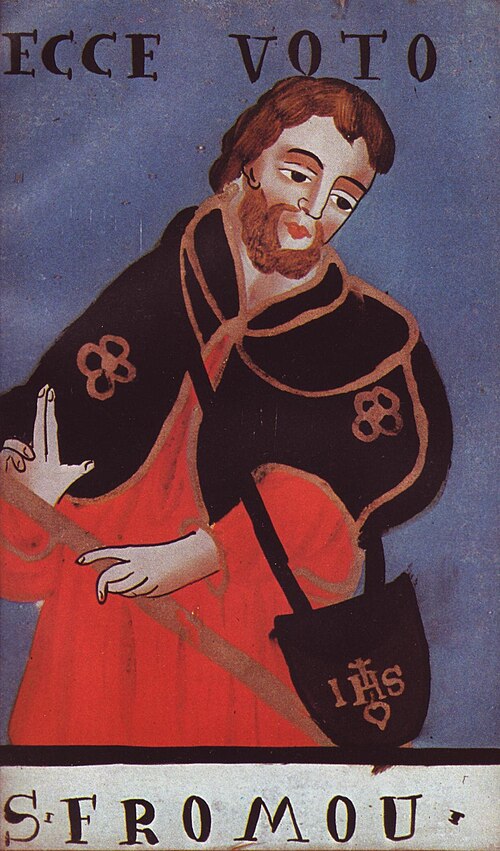
Fromundus (in Romanian Fromond) is a hermit of the 7th century, said by tradition to have lived at Bonfol in the Swiss Jura. His life is known from no written document; only tradition and local legend survive.
The most widespread legend presents him as the son of a Norman king and companion of Saints Ursicinus (Ursanne) and Imier, disciples of Saint Columbanus. Having reached the heights of the Rangiers, the three threw their staffs and each set out in the direction the staff fell. Fromundus came to the Ajoie and halted by a spring, where the village of Bonfol would stand, and made his hermitage some two hundred meters from the water. The staff he planted in the ground is said to have taken root, and the oaks beside the present chapel to descend from it. A few families gathered around him, whom he encouraged by example to clear and till the land. A second tradition, kept by Father Tièche, parish priest of Bonfol from 1786 to 1793, says that the hermit was beaten by two robbers whom he had taken in, and died after five days of suffering, on 12 September 656. Scholars note, however, that these accounts borrow features from the lives of other saints.
Fromundus does not appear in the official list of saints canonized by the Roman Catholic Church, but he has been honored by the faithful of the Jura and Alsace for at least five hundred years, without synodal canonization. His cult is attested from the time of the Reformation, and a late Gothic statue in the church of Bonfol dates from about 1590. He is commemorated on the Friday after the Ascension, and the faithful ask his help for the health of their livestock.