Saint
Germanos Sakellaridis
Metropolitan of Eleftheroupolis
Metropolitan of Eleftheroupolis, born in 1875, who died in 1917 during the Bulgarian occupation of eastern Macedonia.
- Reposed
- 191720th century
- Place
- Dato
- Order
- Hierarchs
Life
Germanos Sakellaridis (in the world Georgios Sakellaridis) was a Greek metropolitan of Eleftheroupolis (Pravishta), born in 1875 in Asia Minor and killed on 5 or 6 July 1917 during the Bulgarian occupation of eastern Macedonia. In Greece he is honoured as an ethnomartyr, that is, a martyr of the nation. Our sources show no Orthodox canonization and give no feast day.
Studies and episcopate
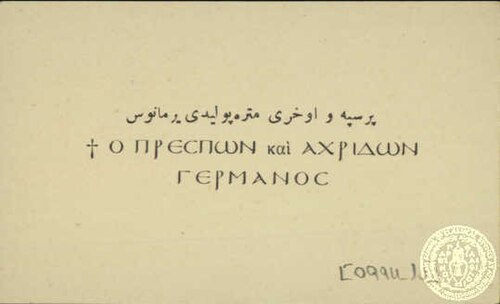
He was born in 1875 in Arvanitochori (Arnautkoy), near Nicomedia, in Asia Minor, then in the Ottoman Empire. He studied in Constantinople and in 1898 graduated from the Theological School of Halki, with distinction. He was ordained priest and served as protosyncellus at the Metropolis of Heraclea (according to a Bulgarian source, first as archdeacon at Nicomedia and from 1902 as protosyncellus at Heraclea). On 17 July 1903 he was elected bishop of Nazianzus, auxiliary to Metropolitan Gregory of Heraclea and Rhaidestos; according to the Bulgarian source, he was consecrated on 15 August at Rodosto by Gregory, with the bishops Joachim of Metra and Athyra and Philotheos of Charioupolis. On 23 May 1906 he was elected metropolitan of Prespa and Achrida, with his seat at Krushevo, in Upper Macedonia, and according to the Greek source made a significant contribution to the Macedonian Struggle.
According to the Greek source, in 1908, after strong representations by the Sublime Porte because of his activity on behalf of the Greeks, he was transferred to the Metropolis of Eleftheroupolis. The Bulgarian source gives 16 July 1909 for the transfer to the see of Pravishta and says he helped the Greek armed propaganda in Macedonia, also keeping contacts with Ion Dragoumis. As bishop he was very active on the religious and national level and took part in the Balkan wars. He denounced the cruelties and looting of the Bulgarians against the Greeks, since the Bulgarians forbade the Greek language and carried out killings and exile of priests, teachers and other citizens.
Arrest and death
His national activity had long been watched by the Bulgarians, who decided to arrest him. After they occupied eastern Macedonia, they arrested him and imprisoned him at Pravi, on 11 February 1917, where they held him in chains and tormented him for five months in the basement of the city administration building, together with other Greeks, often without food and enduring many ungodly and humiliating acts by the Bulgarians. A Bulgarian source says he was arrested in February 1917 by Bulgarian soldiers as a spy.
In the night of 5 to 6 July 1917 they took him out of the prison, with a strong escort of soldiers, on the pretext of taking him to Drama or to Bulgaria. In fact they led him to martyrdom. They cut him down with their lances beside a well, between the settlements of Dato and Amygdaleonas in Philippi. Then they hanged him from a poplar and lit a fire beneath his body. The body they threw into a dry well. The Bulgarian source says he was hanged on 6 July from a tree near the village of Bereketli.
The finding of the grave
After the liberation of Pangaion, in 1918, following a search coordinated by the ethnomartyr's nephew, the lawyer Vasileios Diamantoglou, the nameless grave in which the Bulgarian occupation army had buried him was found, at the prompting of an Ottoman shepherd who had secretly seen the hanging of the hierarch. He was finally buried on 12 May 1919 in the grounds of the church of Saint Nicholas in Eleftheroupolis, and in 1920 a bust was set up. The stone slab of the well beside which he was hanged is kept today, as evidence of the martyrdom, in the monastery of Saint Silas at Kavala.