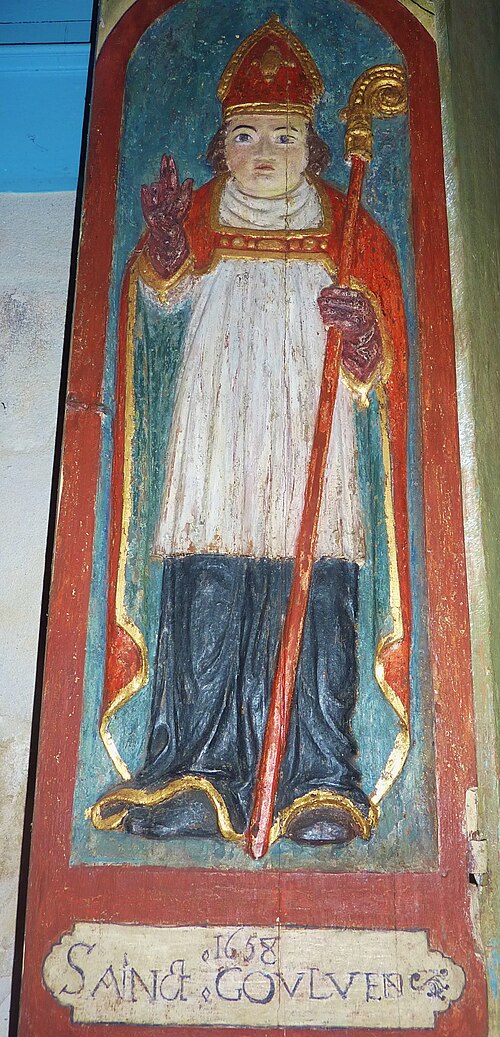
Saint
Goulven of Léon
Bishop in Léon
Breton saint of the sixth and seventh centuries, bishop in Léon; his life is known from a vita of doubtful accuracy.
Life
Saint Goulven (Golven, Golvinus) is a Breton saint of the sixth and seventh centuries, from the time of the undivided Church, honoured as a hermit and as a bishop in Léon, in western Brittany. All that is known of him comes from a Latin life preserved only in a late copy, whose historical value is doubtful. According to this life he was an ascetic renowned for prayer and miracles, elected bishop against his will, and after his death he was venerated above all in Rennes and in the Léon country.
Birth and the spring
According to tradition his parents, Glaudan and Gologuenn, were immigrants from the British Isles who landed in 540 in the cove of Plounéour-Trez, also called Goulven Cove, at a place named Brengorut. Night was falling, the mother was pregnant, and a local farmer, though he saw they were poor and in need, refused them shelter. That night the child was born, at a place called Odena.
The next morning his father asked at a nearby house for water to wash the infant and refresh his wife, but was turned away. A peasant gave him a bucket and showed him the way to a spring, but Glaudan lost his way in the forest and wandered all day until he found himself back with his wife and child. In his distress he prayed, and according to the life a spring of sweet water welled up. The spring (Feunteun Sant Goulven), near which the saint's church was later built, was held to bring healing.
Childhood and solitude
Hearing of the miracle of the spring, a rich and devout man without an heir, named Godian (or Gosian), became the child's godfather and guardian. He named him and saw to his education. From childhood Goulven practised abstinence, living mostly on bread and water.
After finishing his studies he preached the Gospel and then withdrew into the forest to give himself to God. After his parents died Godian offered to make him his heir, but Goulven declined and built a small cell near the sea, the Peneti Sant Goulven. Its door, always open, faced north, towards the cold wind from the ocean, yet, the life says, it was as warm inside as in a well-sheltered manor.
Many came to him to learn, to pray or to seek healing, but he did not allow women into his hermitage. He ate once a day, bread and water, and left his cell only once a day, to walk to three stone crosses and pray at the foot of each. The parish that bears his name, Goulven, later grew up on that spot. He lived in prayer, penance and work together with a disciple named Maden.
Count Even and the monastery land
When raiders from the sea threatened the region, a local count named Even (a legendary figure after whom the town of Lesneven is named) came to Goulven and asked him to pray for him and his men; they were victorious. In return Goulven asked for land for a monastery, and the count agreed. As the saint walked along the boundary of the land, the ground rose up on either side of him, forming a boundary that no one could violate; the place was called Menehi Sant Goulven and became very fertile.
Even built a monastery there, but Goulven remained a hermit and declined to become abbot. The people of Léon also built a chapel in his honour at Odena, the place of his birth, where many miracles occurred.
Earth turned to gold
A tradition tells that Goulven once sent Maden to a rich peasant, named Le Joncour in some sources, asking him to give whatever he was holding in his hands. The man gave him three clods of earth from the furrow he was ploughing. On the way back Maden felt the earth grow heavier: it had turned into gold. From it Goulven had a chalice, three crosses and three bells made. One bell and one cross were kept in the church at Goulven but were lost in later wars; other bells were kept at Lesneven and at Rennes with the saint's relics, and another at the church of Goulien in Cornouaille. All were held to work miracles and to punish those who swore false oaths. A Breton historian saw in this story a symbol of the blessings brought to Armorica by the Breton monks and settlers, who, clearing the forests and tilling the soil, drew treasure from it.
Episcopate and death
In 602 Goulven was unanimously elected Bishop of Léon. To escape this burden he went to Rome, where, the life says, God revealed his worth and calling to Pope Gregory the Great. The people of Léon had to choose someone else in his place, but they also informed the pope, who consecrated him bishop himself. Returning to Brittany, Goulven left his hermitage and fulfilled his ministry with great diligence for more than a decade.
Some years later the affairs of his diocese called him to Rennes; according to some traditions he was also elected Bishop of Rennes there. A few years before his death he withdrew to Saint-Didier, four leagues from Rennes, where he built a small oratory and ended his life as a hermit in strict penance. God revealed to him that his end was near; he told his disciple Maden that he would soon die and that Maden would not be able to take his body back to Léon. He fell ill and, according to his life, reposed on 1 July 616. He was buried in Rennes, in the Abbey of Saint-Melaine. He had a sister, Petronilla, who is venerated in a chapel at Ploudaniel.
The life and the historians
The Latin life was probably written in the eleventh century, during a monastic reform that produced many lives of Breton saints. It survives only in an eighteenth-century Benedictine transcription of a seventeenth-century text. Albert Le Grand published it in French in 1637 in his Lives of the Saints of Armorican Brittany, adding a summary of fifteen miracles that occurred after the saint's death. The standard edition was published by Arthur de La Borderie in 1891.
The life was written in the community of Saint-Pol-de-Léon and itself admits that there is neither written record nor oral tradition about Goulven's episcopate; it is concerned mostly with the places linked to the saint, the spring, the cell and the surrounding land. The historian Charles de Calan judged it unlikely that the body of a bishop of Léon would have remained in Rennes, and suggested that Goulven was rather a bishop of Rennes, or a man of holy life whose body was kept there. Other scholars have observed that in Brittany the veneration of saints centred on springs, bells and crosses more than on relics. The stone crosses were still in place in the nineteenth century, but they may date from the Carolingian period.
The relics
Norse raids forced the monks of Saint-Melaine to move the relics of their own patron, but Goulven's body remained intact in its coffin until 1224, when Bishop Jean Gicquel of Rennes placed the head in a separate reliquary. In 1336, under Bishop Guillaume Ouvrouin, the shrine was renewed. The customary of Rennes Cathedral, of 1415, records that on the saint's day his relics were carried into the cathedral after Vespers and solemnly exposed. The parish of Goulven received an arm bone (in 1503 or, according to another source, in 1533 from Bishop Yves Mahyeuc), and the cathedral of Saint-Pol-de-Léon received a portion of the relics in 1668. In 1743 the cathedral clergy of Rennes made a new reliquary from 600 livres of silver. The head was lost during the French Revolution, but larger bones were still kept in Rennes Cathedral at the end of the nineteenth century.
Veneration
The veneration of Goulven survived the Reformation and the French Revolution. In Rennes in the nineteenth century his coffin was carried in procession through the streets; he was celebrated on 1 July, and the translation of his relics on 23 August. The commune of Goulven in Finistère bears his name and has a holy spring under his patronage and a reliquary in the shape of an arm. At Goulien a bell linked with his name is kept. At Saint-Didier, where he had his hermitage, a church and a school bear his name and a statue of him stands. Chapels of the saint are found at Caurel, Lanvellec, Lanloup and other places in Brittany, and a statue of him stands in the chapel of Saint-Guénolé at Plougastel-Daoulas.
Commemorated the same day July 9
 Theodore of EdessaSaint · Bishop of EdessaJul 9
 EusaniusMartyrJul 9
 Gabriel of AthosVenerable · Abbot of the Elias SketeJul 9
- Agrippinus of AutunSaint · Bishop of AutunJul 9
- Anatolia and AudaxHoly MartyrsJul 9
- AndrewMartyrJul 9
- Brictius of MartolaSaint · Bishop of MartolaJul 9
- Connmach of Ath BlairSaintJul 9
- Constantine LebedevHieromartyrJul 9
- Coprius of EgyptVenerableJul 9
- Coprius of EgyptVenerable MartyrJul 9
- Cyril of GortynaHieromartyr · Bishop of GortynaJul 9