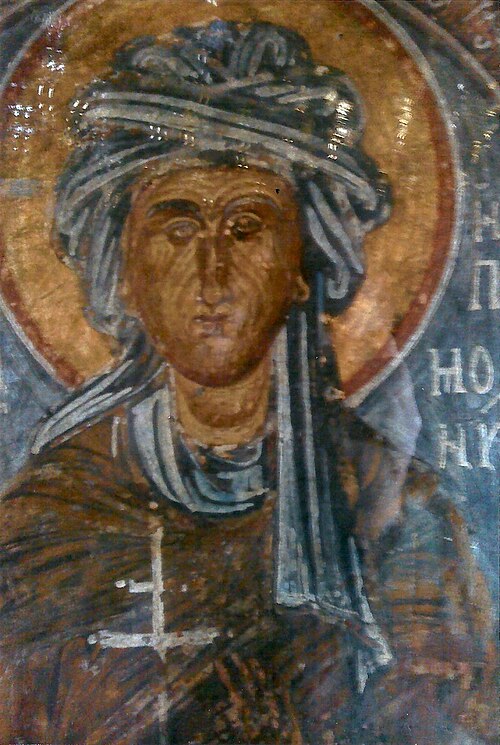
Venerable
Helena Dragaš
Byzantine Empress
Serbian princess, wife of Emperor Manuel II and mother of the last Byzantine emperor, tonsured late in life.
- Feast
- March 13old style March 26
- Reposed
- 145015th century
- Place
- Constantinople
- Order
- Venerables
Life
Saint Helena Dragaš, in monasticism Hypomone (“Patience”), was the wife of the Byzantine emperor Manuel II Palaiologos and mother of the last two emperors of Byzantium, John VIII and Constantine XI. Born into a Serbian noble family, she became a nun in old age and is honoured as a saint in the Orthodox Church. She is commemorated on 29 May, the day of the fall of Constantinople, according to the Russian synaxarion, while other sources give 13 or 23 March.
Family and marriage
She was born around 1372, daughter of the Serbian magnate Constantine Dragaš (Dejanović), lord of the region centred on Velbazhd, and of his first wife, whose name is unknown. Constantine was a great-grandson of King Stefan Dečanski. Her father fell in 1395 at the battle of Rovine, fighting as vassal of Sultan Bayezid I against Mircea the Elder. Helena married Manuel II Palaiologos in 1392; the next day, 11 February, she was crowned “holy empress”. It is not known why the marriage was made, but dynastic links between the Byzantines and the Serbs were not without precedent. Tradition describes her as famed for beauty, piety, wisdom and justice. They had nine children; three died in a plague, and the six who remained were all boys: John VIII, Theodore II, Andronikos, Constantine XI, Demetrios and Thomas. George Sphrantzes praises her greatly.
Nun and mother of emperors
Manuel II became a monk in 1425, with the name Matthew, and died on 21 July 1425. After that Helena too became a nun, at the monastery of Kyra Martha in Constantinople, with the name Hypomone. She was a nun like all the others and did all the obediences; yet many took counsel with her, above all her sons. She helped found a home for the aged, called “The Hope of the Despaired”, beside the monastery of Saint John in Petra, where the relics of Saint Patapios were also kept. She was an influential presence at court during the reigns of her sons, as political adviser. When John VIII learned in Italy, in 1439, of the death of the patriarch, he refused to name another until he had consulted his mother. She was at the head of the party against union with Rome, and even slowed the decisions, but in the end she consented, or at least ceased to oppose, at her son’s wish.
After John VIII’s death, in 1448, the throne was disputed between Constantine and his younger brother Demetrios, ambitious but clumsy. Helena supported Constantine, was regent until his arrival from Mistra, in 1449, and persuaded Sultan Murad II to intervene in his favour. Constantine took the name Constantine XI Dragases Palaiologos, after his mother, the only one of her sons to do so. Helena died in March 1450. Gennadios Scholarios, the first patriarch after the fall of Constantinople, spoke for Constantine a word of consolation “On the death of his mother, the holy Hypomone”, in which he says that everyone who knew her went away a better person.
Veneration
Her veneration began at the monastery of Saint Patapios at Loutraki, where her head was moved. At the end of the twentieth century the centre of her veneration became the church of Saint Athanasius in Athens. The Holy Synod of the Church of Greece canonized her in 1992, as venerable.
Commemorated the same day March 13
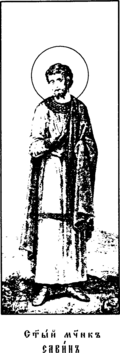 Sabinus of HermopolisMartyr · Martyr of EgyptMar 13
- Christina of PersiaMartyr · Persian noblewomanMar 13
 Cassian the RecluseVenerable · Recluse of the Kiev CavesMar 13
- Gerald of MayoVenerableMar 13
 Mochoemoc of LiathmoreVenerable · Abbot of LiathmoreMar 13
- Africanus of CarthageMartyrMar 13
- Alexander of MacedoniaMartyrMar 13
- Alexander of PydnaMartyrMar 13
- AltheusSaintMar 13
- Ansovinus of CamerinoSaint · Bishop of CamerinoMar 13
- CoincheandSaintMar 13
- CuanghasSaintMar 13