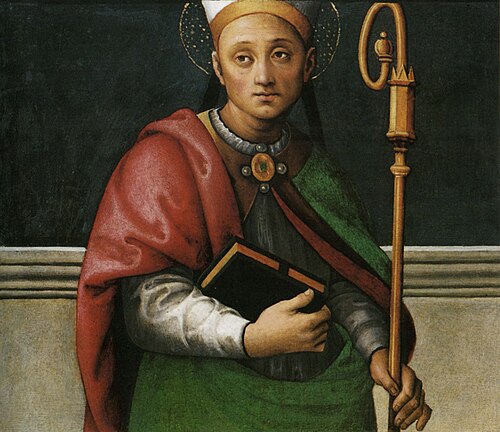
Hieromartyr
Herculanus of Perugia
Bishop of Perugia
Bishop of Perugia who died in 549, honored as patron of the city; his life is told by Pope Gregory the Great.
- Feast
- November 7old style November 20
- Reposed
- 5496th century
- Place
- Perugia
- Order
- Martyrs
Life
Saint Herculanus the Hieromartyr was bishop of Perugia in Italy, killed in 549 when the Ostrogothic king Totila captured the city. He is the patron of Perugia. The Church remembers him on 7 November, and his second feast is on 1 March. His life is told by Saint Pope Gregory the Great in the Dialogues.
According to Saint Gregory, Herculanus tried to save the city by a stratagem: before the city was taken he ordered the last lamb to be fed with the last sack of grain, to show the Ostrogoths that the Perugians had food in plenty. According to another account he threw an ox full of wheat from the wall. Totila seemed at first deceived, but an unfaithful cleric revealed the trick to him, and he returned, captured the city and killed the bishop. It is said that Totila ordered Herculanus flayed alive, but the soldier who had to do it, moved to pity, beheaded him before it was finished. Saint Gregory writes that forty days after the head was cut off, the body was found whole and the head miraculously joined to it, with no trace of torture. The old lives link him with three other saints of Umbria of that time: Bishop Floridus, the priest Amantius of Città di Castello and Bishop Fortunatus of Todi. It is not excluded that he is the same Herculanus who was said to have been sent from Syria to preach at Perugia.
The inhabitants of the castle of Cisterna in Umbria, under Perugian rule, were obliged to send three pounds of wax to Perugia for the feast of Saint Herculanus. The Roman Martyrology says: "At Perugia, Saint Herculanus, bishop and martyr, beheaded by order of Totila, king of the Goths."
Commemorated the same day November 7
 WillibrordSaint · Bishop of UtrechtNov 7
 Congar of SomersetVenerable · Welsh abbotNov 7
 Michael of KulebakiHieromartyr · ArchpriestNov 7
 Cyril SmirnovHieromartyr · Metropolitan of Kazan and SviyazhskNov 7
 The 33 Martyrs of MeliteneHoly MartyrsNov 7
 Sergius ZverevHieromartyr · Archbishop of YeletsNov 7
- Alexander IlinskyHieromartyrNov 7
- Alexander KrylovHieromartyrNov 7
- Alexander KurmyshskyHieromartyrNov 7
 Alexis MolchanovHieromartyrNov 7
- Amarand of MoissacSaintNov 7
- Amaranthus of AlbiMartyrNov 7