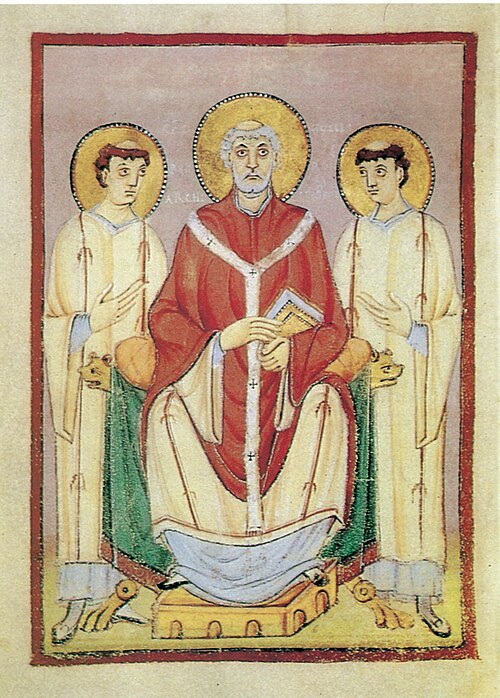
Saint
Willibrord
Bishop of Utrecht
Anglo-Saxon monk and missionary, first bishop of Utrecht, called the Apostle of the Frisians.
- Feast
- November 7old style November 20
- Reposed
- 7398th century
- Place
- Echternach
- Order
- Hierarchs
Life
Saint Willibrord was an Anglo-Saxon monk and missionary, the first bishop of Utrecht, called the Apostle of the Frisians. He died at Echternach in Luxembourg on 7 November 739, and is commemorated on that day. He is often called the apostle of the Benelux countries (Belgium, the Netherlands and Luxembourg).
Early life
He was born around 658 in Northumbria, to Wilgils, a pious Christian who, after his conversion, entrusted his son to Ripon Abbey at the age of seven and withdrew to live in a small oratory near the mouth of the Humber, dedicated to Saint Andrew. Willibrord grew up under the influence of Wilfrid, bishop of York, and became a Benedictine monk. From the age of twenty he spent twelve years at the abbey of Rath Melsigi in Ireland, a centre of learning in the seventh century, where he studied under Egbert of Ripon.
Mission to Frisia
In 690 Egbert sent him, with eleven companions, to preach to the pagan Frisians of the North Sea coast, at the request of Pepin of Herstal, the Frankish mayor of the palace, who had nominal rule over the region. Willibrord went to Rome twice. On the second journey, on 21 November 695, in the church of Santa Cecilia in Trastevere, Pope Sergius I gave him the pallium and consecrated him bishop of the Frisians. Bede says that he went not as a simple pilgrim but to receive from the pope a blessing for the work of preaching. He returned to Frisia, built churches and a monastery at Utrecht, where he placed his cathedral; he is counted as the first bishop of Utrecht.
In 698 he founded the abbey of Echternach, on the site of a Roman villa, given by Irmina of Oeren, Pepin’s mother-in-law. Irmina had founded a convent of Benedictine nuns at Horren near Trier; when a plague threatened the community, she called on Willibrord, and when the sickness passed the convent by, she gave him the lands at Echternach. Willibrord preached fearlessly to the fiercest pagan chiefs, among them King Radbod, who, though he did not become a Christian, let him go in peace. He also made a mission to Denmark, but without great success. In 714 he baptized Pepin the Short, a grandson of Pepin of Herstal.
Pepin of Herstal died in 714. In 716 the pagan Radbod took Frisia back, burned churches and killed many missionaries, and Willibrord and his monks had to flee. After Radbod’s death, in 719, Willibrord returned under the protection of Charles Martel and repaired the damage, ably helped by Saint Boniface.
Death and veneration
He died on 7 November 739, at eighty-one, and was buried at Echternach, as he wished. He was soon venerated as a saint. Springs on his missionary routes were visited by those seeking healing from nervous ailments, especially of children. His veneration spread in the West also through two lives of him, one by Alcuin. At Echternach a dancing procession is held every year at Pentecost in his honour, attested from 1497, which draws thousands of participants. A church at Gravelines in northern France, where he is said to have landed, bears his name. The Russian Orthodox Church honours him as a local saint in the Berlin and German diocese.
Commemorated the same day November 7
 Herculanus of PerugiaHieromartyr · Bishop of PerugiaNov 7
 Congar of SomersetVenerable · Welsh abbotNov 7
 Michael of KulebakiHieromartyr · ArchpriestNov 7
 Cyril SmirnovHieromartyr · Metropolitan of Kazan and SviyazhskNov 7
 The 33 Martyrs of MeliteneHoly MartyrsNov 7
 Sergius ZverevHieromartyr · Archbishop of YeletsNov 7
- Alexander IlinskyHieromartyrNov 7
- Alexander KrylovHieromartyrNov 7
- Alexander KurmyshskyHieromartyrNov 7
 Alexis MolchanovHieromartyrNov 7
- Amarand of MoissacSaintNov 7
- Amaranthus of AlbiMartyrNov 7